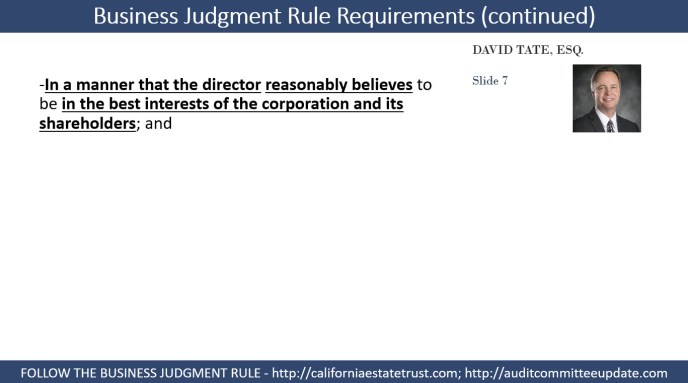
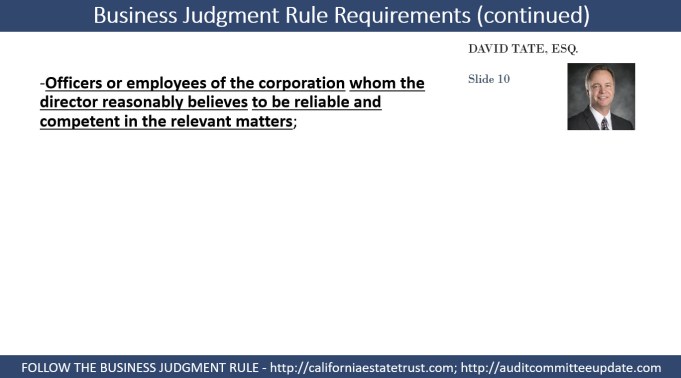
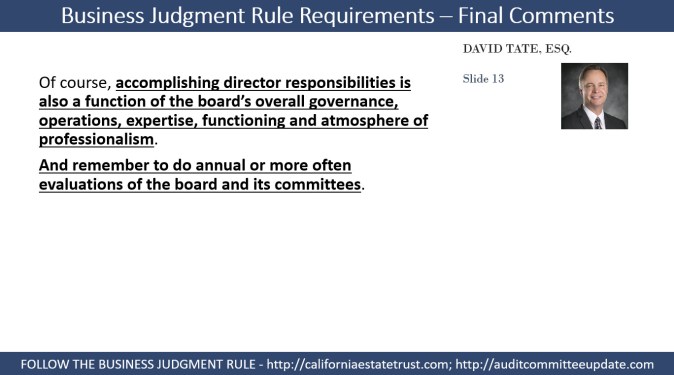
Business Judgment Rule – Slide Numbers 4 Through 13

Below in this post I have provided screenshots of my business judgment rule slide numbers 4 through 13. You should note that the California statutory business judgment rule has some differences for nonprofit and religious entities and organizations, but the slides below, which are for corporations, are still relevant for nonprofits and religious entities and organizations. In California the statutory business judgment rule for corporations is primarily found at Cal. Corp. Code Section 309. The statutory business judgment rule for nonprofit public benefit corporations is primarily found at Cal. Corp. Code Section 5231. The statutory business judgment rule for nonprofit mutual benefit corporations is primarily found at Cal. Corp. Code Section 7231 (and see also Section 7231.5). And the statutory business judgment rule for nonprofit religious corporations is primarily found at Cal. Corp. Code Section 9241 (and see also Section 9240).

Case law interpretation is also important.

I also note that the statutory requirements do not require a level of knowledge or understanding about the particular issue or transaction that is being considered; however, some legal authorities do require certain knowledge or understanding in some situations, a director should at least consider the level of his or her knowledge or understanding of the particular issue or transaction, and a director also should consider whether there are possible independence or conflict of interest issues. See my September 15, 2019, blog post for additional information at https://wp.me/p75iWX-jE.

You should also note, obviously these slides are a summary of what can be a complicated area of law and specific facts, they are not a solicitation for services inside or outside of California, and they do not pertain to any particular situation or to you and your situation. You need to consult with an appropriate professional for your specific situation.

Best to you, Dave Tate, Esq.


Below you will find additional information that you might find useful.

—————————————————————

Remember, every case and situation is different. It is important to obtain and evaluate all of the evidence that is available, and to apply that evidence to the applicable standards and laws. You do need to consult with an attorney and other professionals about your particular situation. This post is not a solicitation for legal or other services inside of or outside of California, and, of course, this post only is a summary of information that changes from time to time, and does not apply to any particular situation or to your specific situation. So . . . you cannot rely on this post for your situation or as legal or other professional advice or representation.

Thank you for reading this post. I ask that you also pass it along to other people who would be interested as it is through collaboration that great things and success occur more quickly. And please also subscribe to this blog and my other blog (see below), and connect with me on LinkedIn and Twitter.

Best to you, David Tate, Esq. (and inactive California CPA) – practicing in California only.

I am also the Chair of the Business Law Section of the Bar Association of San Francisco.

Blogs: Trust, estate/probate, power of attorney, conservatorship, elder and dependent adult abuse, nursing home and care, disability, discrimination, personal injury, responsibilities and rights, and other related litigation, and contentious administrations http://californiaestatetrust.com; Business, D&O, board, director, audit committee, shareholder, founder, owner, and investor litigation, governance, responsibilities and rights, compliance, investigations, and risk management  http://auditcommitteeupdate.com

My law practice primarily involves the following areas and issues:

Probate Court Disputes and Litigation

  • Trust and estate disputes and litigation, and contentious administrations representing fiduciaries and beneficiaries; elder abuse; power of attorney disputes; elder care and nursing home abuse; conservatorships; claims to real and personal property; and other related disputes and litigation.

Business and Business-Related Disputes and Litigation: Private, Closely Held, and Family Businesses; Public Companies; and Nonprofit Entities

  • Business v. business disputes including breach of contract; unlawful, unfair and fraudulent business practices; fraud, deceit and misrepresentation; unfair competition; licensing agreements, breach of the covenant of good faith and fair dealing; etc.
  • Misappropriation of trade secrets
  • M&A disputes
  • Founder, officer, director and board, investor, shareholder, creditor, VC, control, governance, decision making, fiduciary duty, conflict of interest, independence, voting, etc., disputes
  • Buy-sell disputes
  • Funding and share dilution disputes
  • Accounting, lost profits, and royalty disputes and damages
  • Access to corporate and business records disputes
  • Employee, employer and workplace disputes and processes, discrimination, whistleblower and retaliation, harassment, defamation, etc.

Investigations and Governance

  • Corporate and business internal investigations
  • Board, audit committee and special committee governance and processes, disputes, conflicts of interest, independence, culture, ethics, etc.

The following are copies of the tables of contents of three of the more formal materials that I have written over the years about accounting/auditing, audit committees, and related legal topics – Accounting and Its Legal Implications was my first formal effort, which resulted in a published book that had more of an accounting and auditing focus; Chapter 5A, Audit Committee Functions and Responsibilities, for the California Continuing Education of the Bar has a more legal focus; and the most recent Tate’s Excellent Audit Committee Guide (February 2017) also has a more legal focus:

Accounting and Its Legal Implications

Chapter 5A, Audit Committee Functions and Responsibilities, CEB Advising and Defending Corporate Directors and Officers

Tate’s Excellent Audit Committee Guide

The following are other summary materials that you might find useful:

OVERVIEW OF A RISK MANAGEMENT PROCESS THAT YOU CAN USE 03162018

Audit Committee 5 Lines of Success, Diligence, and Defense - David Tate, Esq, 05052018

COSO Enterprise Risk Management Framework ERM Components and Principles

From a prior blog post which you can find at https://wp.me/p75iWX-dk if the below scan is too difficult to read:

* * * * *

AUDIT COMMITTEE SELF-EVALUATION

David W. Tate

Attorney at Law

Certified Public Accountant (inactive California)

Copyright 2019 David W. Tate (however, you are authorized to download and print these materials for your use, and to also pass them to other people who would be interested)

BLOGS

D&O, Audit Committees, Risk Management, Compliance, Investigations & Governance: http://auditcommitteeupdate.com

Trust, Estate, Conservatorship & Elder Abuse Litigation: http://californiaestatetrust.com

Linkedin: http://www.linkedin.com/in/davetateesq

Twitter: http://twitter.com/davidtateesq


Self-evaluation is an important board and committee activity, and can be very helpful if done properly.

A.  Introduction and Overview

The following discussion covers audit committee self-evaluation and provides processes that you can use. As noted elsewhere in these materials, although many board and audit committee functions, responsibilities and tasks are specified by statute, regulation, rule or pronouncement, board and audit committee member standards of care remain significantly dependent on due diligence and prudent judgment.

Boards and audit committees of various entities are required by law, regulation or rule to conduct annual committee self-evaluations; however, it is worthwhile for boards and audit committees of all public and private companies and nonprofit entities to conduct self-evaluations. Board and audit committee jobs are challenging, ongoing, and technical in nature, and require the members to significantly interact with many people in different capacities within and outside of the entity. It only makes sense that both boards and audit committees should at least once each year take time to step back and review, evaluate and make improvements to their manners of operation, and also consider helpful actions that can be taken by other people with whom the boards and audit committees interact. Self-evaluation will be worthwhile even if it results in improving only one area of operation.

Board and audit committee responsibilities originate from several different sources at least including (1) activities and responsibilities that boards or audit committees voluntarily undertake or that are delegated to them; (2) the business judgment rule; (3) the specific laws, regulations and rules that are applicable to the entity’s directors and audit committee members; (4) the wording of the board and audit committee charters, if there are charters; (5) shareholder and stakeholder expectations, and (6) for audit committees, accounting and auditing pronouncements relating to the outside auditor’s activities.

Prudent board and audit committee processes and diligence are also important to reduce member and entity liability and reputation risk. An increasing number of cases hold that board and audit committee members can be liable for failure to exercise sufficient diligence, failure to spot and respond to red flags, and failure to take action. Active board, committee and corporate diligence tend to demonstrate prudent business judgment and negate allegations of recklessness, improper intent, intentional wrongdoing, or “scienter” such as in the context of securities litigation, thus reducing the risk of securities liability and damages. In the context of audit committee activities, potential entity, board, and audit committee member liability typically arises in the context of alleged improper accounting practices, written and oral public misrepresentations (such as with respect to financial matters), and improper employment practices.

Although not required, there can be advantages to having a facilitator conduct an interactive interview approach to the self-evaluation process, but without performance grading or rating: it can be difficult to construct a questionnaire with standardized questions that would be similarly understood by each of the participants in the self-evaluation process; different people use different rating scales; different people express responses in different manners; and certain important issues will change from year to year. A facilitated approach may encourage better discussion and comment, compilation, continuity, explanation, and follow-up. Contact me if you are interested in committee self-evaluation assistance at a reasonable fixed fee.

Issues and topic areas to consider during the self-evaluation process will naturally vary from entity to entity, and from board and audit committee to board and audit committee. Thus, to stimulate discussion, below for both boards and audit committees I have provided lists of potential broad issues or topic areas to consider for discussion and evaluation, including both successes and possible improvements; and I have also outlined processes to assist your board and audit committee self-evaluation processes.

B.  Audit Committee Self-Evaluation

1.  Sample List of Issues and Topics to Consider for Audit Committee Self-Evaluation

The following is a list of issues and topic areas to consider for discussion and evaluation. The list is intended to help trigger thought processes, but, of course, is not exhaustive as areas of discussion and evaluation will vary from entity to entity, and from committee to committee. The following list is not intended to and does not suggest that each or any of the below issues and topics must be considered or covered and is not a checklist – instead, if your audit committee is required to conduct a specific evaluation process or to cover certain specific issues and topics, you will need to separately consider the specific requirements, if any, for your audit committee and its evaluation process pursuant to law, regulation or rule. In that regard, please also see the disclaimer and limitations at the beginning of these materials.

-Audit committee meeting agenda preparation and dissemination process.

-Committee member independence and situational independence, financial literacy, experience and expertise.

-Committee member access to information and/or education pertinent to the functions and responsibilities of the audit committee. Are the needs of the committee members being met, so that they are sufficiently knowledgeable and educated about the company or nonprofit and its industry; relevant significant accounting and auditing issues; relevant legal matters; internal controls, risk assessment and management; governance; and new developments in those and other areas?

-Committee and committee member interactions, including interaction between committee members, and between the committee and the board, the CEO, the CFO, the outside auditor, the internal auditor, legal counsel, compliance and ethics, HR, consultants, and other people.

-The committee’s processes for identifying and spotting issues, evaluation and decision making.

-The contents of the audit committee charter, and a mutual understanding of the audit committee’s responsibilities and tasks. The charter is a requirement for public companies, and is a good idea for many private companies and nonprofit entities. The charter is a prudent document to identify and clarify the audit committee’s responsibilities. In addition to the committee itself, it is important for the board, the executive officers, and other stakeholders to have a correct understanding about the committee’s responsibilities and limitations, and the extent to which state or local jurisdiction, U.S. and international requirements and responsibilities apply or may apply to your audit committee.

-Selection of the outside auditor; audit planning; review of the performance of the outside auditor; and review of the quarterly review and annual audit report and process (or compilation if appropriate).

-Review of recent developments relating to the business judgment rule, standard of care and acceptable reliance on other people.

-Review of accounting and financial internal and fraud/embezzlement related controls and processes, risk assessment and management, possible entity and individual liability and reputation risk exposure; and compliance assessment and management relating to laws, regulations, and rules that are within the scope of the audit committee’s functions and responsibilities including issues relating to the Foreign Corrupt Practices Act.

– Review of the accounting department, and accounting and financial reporting for transactions including all of the subcomponents such as principles and policies applied (quality not just acceptability); judgments, estimates and reserves; timing and cutoff procedures; off balance sheet transactions; related party transactions; contingencies and liabilities; revenue recognition; expenses; inventories; goodwill; insider trading; and other matters relating to accounting and financial statement reports.

-Implementing revenue recognition rules, and other important, new or changing accounting principles.

-Review of internal investigation processes, procedures and needs.

-Review of the financial and internal audit functions, and how they can be helpful to the audit committee in the performance of its responsibilities and tasks.

-Review of risk management and uncertainty issues, practices and processes that are within the scope of the audit committee’s function and responsibilities.

-Implementing COSO 2013 or other appropriate processes.

-Documenting and reporting the audit committee’s activities and minutes.

-The audit committee’s use of attorneys and consultants.

-The company’s investor communication processes.

-Whistleblower, ethics, anonymous reporting and complaint handling processes to the extent that the reporting is within the scope of the audit committee’s function and responsibilities.

-Document retention policies.

-Review of the compliance and ethics function and processes that are within the scope of the audit committee’s responsibilities, and how they can be helpful to the audit committee in the performance of its responsibilities and tasks.

-Governance, including tone at the top, financial leadership, transparency and appearance.

-Review of employer, employee and workplace processes, culture, safety, and disciplinary practices that are within the scope of the audit committee’s function and responsibilities.

-Review of tax compliance and reporting issues that are within the scope of the audit committee’s function and responsibilities.

-Review of cybersecurity and internet security issues that are within the scope of the audit committee’s function and responsibilities.

-Insurance.

-Review of pension and health plan related issues that are within the scope of the audit committee’s function and responsibilities.

-Review of information privacy issues, practices and processes that are within the scope of the audit committee’s function and responsibilities.

-Review of asset protection, IP, trade secret, etc. practices to the extent that they are within the audit committee’s function and responsibilities.

-Review of environmental issues and safety that are within the scope of the audit committee’s function and responsibilities.

-Review of product and consumer safety issues, practices and processes that are within the scope of the audit committee’s function and responsibilities.

-Review of billing and accounting relating to the receipt of funds or revenue from governmental sources such as Medicare and Medicaid; compliance with applicable laws, regulations, rules and other requirements; and oversight of expenses relating to these areas.

-Review of the acceptance, receipt, allocation, expenditure or distribution, and accounting for all charitable and donor funds, grants, contributions, pledges and other resources, including compliance with all requirements, restrictions and special uses.

-Review of accounting for collaboration and joint venture arrangements, including the allocation of receipts/income and distributions/expenses between the entities.

-And, in this economic environment, review of the fair value of funds and investments, including loss of value; liquidity concerns; possible going concern issues; estimates for uncollectibles and related reserves; debt/loan covenants; and funding source uncertainties including those that relate to collaboration and joint venture arrangements.

-It is also important for the audit committee to clarify with the board what responsibilities it has, if any, for oversight of the numerous and various areas of taxation and compliance; ERISA, pension and health and welfare plans; investments; tax exempt status including fund raising, dues, solicitation, and political, campaign and lobby activities; and other areas significant to the entity.

-Discussion about audit committee membership and recruitment needs.

-Additional significant topics or issues that should be discussed.

2.  A Self-Evaluation Process and Format for Audit Committees

The following eight primary steps outline a proposed audit committee self-evaluation process that is workable for audit committees of public companies, private companies and nonprofit entities, whether using or not using, an outside facilitator.


Step 1. Determine the people who will be participating in the evaluation process, including the audit committee members, and other people, if any, to interview for comment.

Provide the names of the people who will participate in the evaluation process.


Step 2. Determine how the participant interviews will be conducted, individually or in a group, in person or by telephone, skype or some other means.

Provide comments or information about how the interviews will be handled with the various different people who will participate in the evaluation.


Step 3. Arrange participant individual or group interview dates and times.

Provide participant individual or group interview date and time information.


Step 4. Provide the participants with pre-interview materials and a list of possible issue or topic areas (broad and specific) for consideration and discussion. Of course, the participants can add additional issues or topics. Use this paper for that purpose.

Provide information regarding the status of disseminating the pre-interview materials.


Step 5. Have each participant provide a list of one to five, or more, issues or topic areas that the participant would specifically like to discuss during the evaluation process.

Provide comments and information regarding receipt of issues or topic areas from the self-evaluation process participants, and the respective issues or topic areas listed.


Step 6. Conduct information intake or interviews with participants individually or as a group.

Provide comments and information from the participants or the status of such – the input can be made by the participants themselves or by a facilitator during self-evaluation interviews.


Step 7. Summarize in a report format the issues and topic areas, information received, and suggestions made during the self-evaluation process.

Provide a summary in a report format.


Step 8. Provide a report back to the audit committee, and possibly conduct a committee group review of the self-evaluation process, information obtained, and suggestions made, and possible future actions or follow-up.

Provide additional comments and information about the self-evaluation process or results.


Concluding comments. I hope you have found this discussion helpful and at least a good starting point for your audit committee self-evaluation. Feel free to contact me if you are interested in discussing the audit committee self-evaluation process, or if you would like help with facilitation of committee self-evaluation at a reasonable fixed fee.

Best to you,

David Tate, Esq.

* * * * *

An Audit Committee Self-Evaluation Discussion and Process; Self-Evaluation Facilitation

Click on the following link for a pdf of my audit committee self-evaluation paper – Audit Committee Self-Evaluation  I hope you find it useful. Please also tell other people about the paper and pass the paper along to people who might find it helpful or interesting. I have also copied and pasted the paper at the bottom of this email to the extent possible; however, because of wordpress formatting limitations the version at the bottom of this email looks a bit different and is not as user friendly. Enjoy. Dave Tate, Esq.

—————————————————————

Remember, every case and situation is different. It is important to obtain and evaluate all of the evidence that is available, and to apply that evidence to the applicable standards and laws. You do need to consult with an attorney and other professionals about your particular situation. This post is not a solicitation for legal or other services inside of or outside of California, and, of course, this post only is a summary of information that changes from time to time, and does not apply to any particular situation or to your specific situation. So . . . you cannot rely on this post for your situation or as legal or other professional advice or representation.

Thank you for reading this post. I ask that you also pass it along to other people who would be interested as it is through collaboration that great things and success occur more quickly. And please also subscribe to this blog and my other blog (see below), and connect with me on LinkedIn and Twitter.

Best to you, David Tate, Esq. (and inactive California CPA) – practicing in California only.

I am also the Chair of the Business Law Section of the Bar Association of San Francisco.

Blogs: Trust, estate/probate, power of attorney, conservatorship, elder and dependent adult abuse, nursing home and care, disability, discrimination, personal injury, responsibilities and rights, and other related litigation, and contentious administrations http://californiaestatetrust.com; Business, D&O, board, director, audit committee, shareholder, founder, owner, and investor litigation, governance, responsibilities and rights, compliance, investigations, and risk management  http://auditcommitteeupdate.com

My law practice primarily involves the following areas and issues:

Probate Court Disputes and Litigation

  • Trust and estate disputes and litigation, and contentious administrations representing fiduciaries and beneficiaries; elder abuse; power of attorney disputes; elder care and nursing home abuse; conservatorships; claims to real and personal property; and other related disputes and litigation.

Business and Business-Related Disputes and Litigation: Private, Closely Held, and Family Businesses; Public Companies; and Nonprofit Entities

  • Business v. business disputes including breach of contract; unlawful, unfair and fraudulent business practices; fraud, deceit and misrepresentation; unfair competition; licensing agreements, breach of the covenant of good faith and fair dealing; etc.
  • Misappropriation of trade secrets
  • M&A disputes
  • Founder, officer, director and board, investor, shareholder, creditor, VC, control, governance, decision making, fiduciary duty, conflict of interest, independence, voting, etc., disputes
  • Buy-sell disputes
  • Funding and share dilution disputes
  • Accounting, lost profits, and royalty disputes and damages
  • Access to corporate and business records disputes
  • Employee, employer and workplace disputes and processes, discrimination, whistleblower and retaliation, harassment, defamation, etc.

Investigations and Governance

  • Corporate and business internal investigations
  • Board, audit committee and special committee governance and processes, disputes, conflicts of interest, independence, culture, ethics, etc.

The following are copies of the tables of contents of three of the more formal materials that I have written over the years about accounting/auditing, audit committees, and related legal topics – Accounting and Its Legal Implications was my first formal effort, which resulted in a published book that had more of an accounting and auditing focus; Chapter 5A, Audit Committee Functions and Responsibilities, for the California Continuing Education of the Bar has a more legal focus; and the most recent Tate’s Excellent Audit Committee Guide (February 2017) also has a more legal focus:

Accounting and Its Legal Implications

Chapter 5A, Audit Committee Functions and Responsibilities, CEB Advising and Defending Corporate Directors and Officers

Tate’s Excellent Audit Committee Guide

The following are other summary materials that you might find useful:

OVERVIEW OF A RISK MANAGEMENT PROCESS THAT YOU CAN USE 03162018

Audit Committee 5 Lines of Success, Diligence, and Defense - David Tate, Esq, 05052018

COSO Enterprise Risk Management Framework ERM Components and Principles

From a prior blog post which you can find at https://wp.me/p75iWX-dk if the below scan is too difficult to read:

* * * * *

AUDIT COMMITTEE SELF-EVALUATION

David W. Tate

Attorney at Law

Certified Public Accountant (inactive California)

Copyright 2019 David W. Tate (however, you are authorized to download and print these materials for your use, and to also pass them to other people who would be interested)

BLOGS

D&O, Audit Committees, Risk Management, Compliance, Investigations & Governance: http://auditcommitteeupdate.com

Trust, Estate, Conservatorship & Elder Abuse Litigation: http://californiaestatetrust.com

Linkedin: http://www.linkedin.com/in/davetateesq

Twitter: http://twitter.com/davidtateesq


Self-evaluation is an important board and committee activity, and can be very helpful if done properly.

A.  Introduction and Overview

The following discussion covers audit committee self-evaluation and provides processes that you can use. As noted elsewhere in these materials, although many board and audit committee functions, responsibilities and tasks are specified by statute, regulation, rule or pronouncement, board and audit committee member standards of care remain significantly dependent on due diligence and prudent judgment.

Boards and audit committees of various entities are required by law, regulation or rule to conduct annual committee self-evaluations; however, it is worthwhile for boards and audit committees of all public and private companies and nonprofit entities to conduct self-evaluations. Board and audit committee jobs are challenging, ongoing, and technical in nature, and require the members to significantly interact with many people in different capacities within and outside of the entity. It only makes sense that both boards and audit committees should at least once each year take time to step back and review, evaluate and make improvements to their manners of operation, and also consider helpful actions that can be taken by other people with whom the boards and audit committees interact. Self-evaluation will be worthwhile even if it results in improving only one area of operation.

Board and audit committee responsibilities originate from several different sources at least including (1) activities and responsibilities that boards or audit committees voluntarily undertake or that are delegated to them; (2) the business judgment rule; (3) the specific laws, regulations and rules that are applicable to the entity’s directors and audit committee members; (4) the wording of the board and audit committee charters, if there are charters; (5) shareholder and stakeholder expectations, and (6) for audit committees, accounting and auditing pronouncements relating to the outside auditor’s activities.

Prudent board and audit committee processes and diligence are also important to reduce member and entity liability and reputation risk. An increasing number of cases hold that board and audit committee members can be liable for failure to exercise sufficient diligence, failure to spot and respond to red flags, and failure to take action. Active board, committee and corporate diligence tend to demonstrate prudent business judgment and negate allegations of recklessness, improper intent, intentional wrongdoing, or “scienter” such as in the context of securities litigation, thus reducing the risk of securities liability and damages. In the context of audit committee activities, potential entity, board, and audit committee member liability typically arises in the context of alleged improper accounting practices, written and oral public misrepresentations (such as with respect to financial matters), and improper employment practices.

Although not required, there can be advantages to having a facilitator conduct an interactive interview approach to the self-evaluation process, but without performance grading or rating: it can be difficult to construct a questionnaire with standardized questions that would be similarly understood by each of the participants in the self-evaluation process; different people use different rating scales; different people express responses in different manners; and certain important issues will change from year to year. A facilitated approach may encourage better discussion and comment, compilation, continuity, explanation, and follow-up. Contact me if you are interested in committee self-evaluation assistance at a reasonable fixed fee.

Issues and topic areas to consider during the self-evaluation process will naturally vary from entity to entity, and from board and audit committee to board and audit committee. Thus, to stimulate discussion, below for both boards and audit committees I have provided lists of potential broad issues or topic areas to consider for discussion and evaluation, including both successes and possible improvements; and I have also outlined processes to assist your board and audit committee self-evaluation processes.

B.  Audit Committee Self-Evaluation

1.  Sample List of Issues and Topics to Consider for Audit Committee Self-Evaluation

The following is a list of issues and topic areas to consider for discussion and evaluation. The list is intended to help trigger thought processes, but, of course, is not exhaustive as areas of discussion and evaluation will vary from entity to entity, and from committee to committee. The following list is not intended to and does not suggest that each or any of the below issues and topics must be considered or covered and is not a checklist – instead, if your audit committee is required to conduct a specific evaluation process or to cover certain specific issues and topics, you will need to separately consider the specific requirements, if any, for your audit committee and its evaluation process pursuant to law, regulation or rule. In that regard, please also see the disclaimer and limitations at the beginning of these materials.

-Audit committee meeting agenda preparation and dissemination process.

-Committee member independence and situational independence, financial literacy, experience and expertise.

-Committee member access to information and/or education pertinent to the functions and responsibilities of the audit committee. Are the needs of the committee members being met, so that they are sufficiently knowledgeable and educated about the company or nonprofit and its industry; relevant significant accounting and auditing issues; relevant legal matters; internal controls, risk assessment and management; governance; and new developments in those and other areas?

-Committee and committee member interactions, including interaction between committee members, and between the committee and the board, the CEO, the CFO, the outside auditor, the internal auditor, legal counsel, compliance and ethics, HR, consultants, and other people.

-The committee’s processes for identifying and spotting issues, evaluation and decision making.

-The contents of the audit committee charter, and a mutual understanding of the audit committee’s responsibilities and tasks. The charter is a requirement for public companies, and is a good idea for many private companies and nonprofit entities. The charter is a prudent document to identify and clarify the audit committee’s responsibilities. In addition to the committee itself, it is important for the board, the executive officers, and other stakeholders to have a correct understanding about the committee’s responsibilities and limitations, and the extent to which state or local jurisdiction, U.S. and international requirements and responsibilities apply or may apply to your audit committee.

-Selection of the outside auditor; audit planning; review of the performance of the outside auditor; and review of the quarterly review and annual audit report and process (or compilation if appropriate).

-Review of recent developments relating to the business judgment rule, standard of care and acceptable reliance on other people.

-Review of accounting and financial internal and fraud/embezzlement related controls and processes, risk assessment and management, possible entity and individual liability and reputation risk exposure; and compliance assessment and management relating to laws, regulations, and rules that are within the scope of the audit committee’s functions and responsibilities including issues relating to the Foreign Corrupt Practices Act.

– Review of the accounting department, and accounting and financial reporting for transactions including all of the subcomponents such as principles and policies applied (quality not just acceptability); judgments, estimates and reserves; timing and cutoff procedures; off balance sheet transactions; related party transactions; contingencies and liabilities; revenue recognition; expenses; inventories; goodwill; insider trading; and other matters relating to accounting and financial statement reports.

-Implementing revenue recognition rules, and other important, new or changing accounting principles.

-Review of internal investigation processes, procedures and needs.

-Review of the financial and internal audit functions, and how they can be helpful to the audit committee in the performance of its responsibilities and tasks.

-Review of risk management and uncertainty issues, practices and processes that are within the scope of the audit committee’s function and responsibilities.

-Implementing COSO 2013 or other appropriate processes.

-Documenting and reporting the audit committee’s activities and minutes.

-The audit committee’s use of attorneys and consultants.

-The company’s investor communication processes.

-Whistleblower, ethics, anonymous reporting and complaint handling processes to the extent that the reporting is within the scope of the audit committee’s function and responsibilities.

-Document retention policies.

-Review of the compliance and ethics function and processes that are within the scope of the audit committee’s responsibilities, and how they can be helpful to the audit committee in the performance of its responsibilities and tasks.

-Governance, including tone at the top, financial leadership, transparency and appearance.

-Review of employer, employee and workplace processes, culture, safety, and disciplinary practices that are within the scope of the audit committee’s function and responsibilities.

-Review of tax compliance and reporting issues that are within the scope of the audit committee’s function and responsibilities.

-Review of cybersecurity and internet security issues that are within the scope of the audit committee’s function and responsibilities.

-Insurance.

-Review of pension and health plan related issues that are within the scope of the audit committee’s function and responsibilities.

-Review of information privacy issues, practices and processes that are within the scope of the audit committee’s function and responsibilities.

-Review of asset protection, IP, trade secret, etc. practices to the extent that they are within the audit committee’s function and responsibilities.

-Review of environmental issues and safety that are within the scope of the audit committee’s function and responsibilities.

-Review of product and consumer safety issues, practices and processes that are within the scope of the audit committee’s function and responsibilities.

-Review of billing and accounting relating to the receipt of funds or revenue from governmental sources such as Medicare and Medicaid; compliance with applicable laws, regulations, rules and other requirements; and oversight of expenses relating to these areas.

-Review of the acceptance, receipt, allocation, expenditure or distribution, and accounting for all charitable and donor funds, grants, contributions, pledges and other resources, including compliance with all requirements, restrictions and special uses.

-Review of accounting for collaboration and joint venture arrangements, including the allocation of receipts/income and distributions/expenses between the entities.

-And, in this economic environment, review of the fair value of funds and investments, including loss of value; liquidity concerns; possible going concern issues; estimates for uncollectibles and related reserves; debt/loan covenants; and funding source uncertainties including those that relate to collaboration and joint venture arrangements.

-It is also important for the audit committee to clarify with the board what responsibilities it has, if any, for oversight of the numerous and various areas of taxation and compliance; ERISA, pension and health and welfare plans; investments; tax exempt status including fund raising, dues, solicitation, and political, campaign and lobby activities; and other areas significant to the entity.

-Discussion about audit committee membership and recruitment needs.

-Additional significant topics or issues that should be discussed.

2.  A Self-Evaluation Process and Format for Audit Committees

The following eight primary steps outline a proposed audit committee self-evaluation process that is workable for audit committees of public companies, private companies and nonprofit entities, whether using or not using an outside facilitator.


Step 1. Determine the people who will be participating in the evaluation process, including the audit committee members, and other people, if any, to interview for comment.

Provide the names of the people who will participate in the evaluation process.


Step 2. Determine how the participant interviews will be conducted, individually or in a group, in person or by telephone, skype or some other means.

Provide comments or information about how the interviews will be handled with the various different people who will participate in the evaluation.


Step 3. Arrange participant individual or group interview dates and times.

Provide participant individual or group interview date and time information.


Step 4. Provide the participants with pre-interview materials and a list of possible issue or topic areas (broad and specific) for consideration and discussion. Of course, the participants can add additional issues or topics. Use this paper for that purpose.

Provide information regarding the status of disseminating the pre-interview materials.


Step 5. Have each participant provide a list of one to five, or more, issues or topic areas that the participant would specifically like to discuss during the evaluation process.

Provide comments and information regarding receipt of issues or topic areas from the self-evaluation process participants, and the respective issues or topic areas listed.


Step 6. Conduct information intake or interviews with participants individually or as a group.

Provide comments and information from the participants or the status of such – the input can be made by the participants themselves or by a facilitator during self-evaluation interviews.


Step 7. Summarize in a report format the issues and topic areas, information received, and suggestions made during the self-evaluation process.

Provide a summary in a report format.


Step 8. Provide a report back to the audit committee, and possibly conduct a committee group review of the self-evaluation process, information obtained, and suggestions made, and possible future actions or follow-up.

Provide additional comments and information about the self-evaluation process or results.


Concluding comments. I hope you have found this discussion helpful and at least a good starting point for your audit committee self-evaluation. Feel free to contact me if you are interested in discussing the audit committee self-evaluation process, or if you would like help with facilitation of committee self-evaluation at a reasonable fixed fee.

Best to you,

David Tate, Esq.

* * * * *


The California business judgment rule statutes for corporations, nonprofits, and religious organizations, for your ease of reading and reference

For your ease of reading and reference, the following are the California business judgment rule statutes for:

Corporations – Cal. Corp. Code §309;

Nonprofit public benefit corporations – Cal. Corp. Code §5231;

Nonprofit mutual benefit corporations – Cal. Corp. Code §7231 (and see also §7231.5); and

Nonprofit religious corporations – Cal. Corp. Code §9241 (and see also §9240(c)).

The business judgment rule is state specific – see, for example, Del. Gen. Corp. Law §141 for Delaware corporations, in addition to relevant case law.

Also note that the statutory business judgment rule differs some for corporations, nonprofit public benefit corporations, nonprofit mutual benefit corporations, and nonprofit religious corporations.

Why am I posting this information? Because the business judgment rule is a good rule for people to follow, and to consider, in public company, private business, nonprofit organization, and governmental entity settings and situations. And in this context, when I refer to “people,” I am not referring only to directors, but also to officers, managers and all people throughout the organization. Note: I am not representing that all of these people are legally required to follow the business judgment rule – indeed, the rule is merely a possible defense to liability and possibly relevant to the burden of proof for the people to which it applies and who fact follow the rule – for other people, in the context of this post I am merely suggesting that all people should consider following the rule, or at least keep it in mind as possible guidance in a multitude of public company, private business, nonprofit organization, and governmental entity settings and situations.

Also note that I underlined the provisions below that are underlined (that is, the wording below that is underlined is not underlined in the actual statute).

California Corporations Code Section 309, for corporations:

(a) A director shall perform the duties of a director, including duties as a member of any committee of the board upon which the director may serve, in good faith, in a manner such director believes to be in the best interests of the corporation and its shareholders and with such care, including reasonable inquiry, as an ordinarily prudent person in a like position would use under similar circumstances.

(b) In performing the duties of a director, a director shall be entitled to rely on information, opinions, reports or statements, including financial statements and other financial data, in each case prepared or presented by any of the following:

(1) One or more officers or employees of the corporation whom the director believes to be reliable and competent in the matters presented.

(2) Counsel, independent accountants or other persons as to matters which the director believes to be within such person’s professional or expert competence.

(3) A committee of the board upon which the director does not serve, as to matters within its designated authority, which committee the director believes to merit confidence, so long as, in any such case, the director acts in good faith, after reasonable inquiry when the need therefor is indicated by the circumstances and without knowledge that would cause such reliance to be unwarranted.

(c) A person who performs the duties of a director in accordance with subdivisions (a) and (b) shall have no liability based upon any alleged failure to discharge the person’s obligations as a director. In addition, the liability of a director for monetary damages may be eliminated or limited in a corporation’s articles to the extent provided in paragraph (10) of subdivision (a) of Section 204.

(Amended by Stats. 1987, Ch. 1203, Sec. 2. Effective September 27, 1987.)

California Corporations Code Section 5231, for nonprofit public benefit corporations:

(a) A director shall perform the duties of a director, including duties as a member of any committee of the board upon which the director may serve, in good faith, in a manner that director believes to be in the best interests of the corporation and with such care, including reasonable inquiry, as an ordinarily prudent person in a like position would use under similar circumstances.

(b) In performing the duties of a director, a director shall be entitled to rely on information, opinions, reports or statements, including financial statements and other financial data, in each case prepared or presented by:

(1) One or more officers or employees of the corporation whom the director believes to be reliable and competent in the matters presented;

(2) Counsel, independent accountants or other persons as to matters which the director believes to be within that person’s professional or expert competence; or

(3) A committee upon which the director does not serve that is composed exclusively of any or any combination of directors, persons described in paragraph (1), or persons described in paragraph (2), as to matters within the committee’s designated authority, which committee the director believes to merit confidence, so long as, in any case, the director acts in good faith, after reasonable inquiry when the need therefor is indicated by the circumstances and without knowledge that would cause that reliance to be unwarranted.

(c) Except as provided in Section 5233, a person who performs the duties of a director in accordance with subdivisions (a) and (b) shall have no liability based upon any alleged failure to discharge the person’s obligations as a director, including, without limiting the generality of the foregoing, any actions or omissions which exceed or defeat a public or charitable purpose to which a corporation, or assets held by it, are dedicated.

(Amended by Stats. 2009, Ch. 631, Sec. 14. (AB 1233) Effective January 1, 2010.)

California Corporations Code Section 7231, for nonprofit mutual benefit corporations:

(a) A director shall perform the duties of a director, including duties as a member of any committee of the board upon which the director may serve, in good faith, in a manner such director believes to be in the best interests of the corporation and with such care, including reasonable inquiry, as an ordinarily prudent person in a like position would use under similar circumstances.

(b) In performing the duties of a director, a director shall be entitled to rely on information, opinions, reports or statements, including financial statements and other financial data, in each case prepared or presented by:

(1) One or more officers or employees of the corporation whom the director believes to be reliable and competent in the matters presented;

(2) Counsel, independent accountants or other persons as to matters which the director believes to be within such person’s professional or expert competence; or

(3) A committee upon which the director does not serve that is composed exclusively of any or any combination of directors, persons described in paragraph (1), or persons described in paragraph (2), as to matters within the committee’s designated authority, which committee the director believes to merit confidence, so long as, in any case, the director acts in good faith, after reasonable inquiry when the need therefor is indicated by the circumstances and without knowledge that would cause such reliance to be unwarranted.

(c) A person who performs the duties of a director in accordance with subdivisions (a) and (b) shall have no liability based upon any alleged failure to discharge the person’s obligations as a director, including, without limiting the generality of the foregoing, any actions or omissions which exceed or defeat a public or charitable purpose to which assets held by a corporation are dedicated.

(Amended by Stats. 2009, Ch. 631, Sec. 24. (AB 1233) Effective January 1, 2010.)

See also Cal. Corp. Code §7231.5:

(a) Except as provided in Section 7233 or 7236, there is no monetary liability on the part of, and no cause of action for damages shall arise against, any volunteer director or volunteer executive officer of a nonprofit corporation subject to this part based upon any alleged failure to discharge the person’s duties as a director or officer if the duties are performed in a manner that meets all of the following criteria:

(1) The duties are performed in good faith.

(2) The duties are performed in a manner such director or officer believes to be in the best interests of the corporation.

(3) The duties are performed with such care, including reasonable inquiry, as an ordinarily prudent person in a like position would use under similar circumstances.

(b) “Volunteer” means the rendering of services without compensation. “Compensation” means remuneration whether by way of salary, fee, or other consideration for services rendered. However, the payment of per diem, mileage, or other reimbursement expenses to a director or executive officer does not affect that person’s status as a volunteer within the meaning of this section.

(c) “Executive officer” means the president, vice president, secretary, or treasurer of a corporation or other individual serving in like capacity who assists in establishing the policy of the corporation.

(d) This section shall apply only to trade, professional, and labor organizations incorporated pursuant to this part which operate exclusively for fraternal, educational, and other nonprofit purposes, and under the provisions of Section 501(c) of the United States Internal Revenue Code.

(e) This section shall not be construed to limit the provisions of Section 7231.

(Amended by Stats. 1990, Ch. 107, Sec. 5.)

California Corporations Code Section 9241, for nonprofit religious corporations:

(a) A director shall perform the duties of a director, including duties as a member of any committee of the board upon which the director may serve, in good faith, in a manner such director believes to be in the best interests of the corporation and with such care, including reasonable inquiry, as is appropriate under the circumstances.

(b) In performing the duties of a director, a director shall be entitled to rely on information, opinions, reports, or statements, including financial statements and other financial data, in each case prepared or presented by:

(1) One or more officers or employees of the corporation whom the director believes to be reliable and competent in the matters presented;

(2) Counsel, independent accountants, or other persons as to matters which the director believes to be within that person’s professional or expert competence;

(3) A committee upon which the director does not serve that is composed exclusively of any or any combination of directors, persons described in paragraph (1), or persons described in paragraph (2), as to matters within the committee’s designated authority, which committee the director believes to merit confidence; or

(4) Religious authorities and ministers, priests, rabbis, or other persons whose position or duties in the religious organization the director believes justify reliance and confidence and whom the director believes to be reliable and competent in the matters presented, so long as, in any case, the director acts in good faith, after reasonable inquiry when the need therefor is indicated by the circumstances, and without knowledge that would cause that reliance to be unwarranted.

(c) The provisions of this section, and not Section 9243, shall govern any action or omission of a director in regard to the compensation of directors, as directors or officers, or any loan of money or property to or guaranty of the obligation of any director or officer. No obligation, otherwise valid, shall be voidable merely because directors who benefited by a board resolution to pay such compensation or to make such loan or guaranty participated in making such board resolution.

(d) Except as provided in Section 9243, a person who performs the duties of a director in accordance with subdivisions (a) and (b) shall have no liability based upon any alleged failure to discharge his or her obligations as a director, including, without limiting the generality of the foregoing, any actions or omissions which exceed or defeat any purpose to which the corporation, or assets held by it, may be dedicated.

(Amended by Stats. 2009, Ch. 631, Sec. 33. (AB 1233) Effective January 1, 2010.)

See also Cal. Corp. Code §9240(c):

(c) A director, in making a good faith determination, may consider what the director believes to be:

(1) The religious purposes of the corporation; and

(2) Applicable religious tenets, canons, laws, policies, and authority.

(Amended by Stats. 1987, Ch. 923, Sec. 1.4. Operative January 1, 1988, by Sec. 103 of Ch. 923.)

—————————————————————

Remember, every case and situation is different. It is important to obtain and evaluate all of the evidence that is available, and to apply that evidence to the applicable standards and laws. You do need to consult with an attorney and other professionals about your particular situation. This post is not a solicitation for legal or other services inside of or outside of California, and, of course, this post only is a summary of information that changes from time to time, and does not apply to any particular situation or to your specific situation. So . . . you cannot rely on this post for your situation or as legal or other professional advice or representation.

Thank you for reading this website. I ask that you also pass it along to other people who would be interested as it is through collaboration that great things and success occur more quickly.

Best to you, David Tate, Esq. (and inactive California CPA) – practicing in California only.

I am also the Chair of the Business Law Section of the Bar Association of San Francisco.

Blogs: Trust, estate/probate, power of attorney, conservatorship, elder and dependent adult abuse, nursing home and care, disability, discrimination, personal injury, responsibilities and rights, and other related litigation, and contentious administrations http://californiaestatetrust.com; Business, D&O, board, director, audit committee, shareholder, founder, owner, and investor litigation, governance, responsibilities and rights, compliance, investigations, and risk management  http://auditcommitteeupdate.com

The following are copies of the tables of contents of three of the more formal materials that I have written over the years about accounting/auditing, audit committees, and related legal topics – Accounting and Its Legal Implications was my first formal effort, which resulted in a published book that had more of an accounting and auditing focus; Chapter 5A, Audit Committee Functions and Responsibilities, for the California Continuing Education of the Bar has a more legal focus; and the most recent Tate’s Excellent Audit Committee Guide (February 2017) also has a more legal focus:

Accounting and Its Legal Implications

Chapter 5A, Audit Committee Functions and Responsibilities, CEB Advising and Defending Corporate Directors and Officers

Tate’s Excellent Audit Committee Guide

The following are other summary materials that you might find useful:

OVERVIEW OF A RISK MANAGEMENT PROCESS THAT YOU CAN USE 03162018

Audit Committee 5 Lines of Success, Diligence, and Defense - David Tate, Esq, 05052018

COSO Enterprise Risk Management Framework ERM Components and Principles

From a prior blog post which you can find at https://wp.me/p75iWX-dk if the below scan is too difficult to read:

* * * * *


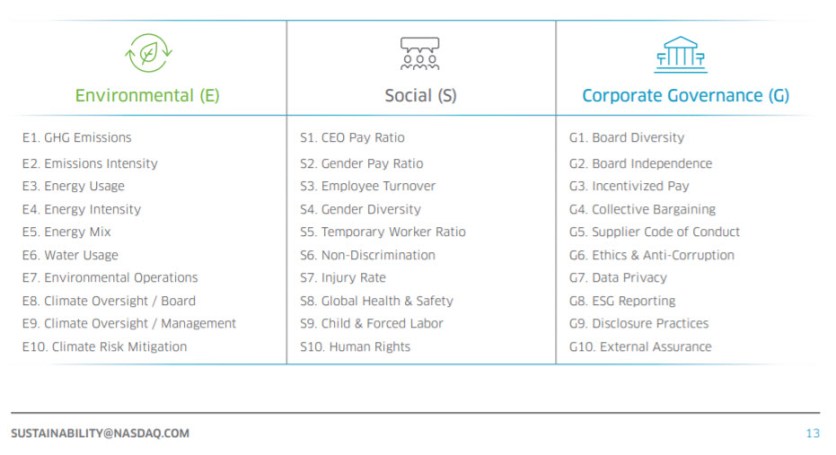
Just a snapshot of the NASDAQ ESG Reporting Guide 2.0 ESG Metrics

Below is a snapshot of the NASDAQ ESG metrics from the May 2019 NASDAQ ESG Reporting Guide 2.0. Pursuant to the Guide, the metrics were significantly developed or decided upon based on existing United Nations ESG materials. Viewing ESG from a worldwide perspective, focusing more significantly on metrics that are contained in United Nations materials could be one reasonable approach. However, from a US listed company perspective, I would have kept some of those metrics, and replaced some with other metrics that are perhaps more pertinent and diverse. As the Guide states, the metrics that NASDAQ selected are not required or mandated metrics.

There is the snapshot:

—————————————————————

Remember, every case and situation is different. It is important to obtain and evaluate all of the evidence that is available, and to apply that evidence to the applicable standards and laws. You do need to consult with an attorney and other professionals about your particular situation. This post is not a solicitation for legal or other services inside of or outside of California, and, of course, this post only is a summary of information that changes from time to time, and does not apply to any particular situation or to your specific situation. So . . . you cannot rely on this post for your situation or as legal or other professional advice or representation.

Thank you for reading this website. I ask that you also pass it along to other people who would be interested as it is through collaboration that great things and success occur more quickly.

Best to you, David Tate, Esq. (and inactive California CPA) – practicing in California only.

I am also the Chair of the Business Law Section of the Bar Association of San Francisco.

Blogs: Trust, estate/probate, power of attorney, conservatorship, elder and dependent adult abuse, nursing home and care, disability, discrimination, personal injury, responsibilities and rights, and other related litigation, and contentious administrations http://californiaestatetrust.com; Business, D&O, board, director, audit committee, shareholder, founder, owner, and investor litigation, governance, responsibilities and rights, compliance, investigations, and risk management  http://auditcommitteeupdate.com

The following are copies of the tables of contents of three of the more formal materials that I have written over the years about accounting/auditing, audit committees, and related legal topics – Accounting and Its Legal Implications was my first formal effort, which resulted in a published book that had more of an accounting and auditing focus; Chapter 5A, Audit Committee Functions and Responsibilities, for the California Continuing Education of the Bar has a more legal focus; and the most recent Tate’s Excellent Audit Committee Guide (February 2017) also has a more legal focus:

Accounting and Its Legal Implications

Chapter 5A, Audit Committee Functions and Responsibilities, CEB Advising and Defending Corporate Directors and Officers

Tate’s Excellent Audit Committee Guide

The following are other summary materials that you might find useful:

OVERVIEW OF A RISK MANAGEMENT PROCESS THAT YOU CAN USE 03162018

Audit Committee 5 Lines of Success, Diligence, and Defense - David Tate, Esq, 05052018

COSO Enterprise Risk Management Framework ERM Components and Principles

From a prior blog post which you can find at https://wp.me/p75iWX-dk if the below scan is too difficult to read:

* * * * *


Forwarding from The FCPA Blog – “Yes, ‘ethical culture’ can be measured” or audited – and so can governance, risk management, compliance, and almost everything, etc. . . .

I am forwarding a July 22, 2019, post by Vera Cherepanova on the FCPA Blog – the following is the link to Ms. Cherepanova’s post: http://www.fcpablog.com/blog/2019/7/22/yes-ethical-culture-can-be-measured.html

Ms. Cherepanova highlights the recent Department of Justice update to its “Evaluation of Corporate Compliance Programs,” and also references the U.S. Federal Sentencing Guidelines, noting that both in part refer to the importance “for a company to create and foster a culture of ethics and compliance.” She then queries: “But how does a company measure its culture of compliance, and what steps does it take in response to its measurement of the compliance culture?” Responding to her query, Ms. Cherepanova states, “Although they sometimes may be labeled differently, the key five you would want to incorporate [into] your measurement include the following: Achievability of targets, goals, and tasks . . . Communication . . . Leadership . . . Organizational justice . . . [and] Accountability.”

I view the blog post as discussing at least two issues: “yes, ethical culture can be measured,” and “criteria that might be used to measure ethical culture.” My response to the first issue also is “yes.” In fact, ethical culture not only can be measured, but can also be audited, such as by internal audit or outside audit. Related to culture, tone-at-the-top and internal controls and control processes have long been recognized as elements in an audit at least from the standpoint of evaluating the possibility of fraud and the extent to which records can be relied upon in designing the audit. Almost anything can be audited including, for example, not just financial transactions but also governance, risk management or risk management processes, compliance with laws, and the list is almost endless.

The more challenging issue is what criteria to use to measure or audit ethical culture and other areas? And, of course, there are follow up issues such as determining who will actually perform and evaluate the measurement or audit process, and will the task of establishing ethical culture not only involve management but also oversight by the board, or the audit committee, or a separate risk committee? Guidelines require board and/or board committee oversight. Relevant to these issues, also click on the following link for a May 2019 post that I wrote about the new DOJ guidelines https://wp.me/p75iWX-fc

Ms. Cherepanova lists some good key areas to measure or audit. It is possible to add additional key areas, and additional criteria can be added to the five areas that the blog post identifies. I’m not being critical of the five key areas that are listed, instead, I am merely pointing out that there is lack of agreement on the key areas to include in the measurement or audit process. Certainly at least DOJ and court case guidance should be consulted. It should also be added, for example, the establishment of a robust anonymous reporting process, and related investigation processes. In addition to others, you should also consult legal counsel for additional guidance. Consider using a team approach as these topics can require input from attorneys and other professionals who have backgrounds in a multitude of different areas.

Ms. Cherepanova’s post raises many additional issues, in fact too many to cover in this post. Under Leadership and Accountability, for example, does or will the alleged wrongdoer’s stature or status within the organization impact the investigation and/or the resulting discipline, if any? These can be difficult questions. Whereas one might argue that stature or status should not be relevant criteria, the severity of disciplinary measures can both positively and negatively impact an organization when a key member of the organization is involved.

My view has been and remains that organizational culture and ethical culture are here to stay as significant or at least relevant organizational issues.

—————————————————————

Remember, every case and situation is different. It is important to obtain and evaluate all of the evidence that is available, and to apply that evidence to the applicable standards and laws. You do need to consult with an attorney and other professionals about your particular situation. This post is not a solicitation for legal or other services inside of or outside of California, and, of course, this post only is a summary of information that changes from time to time, and does not apply to any particular situation or to your specific situation. So . . . you cannot rely on this post for your situation or as legal or other professional advice or representation.

Thank you for reading this website. I ask that you also pass it along to other people who would be interested as it is through collaboration that great things and success occur more quickly.

Best to you, David Tate, Esq. (and inactive California CPA) – practicing in California only.

I am also the new Chair of the Business Law Section of the Bar Association of San Francisco.

Blogs: Trust, estate/probate, power of attorney, conservatorship, elder and dependent adult abuse, nursing home and care, disability, discrimination, personal injury, responsibilities and rights, and other related litigation, and contentious administrations http://californiaestatetrust.com; Business, D&O, board, director, audit committee, shareholder, founder, owner, and investor litigation, governance, responsibilities and rights, compliance, investigations, and risk management  http://auditcommitteeupdate.com

The following are copies of the tables of contents of three of the more formal materials that I have written over the years about accounting/auditing, audit committees, and related legal topics – Accounting and Its Legal Implications was my first formal effort, which resulted in a published book that had more of an accounting and auditing focus; Chapter 5A, Audit Committee Functions and Responsibilities, for the California Continuing Education of the Bar has a more legal focus; and the most recent Tate’s Excellent Audit Committee Guide (February 2017) also has a more legal focus:

Accounting and Its Legal Implications

Chapter 5A, Audit Committee Functions and Responsibilities, CEB Advising and Defending Corporate Directors and Officers

Tate’s Excellent Audit Committee Guide

The following are other summary materials that you might find useful:

OVERVIEW OF A RISK MANAGEMENT PROCESS THAT YOU CAN USE 03162018

Audit Committee 5 Lines of Success, Diligence, and Defense - David Tate, Esq, 05052018

COSO Enterprise Risk Management Framework ERM Components and Principles

From a prior blog post which you can find at https://wp.me/p75iWX-dk if the below scan is too difficult to read:

* * * * *

New July 11, 2019, PCAOB CAM Guidance For Audit Committees – Is A Matter A CAM (See Chart); And Responses To FAQs

On July 11, 2019, the PCAOB published additional guidance for audit committees about CAMs (Critical Audit Matters). I have provided a link below to the additional guidance. From the additional guidance, I am also providing immediately below a snapshot to the PCAOB’s chart to help determine whether a matter is a CAM, plus four of the PCAOB’s responses to frequently asked questions that I found interesting. This is my fourth relatively recent post in which I have commented about CAMs.

Immediately below is a snapshot to the PCAOB’s chart to determine whether a matter is a CAM:

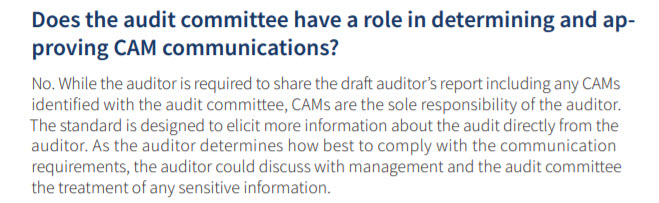
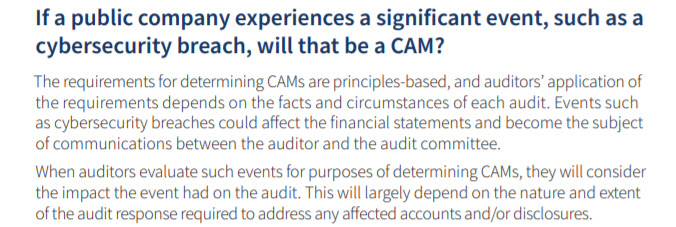
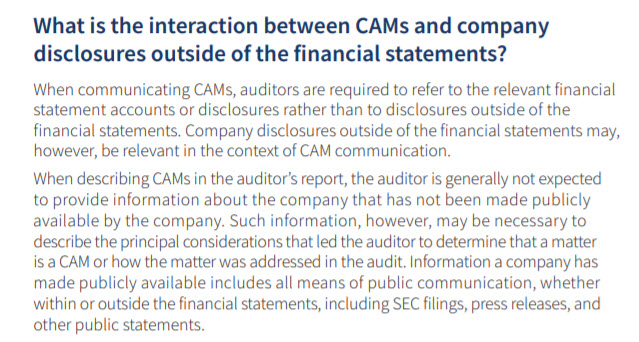
The following are snapshots of four of the PCAOB’s responses to frequently asked questions that I found to be interesting. While the responses are useful and helpful, I don’t find that they simplify the matter. The response in the first snapshot below also could be confusing – I expect that audit committees will want to have a significant role in, or at least significant input in or comments about, CAMs and certain specific CAMs and proposed CAMs in particular. Whereas the auditor might have ultimate say about how a CAM is worded (because it is the auditor’s report), I expect that audit committees will be directly involved in and vocal about whether or not a matter is a CAM, and how the CAM is communicated. And I expect that in some circumstances there might be or will be disagreement, at which point the audit committee, or the board, or the company might be put the position of having to evaluate whether to communicate or respond further about the CAM, and the manner of doing so.

The following are snapshots of four of the PCAOB’s responses to frequently asked questions that I found to be interesting:

Click on the following link to be taken to the PCAOB’s page with the new July 11, 2019, PCAOB guidance for audit committees about CAMs:

Click to access Audit-Committee-Resource-CAMs.pdf

—————————————————————

Remember, every case and situation is different. It is important to obtain and evaluate all of the evidence that is available, and to apply that evidence to the applicable standards and laws. You do need to consult with an attorney and other professionals about your particular situation. This post is not a solicitation for legal or other services inside of or outside of California, and, of course, this post only is a summary of information that changes from time to time, and does not apply to any particular situation or to your specific situation. So . . . you cannot rely on this post for your situation or as legal or other professional advice or representation.

Thank you for reading this website. I ask that you also pass it along to other people who would be interested as it is through collaboration that great things and success occur more quickly.

Best to you, David Tate, Esq. (and inactive California CPA) – practicing in California only.

I am also the new Chair of the Business Law Section of the Bar Association of San Francisco.

Blogs: Trust, estate/probate, power of attorney, conservatorship, elder and dependent adult abuse, nursing home and care, disability, discrimination, personal injury, responsibilities and rights, and other related litigation, and contentious administrations http://californiaestatetrust.com; Business, D&O, board, director, audit committee, shareholder, founder, owner, and investor litigation, governance, responsibilities and rights, compliance, investigations, and risk management  http://auditcommitteeupdate.com

The following are copies of the tables of contents of three of the more formal materials that I have written over the years about accounting/auditing, audit committees, and related legal topics – Accounting and Its Legal Implications was my first formal effort, which resulted in a published book that had more of an accounting and auditing focus; Chapter 5A, Audit Committee Functions and Responsibilities, for the California Continuing Education of the Bar has a more legal focus; and the most recent Tate’s Excellent Audit Committee Guide (February 2017) also has a more legal focus:

Accounting and Its Legal Implications

Chapter 5A, Audit Committee Functions and Responsibilities, CEB Advising and Defending Corporate Directors and Officers

Tate’s Excellent Audit Committee Guide

The following are other summary materials that you might find useful:

OVERVIEW OF A RISK MANAGEMENT PROCESS THAT YOU CAN USE 03162018

Audit Committee 5 Lines of Success, Diligence, and Defense - David Tate, Esq, 05052018

COSO Enterprise Risk Management Framework ERM Components and Principles

From a prior blog post which you can find at https://wp.me/p75iWX-dk if the below scan is too difficult to read:

* * * * *

PCAOB – Implementation of Critical Audit Matters Deeper Dive

As I discussed in a prior post re critical audit matters (Click Here), external auditors are required to include a discussion of critical audit matters in their audit opinion reports for large accelerated filers for audits of fiscal years ending on or after June 30, 2019, and for other public companies for audits of fiscal years ending on or after December 31, 2020. I expect that CAMs and the wording of CAMs will in some instances present or cause contentions between the external auditor on the one hand, and the audit committee, board, and executive officers on the other hand.

A Critical Audit Matter or CAM is defined as:

Any matter arising from the audit of the financial statements that was communicated or required to be communicated to the audit committee: and that:

  1. Relates to accounts or disclosures that are material to the financial statements; and
  2. Involved especially challenging, subjective, or complex auditor judgment.

Thus, based on the above definition, simply determining whether a matter is a CAM could be a challenging issue.

For example, in any given audit situation consider:

-What matters were communicated, or were required to be communicated to the audit committee;

-Relating to accounts or disclosures that are material to the financial statements; and

-Involved especially challenging, subjective, or complex auditor judgment?

The PCAOB has issued a more detailed and worthwhile discussion about critical audit matters and the reporting requirements that is entitled Implementation of Critical Audit Matters Deeper Dive. To view the paper, Click Here

In some circumstances critical audit matters will now become important topics for discussion. The Implementation of Critical Audit Matters Deeper Dive paper also identifies many uncertainties that are yet to be resolved relating to CAMs. Indeed, CAMs are principles based, and likely will vary from auditor to auditor based in part on the auditor’s objective, or subjective, evaluation and judgment. I note that the PCAOB’s paper provides a worthwhile discussion and many examples that should be studied. And the PCAOB also notes twice in the paper that they expect that most audits will include at least one or more CAM. And it should also be noted that the existence of a CAM should not automatically be thought of as a negative or detrimental item – it all depends on the nature of the CAM and how it is worded, as not all CAMs are equal.

Every case and situation is different. You do need to consult with an attorney and other professionals about your particular situation. This post is not a solicitation for legal or other services inside of or outside of California, and, of course, this post only is a summary of information that changes from time to time, and does not apply to any particular situation or to your specific situation. So . . . you cannot rely on this post for your situation or as legal or other professional advice or representation.

Thank you for reading this website. I ask that you also pass it along to other people who would be interested as it is through collaboration that great things and success occur more quickly.

Best to you, David Tate, Esq. (and inactive California CPA) – practicing in California only.

Blogs: Trust, estate/probate, power of attorney, conservatorship, elder and dependent adult abuse, nursing home and care, disability, discrimination, personal injury, responsibilities and rights, and other related litigation, and contentious administrations http://californiaestatetrust.com; Business, D&O, board, director, audit committee, shareholder, founder, owner, and investor litigation, governance, responsibilities and rights, compliance, investigations, and risk management  http://auditcommitteeupdate.com


OVERVIEW OF A RISK MANAGEMENT PROCESS THAT YOU CAN USE 03162018

Audit Committee 5 Lines of Success, Diligence, and Defense - David Tate, Esq, 05052018

COSO Enterprise Risk Management Framework ERM Components and Principles

* * * * *

New April 2019, DOJ Evaluation of Corporate Compliance Programs – the word risk is used 49 times, the board 11 times, and the audit committee 2 times

I have provided below a link to the new 19-page, April 2019, DOJ Evaluation of Corporate Compliance Programs guidance. Obviously a tremendous number of law firms will be discussing and advising about this new guidance. I note that the term risk management is used only once in the document but the word risk or words associated with risk are used 49 times, board or board of directors are used 11 times, and audit committee is used twice. With respect to boards or boards of directors, and audit committees, the guidance is looking for oversight by a source that is autonomous from management, and for there to be a means to allow (or encourage) reporting to a source that is autonomous from management. But in that regard I note that autonomy from management can be a complicated issue as some board members might be involved in management, and other board members, although independent from management, might have conflicts or might not truly be independent such as because of relationships, or perceived alliances, influences, or pressures, or other possible situations.

Click on the following link for the Evaluation of Corporate Compliance Programs guidance: DOJ – Evaluation of Corporate Compliance Programs April 2019, 

Every case and situation is different. You do need to consult with an attorney and other professionals about your particular situation. This post is not a solicitation for legal or other services inside of or outside of California, and, of course, this post only is a summary of information that changes from time to time, and does not apply to any particular situation or to your specific situation. So . . . you cannot rely on this post for your situation or as legal or other professional advice or representation.

Thank you for reading this website. I ask that you also pass it along to other people who would be interested as it is through collaboration that great things and success occur more quickly.

Best to you, David Tate, Esq. (and inactive California CPA) – practicing in California only.

Blogs: Trust, estate/probate, power of attorney, conservatorship, elder and dependent adult abuse, nursing home and care, disability, discrimination, personal injury, responsibilities and rights, and other related litigation, and contentious administrations http://californiaestatetrust.com; Business, D&O, board, director, audit committee, shareholder, founder, owner, and investor litigation, governance, responsibilities and rights, compliance, investigations, and risk management  http://auditcommitteeupdate.com

* * * * *

New Musk / SEC Agreement – Will It Work? – Red Flags – If I Were The Judge

At this point most reasonable people would not dispute that Mr. Musk has difficulty wording his communications (tweets) in a manner that is acceptable or more likely to be acceptable under the securities laws. Greatly summarizing the law, ask yourself if the wording and information that Mr. Musk has communicated or is proposing to communicate is or would be (1) viewed as being material to the average investor, (2) vague puffery, (3) a statement or assertion of current fact, (4) a statement or assertion of forward-looking wording and information, or (5) a mixed combination of any of (1)-(4)?

Vague puffery should not be actionable. Information that is not “material” also should not be actionable; however, whether information is material (quantitatively or qualitatively) can be a slippery slope question of fact, and you might ask why Mr. Musk would be communicating the information if he did not consider the information to be important as to Tesla? Regarding (3), well . . . is the statement or assertion of current fact true and accurate as expressed? Regarding (4), well . . . even if the statement or assertion includes forward-looking warnings or disclaimers (which it should/must), is there a reasonable factual basis for making and believing the truth and accuracy of the forward-looking statement or assertion?

The players involved at least include Mr. Musk, the SEC, the Board, the Audit Committee, the Disclosure Controls Committee, and the new experienced securities attorney who is supposed to review, fix/modify, and authorize Mr. Musk’s communications before Mr. Musk makes them. Obviously, this has been, and will be a challenge for Ms. Musk. Presumably, he views Tesla and Tesla’s further future success, or not, as his creation, and rightly so. Mr. Musk has accomplished an amazing task thus far. But public companies have rules of communication that must be followed. And it is arguable that at this point his manner of communications might be hurting Tesla as much as they help. Assertions of current fact, and assertions of forward-looking statements certainly can be made, and it is arguable that they are supposed to be or at times must be made or disclosed, but they need to be made in an appropriate manner.

Where has the Board been in all of this? We don’t know, because the Board has not said. The Board is overall responsible for risk management.

These certainly are risk management, governance, and internal controls issues.

Where has the Audit Committee been in all of this? We don’t know, because the Audit Committee has not said. The Audit Committee Charter in part states that the Audit Committee assists the Board with oversight of the Company’s compliance with legal and regulatory requirements, and also assists the Board with oversight of the Company’s risk management. The Charter further states that the Audit Committee also is involved in the oversight of internal controls and at least some of Tesla’s corporate communications.

Tesla also has a Disclosure Controls Committee. Where has the Disclosure Controls Committee been in all of this? We don’t know because the Disclosure Controls Committee has not said.

And, assuming that the Court approves the new Musk / SEC agreement, going forward where will then be the experienced securities attorney who is supposed to review, fix/modify, and authorize Mr. Musk’s communications before Mr. Musk makes them?

Thus far, oversight has not worked. And, there are red flags all over the place. Although Boards, and Board Committees (e.g., the Audit Committee), and in-house legal and compliance professionals usually are not personally liable for unlawful activities of the company or its officers, that is a changing environment, and cases also do hold that liability can attach when red flags are ignored or not remedied.

This is really easy to resolve if Mr. Musk wants to modify how he does his communications, as frustrating as that might be for him.

What will/should the Judge do? I would approve the new agreement, perhaps with a few minor changes. I would put in place a process for meet and confer between the parties, and then also quick Court involvement if there is a perceived new violation of the new agreement, and I would schedule a new status hearing in the not-to-distant future, such as 30 days.

Every case and situation is different. You do need to consult with an attorney and other professionals about your particular situation. This post is not a solicitation for legal or other services inside of or outside of California, and, of course, this post only is a summary of information that changes from time to time, and does not apply to any particular situation or to your specific situation. So . . . you cannot rely on this post for your situation or as legal or other professional advice or representation.

Thank you for reading this website. I ask that you also pass it along to other people who would be interested as it is through collaboration that great things and success occur more quickly.

Best to you, David Tate, Esq. (and inactive California CPA) – practicing in California only.

Blogs: Trust, estate/probate, power of attorney, conservatorship, elder and dependent adult abuse, nursing home and care, disability, discrimination, personal injury, responsibilities and rights, and other related litigation, and contentious administrations http://californiaestatetrust.com; Business, D&O, board, director, audit committee, shareholder, founder, owner, and investor litigation, governance, responsibilities and rights, compliance, investigations, and risk management  http://auditcommitteeupdate.com

* * * * *

New COSO ERM Framework – Enterprise Risk Management – Integrating with Strategy and Performance; COSO 2013 Internal Control Framework; the Business Judgment Rule

You may have heard or seen that the new COSO ERM Framework is out as of a day or two ago – Enterprise Risk Management – Integrating with Strategy and Performance. This is a project that COSO announced on October 21, 2014, so it is a longtime in the works. The original (first) framework was issued in 2004. Below I have provided the bare bones outline for the new ERM Framework, in addition to the bare bones outline for the COSO 2013 Internal Control Framework, and a summary of the business judgment rule. Why did I provide all three? Because for boards and audit committees, and for business entities and their executive officers, and sometimes for the employees also, all three are, or should be, tied together.

I will be commenting about and outlining the ERM Framework in detail in later posts (after I have had time to evaluate the detailed materials, and discuss them with colleagues). For now, all I can give you is the outline below. I do note – and I’m not being negative about this – that I have some concern that the five concepts and twenty principles, with the detail added, might be a lot for some small and mid-sized business entities, nonprofits and governmental entities to handle. But it is what it is. And as you may know, although it is now recognized that boards are responsible for oversight of risk management, many audit committees are responsible for risk management oversight pursuant to statute, regulation, or exchange requirements, and a typical audit committee charter lists oversight of risk management as an area of responsibility, generally there is no legally required or mandated risk management framework or process, although some industries (such as banks, for example) are heavily regulated for risk management purposes. It is possible that the new COSO ERM Framework will become the accepted framework to follow, although other frameworks do exist.

COSO (the Committee of Sponsoring Organizations of the Treadway Commission) is a private sector initiative, jointly sponsored and funded by the American Accounting Association, American Institute of Certified Public Accountants, Financial Executives International, Institute of Management Accountants, and The Institute of Internal Auditors.

The new COSO ERM Framework is organized into five interrelated primary or core components, which are supported by a set of twenty principles. The following is a broad outline of the five components and twenty principles. And as I stated above, in later posts I will be adding considerable detail. Below I have also provided an outline for the COSO 2013 Internal Control Framework, and a discussion about the business judgment rule.

Thanks for reading. David Tate, Esq., Royse Law Firm, Menlo Park office, with offices in the San Francisco Bay Area and Los Angeles


COSO ERM Framework – Enterprise Risk Management – Integrating with Strategy and Performance (five components, and twenty principles)

I.  Governance and Culture Component:

Supporting Principles:

  1. Exercises Board Risk Oversight
  2. Establishes Operating Structures
  3. Defines Desired Culture
  4. Demonstrates Commitment to Core Values
  5. Attracts, Develops, and Retains Capable Individuals

II.  Strategy and Objective-Setting Component:

  1. Analyzes Business Context
  2. Defines Risk Appetite
  3. Evaluates Alternative Strategies
  4. Formulates Business Objectives

III.  Performance Component:

  1. Identifies Risk
  2. Assesses Severity of Risk
  3. Prioritizes Risks
  4. Implements Risk Responses
  5. Develops Portfolio View

IV.  Review and Revision Component:

  1. Assesses Substantial Change
  2. Reviews Risk and Performance
  3. Pursues Improvement in Enterprise Risk Management

V.  Information, Communication, and Reporting Component:

  1. Leverages Information and Technology
  2. Communicates Risk Information
  3. Reports on Risk, Culture, and Performance


Enterprise Risk Management (ERM) and internal controls work together and should complement each other. The following is the broad outline of the COSO 2013 Internal Control Framework.

Sarbanes-Oxley section 404 requires public company management and its external auditors to attest to the design and operating effectiveness of a company’s internal control over external financial reporting. Internal controls should also be designed and implemented for private company, nonprofit and governmental entities.

COSO 2013 Internal Control Framework – 5 Components, and 17 Principles

1.  Control Environment Component:

Mandatory Principles

  1. Demonstrate commitment to integrity and ethical values.
  2. Board of directors demonstrates independence from management and exercises oversight of the development and performance of internal control.
  3. Management establishes, with board oversight, structures and reporting lines and appropriate authorities and responsibilities in the pursuit of objectives.
  4. Demonstrate commitment to attract, develop and retain competent individuals in alignment with objectives.
  5. Hold individuals accountable for their internal control responsibilities in the pursuit of objectives.

2.  Risk Assessment Component:

Mandatory Principles

  1. Specify objectives with sufficient clarity to enable the identification and assessment of risks relating to objectives.
  2. Identify risks to the achievement of its objectives across the entity and analyze risks as a basis for determining how the risks should be managed.
  3. Consider the potential for fraud in assessing risks to the achievement of objectives.
  4. Identify and assess changes that could significantly impact the system of internal control.

3.  Control Activities Component:

Mandatory Principles

  1. Select and develop control activities that contribute to the mitigation of risks to the achievement of objectives and acceptable levels.
  2. Select and develop general control activities over technology to support the achievement of objectives.
  3. Deploy control activities through policies that establish what is expected and procedures that put policies into action.

4.  Information & Communication Component:

Mandatory Principles

  1. Obtain or generate and use relevant, quality information to support the functioning of internal control.
  2. Internally communicate information, including objectives and responsibilities for internal control, necessary to support the functioning of internal control.
  3. Communicate with external parties regarding matters affecting the functioning of internal control.

5.  Monitoring Activities Component:

Mandatory Principles

  1. Select, develop and perform ongoing and/or separate evaluations to ascertain whether the components of internal control are present and functioning.
  2. Evaluate and communicate internal control deficiencies in a timely manner to those parties responsible for taking corrective action, including senior management and the board of directors, as appropriate.


The Business Judgment Rule

The business judgment rule also is relevant on these topics (from Tate’s Excellent Audit Committee Guide). The business judgment rule provides a director with a defense to personal liability, holding that as a general principle of law, a director, including a director who serves as a member of a board committee, who satisfies the business judgment rule has satisfied his or her duties. Thus, the business judgment rule provides one standard of care, although other standards may very well also apply to specific tasks and responsibilities. The business judgment rule provides a very good overall approach for directors and audit committee members to follow, although the rule itself is lacking in specific detail. In some states the business judgment rule is codified by statute while in other states the rule is established by case law (see, i.e., Cal. Corp. Code §309 for California corporations, Del. Gen. Corp. Law §141 for Delaware corporations, in addition to relevant case law). The rule also applies to directors as board committee members.

The Business Judgment Rule

In summary, as a general principle the business judgment rule provides that a director should undertake his or her duties:

-In good faith, with honesty and without self-dealing, conflict or improper personal benefit;

-In a manner that the director reasonably believes to be in the best interests of the corporation and its shareholders; and

-With the care, including reasonable inquiry, that an ordinarily prudent person in a like position with like expertise would use under similar circumstances. The rule itself doesn’t require a particular level of expertise, knowledge or understanding; however, as you might be aware, public company audit committee members do have such a requirement, and you can at least argue that, depending on the facts and circumstances, a board or committee member should have or should obtain a certain unspecified level of knowledge or understanding to be sufficiently prepared to ask questions, evaluate information provided, and make decisions.

Reliance Upon Other People Under the Business Judgment Rule

In the course and scope of performing his or her duties, a director must necessarily obtain information from and rely upon other people. An independent director is not involved in the day-to-day operations of the business. The director provides an oversight function. Pursuant to the business judgment rule, a director is entitled to rely on information, opinions, reports or statements, including financial statements and other financial data, prepared or presented by any of the following:

-Officers or employees of the corporation whom the director reasonably believes to be reliable and competent in the relevant matters;

-Legal counsel, independent accountants or other persons as to matters that the director reasonably believes are within the person’s professional or expert competence; or

-A committee of the board on which the director does not serve, as to matters within that committee’s designated authority, so long as the director acts in good faith, after reasonable inquiry as warranted by the circumstances, and without knowledge that would cause reliance to be unwarranted.

That’s it for now. Thanks for reading. Much, much more to come on these topics. David Tate, Esq., Royse Law Firm, Menlo Park office, with offices in the San Francisco Bay Area and Los Angeles

* * * * *