New Governance Guidance Stretches Thinking on Ethics, Risk, and More

​The King IV draft code has much to say about governance, risk management, compliance, and assurance. Click on the following link for the discussion by Norman Marks and see my comments below: iaonline.theiia.org

This article by Norman Marks discusses parts of the new King IV code that concentrate on culture, ethics and risk. It’s interesting for thought with respect to your own organization. It is and has been long well-known that all three corporate areas, culture, ethics and risk management, are instrumental to business performance and legal compliance.

And although these areas are discussed, and significant strides have been made in or discussed about risk management during the past couple of years, there still are no universally recognized standards or criteria to evaluate or audit how the business is doing in these areas.

I have long been surprised that the auditing professions, external and internal, have not jumped on these areas and also governance.

See also Tate’s Excellent Audit Committee Guide at CLICK HERE

Best, Dave Tate, Esq. (San Francisco and California), http://auditcommitteeupdate.com, http://californiaestatetrust.com, http://tateattorney.com

DTatePicture_Square

The Kroll 2016 Anti-Bribery And Corruption Report – Worthwhile Reading for D&O And Audit Committees

Below are a couple of snapshots from the Kroll 2016 Anti-Bribery and Corruption Report. The Report is worthwhile reading for audit committees, officers, directors and corporate counsel if for no other reason than to jog the thought process. The Report is 36 pages, but the below snapshots, for example, should by themselves prompt some diligence and compliance thoughts. Below the snapshots I have provided a link to the Report, along with a link to Tate’s Excellent Audit Committee Guide.

Kroll 2016 Anti-Bribery and Corruption Report Slide 1

Kroll 2016 Anti-Bribery and Corruption Report Slide 2

Kroll 2016 Anti-Bribery and Corruption Report Slide 3

The following page from Kroll contains a link to the full report – you don’t need to provide any additional information, simply click the link on the page, http://www.kroll.com/en-us/intelligence-center/press-releases/2016-anti-bribery-corruption-report-Toronto

See also Tate’s Excellent Audit Committee Guide, updated January 3, 2016, at http://wp.me/p75iWX-q

Dave Tate, Esq., San Francisco and California

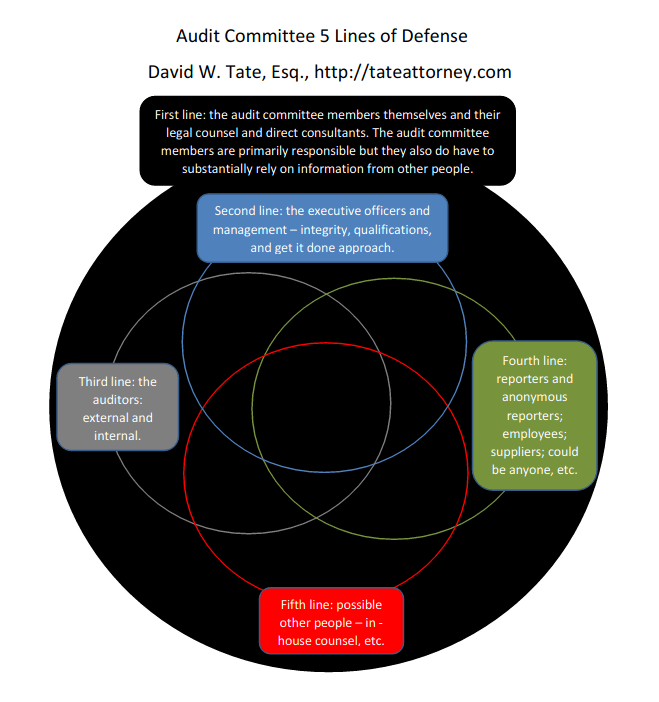
Audit Committee 5 Lines of Defense 02132016 David W. Tate, Esq.


DTatePicture_Square

What Insight Do Audit Committees Receive From Internal Audit – Not Enough Or Much – KPMG Survey

What insight to audit committees receive from IA

The above chart is from a new KPMG survey of audit committee chairs and CFOs. You can find the survey at

Click to access GM-OTS-1653_SeekingValueThrough_IAB_V1.pdf

.

The survey and the above chart identify ongoing challenges for internal audit to provide and prove enough value to audit committee members and CFOs. It is well-documented that these challenges have existed for years – basically forever. But let’s not over generalize – one size doesn’t fit all, and certainly there are internal audit functions that are up-to-speed and that are providing good value.

If there is a problem in this area, you must also ask the audit committee members, not just the audit committee chair but also the individual members who aren’t the chair, why they aren’t getting the information that they need from internal audit? There’s either a lack of common understanding, and that lack of understanding might also be the fault of the audit committee members if they are not expressing themselves sufficiently, or there is a problem with the internal audit function, or its funding, or the qualifications of its members. In theory, it also is possible that the audit committee or the CFO simply are asking internal audit to perform a task or to provide information that is unreasonable; however, that is like saying “I can’t do that for you,” which of course is a very bad approach.

You can also see Tate’s Excellent Audit Committee Guide (updated January 3, 2016), at http://wp.me/p75iWX-q

Dave Tate, Esq., San Francisco and California, http://auditcommitteeupdate.com

Audit Committee 5 Lines of Defense 02132016 David W. Tate, Esq.

DTatePicture_Square

Extra Protection for Independent Directors: Wealth Security Policy | Woodruff-Sawyer & Co.

A question that often comes up for independent directors at public companies, private companies and even nonprofits is: What happens if the company has nothing left to protect me? Maybe …

Click on the following link for the full article: wsandco.com

Dave Tate, Esq. comment – a very important topic for audit committee members and independent directors, from Priya Cherian Huskins at Woodruff-Sawyer. Enjoy. Dave Tate, Esq., San Francisco and throughout California – see also my blog for a link to Tate’s Excellent Audit Committee Guide, updated January 2016.

Fuzzy-Math Accounting Gets Fresh SEC Scrutiny

It’s generally accepted that a lot of accounting isn’t, well, generally accepted . . . click on the following link for the article: www.accountingtoday.com

Dave Tate, Esq. comments. Fuzzy-math v. fuzzy-reporting v. fuzzy-presentation v. fuzzy-accounting?  I don’t necessarily agree with the “fuzzy” or that “a lot of accounting isn’t, well, generally accepted.” Viewing the issue as an attorney, CPA and audit committee member, each situation must be evaluated on a case-by-case basis. If the rules aren’t absolute, or are vague, discretionary or subject to interpretation, you are going to have these differences, and it doesn’t mean that the company did anything wrong – it might simply mean that the SEC has a viewpoint that is different than the company and the company’s external auditor. The accounting/auditing pronouncement authorities are shifting to a more “principles” based accounting approach, and away from some of the exact rules. I have previously commented that this “principles” based approach, which was the approach at the time when I first became a CPA, also may lead to more uncertainty and discretion. Most likely these situations will be increasing in numbers.

Internal Auditors Not Giving Enough Risk Insights

CFOs and audit committee chairs are not getting enough insights into corporate risk management from their companies internal audit function, according to a new survey.

Click on the following link for the article: www.accountingtoday.com

Dave Tate, Esq. comment. The results of this survey really shouldn’t be surprising. There isn’t even agreement on what risk management is or a recommended process.

Risk management is a collaborative effort. If I’m on a board risk committee or on audit committee that has been delegated initial risk management oversight, yes, I’m going to request and expect executive management and internal audit to not only provide comments and evaluations about risk management, and also about the processes that are being used, and that should be updated and used.

However, as a risk or audit committee member, I’m also going to provide my comments about what I need to see and receive in that regard so that I am comfortable that what I am receiving allows me to perform my oversight responsibilities. Okay, so if internal audit isn’t giving enough risk insight as the article indicates, why is that, and what must be done to correct that dynamic? Those are questions that the risk or audit committee members must ask and act upon to satisfy their responsibilities as required by the business judgment rule, statutes, regulations, rules and the committee charter.

‘Internal audit is crucial to assessing impact of corporate culture’

Internal audit’s mandate is much broader than external audit’s, says Richard Chambers of Institute of Internal Auditors

Click on the following link for the article: www.thehindubusinessline.com

Dave Tate, Esq. comment.


I’m going to disagree with Mr. Chambers on this one. I believe it is better for external audit to be auditing this issue – which is an issue that external audit already should be taking into consideration when designing the audit and the extent to which management and the accounting and internal control functions can be relied upon.


Although internal audit could be assigned a task or project relating to culture, on this topic I would keep the task or project very specific. Internal audit does also work and interact with management and executive management – assessing culture might detrimentally impact those relationships. I would however recommend that internal audit be more involved in risk management, which could involve culture but in a different context.


Audit committee, D&O, risk management, etc. blog: http://auditcommitteeupdate.com

Website: http://tateattorney.com

Trust, estate, conservatorship and elder abuse litigation blog: http://californiaestatetrust.com


I will be attending the NACD No. California Feb. 24, Shareholder Activism program – will you be there – say hello

For my contacts, I will be attending the February 24, 2016, NACD Northern California program about shareholder activism in San Francisco from 5:30-7:30 at night. If any of my contacts will also be attending, please be sure to say hello.

Dave Tate, Esq., San Francisco and California, WEBSITE AND BLOGS, and click on the following for Tate’s Excellent Audit Committee Guide updated January 3, 2016

How Can Internal Audit Support the Growing Responsibilities of the Audit Committee?

Recent 2015 audit surveys report some interesting findings about the current role of audit committees. They highlight not only how complex the world of risk management and oversight has become in the corporate world, but also the enormous breadth of responsibilities that the audit committee is expected to bear.

Click on the following link for the article: corporatecomplianceinsights.com

Dave Tate, Esq. comments: although this is a very brief article, the topics and issues listed are large and complex. The article also offers no help at resolution. But, these issues are here to stay for boards and audit committees. Every internal audit function is different – some are qualified or partially qualified to help with these issues, whereas some are not. For some additional information, see Tate’s Excellent Audit Committee Guide (January 3, 2016, version, 183 pages) at http://wp.me/p75iWX-q.


Best. Dave Tate, Esq. (San Francisco and California. See also my other blog re trust, estate, conservatorship, power of attorney and elder abuse litigation and contentious administrations at http://californiaestatetrust.com, and my website at http://tateattorney.com.

Do You Have a Contrarian on Your Team?

A divergent opinion can lead to more creative and better decisions.

Click on the following for the article: www.gsb.stanford.edu

Dave Tate, Esq. comments – good for thought – every board and management situation is different anyway – but also, did anyone say that there shouldn’t be or can’t be contrarian views on a board or committee? Look at the business judgment rule – there’s nothing there about all having to agree. One vote per person. My website: http://tateattorney.com.