An Open Letter to Newly Appointed Audit Committee Members – From IIA President and CEO Richard F. Chambers

The following link is worthwhile reading from Richard Chambers, President and CEO of the Institute of Internal Auditors. I have long thought that not enough is written about internal audit, COSO 2013, and the interactions and communications between internal audit and the audit committee, including how they can help each other. Similarly, although every organization, audit committee, chief audit executive, and internal audit department is different, in general I have believed that some audit committees definitely should make better use of internal audit, make more demands upon them, and have higher expectations from them, and some CAEs and internal audit departments need to improve their game. In any event, the following is a link to an October 3, 2016, discussion by Mr. Chambers about internal audit for new audit committee members, but I believe it is also worthwhile for more experienced committee members. CLICK HERE

Best, Dave Tate, Esq., San Francisco and California


Why startups need a defensive IP strategy

Shortly I will be adding asset safeguarding materials to the audit committee guide. And I will be posting some of those links to this blog. You very seldom (if ever) hear or read about asset protection in the context of board responsibilities. In that context, however, very most likely it is the audit committee that would address that oversight, and definitely at least certain aspects of asset protection and safeguarding fall under internal controls and COSO 2013. The following, below, is a link that you can click for an article about defensive IP strategy that I was reading last night,

https://techcrunch.com/2016/08/17/why-startups-need-a-defensive-ip-strategy/

Best, Dave Tate, Esq., San Francisco and California

Audit Committee 5 Lines of Defense 07182016

DTatePicture_Square

Clinton Trump You’re a Racist You’re a Bigot – Vote for Me – Leadership?

Tate’s Audit Committee Guide – click on the following link (January 2016), http://wp.me/p75iWX-q

DTatePicture_Square

Audit Committee 5 Lines of Defense 07182016

Forwarding a worthwhile paper discussing objective based risk management

I am forwarding a link to a short article by Tim Leech and Lauren Hanlon discussing, as they say, Paradigm paralysis in ERM & internal audit. I am providing you with this article because of the discussion between risk management that first and primarily identifies risk, and one that first starts with the objectives of the enterprise, and then follows with the risks to those objectives.

You might also be aware that soon, perhaps next month in September, COSO will be making available its eagerly awaited ERM update, which could be an important development.

Below is the link to the Leech/Hanlon paper (I do also note that they lost me a little with the sample summary report on the second page of the paper – I prefer reports that very easily speak for themselves – but I have found that sometimes professionals with Tim’s experience tend to write in a manner that is not always the most easy or simple to understand). This is a worthwhile paper – please read it.  Dave Tate, Esq., San Francisco and California.

Click to access Risk-Oversight-Solutions-Paradigm-Paralysis-in-ERM-IA-Tim-Leech-Lauren-Hanlon.pdf

Disparate Impact – U.S. Supreme Court – Texas Dept. of Hous. & Cmty. Affairs – Plaintiff Must Establish Causation

This is a bit of a side topic for this blog, but not entirely as it deals with a disparate impact claim, typically made in the context of employment or housing discrimination litigation, but possibly relevant in other areas also. It is useful to keep in mind that in Texas Dept. of Hous & Cmty. Affairs v. Inclusive Communities Project the U.S. Supreme Court held that the plaintiff must establish causation. Relevant wording from the Court is as follows:

Disparate Impact - Texas Dept. Hous. & Cmty. Affairs, - U.S. Supreme Court

Best, Dave Tate, Esq., San Francisco and California.

Tate’s Excellent Audit Committee Guide, updated January 3, 2016, CLICK HERE FOR THE PDF LINK.

Audit Committee 5 Lines of Defense 07182016

DTatePicture_Square

New PCAOB Guidance On Form AP – Yes, To My Surprise, Some Of This Is Interesting

I have previously commented briefly about the new audit partner disclosure requirement – essentially, my comment was that I did not really see what the big deal is about this. But on June 28, 2016, the PCAOB issued staff guidance for Form AP, and as a result, I have to step back a little my initial comments. The following is a link to the PCAOB guidance, and Form AP, CLICK HERE

I still don’t believe in the broad view that it is a big deal to name the audit partner, however, I am now seeing that it might be possible to do a tally on how many audits a particular person (identified by a specific numeric code for that particular person) is listed as the audit partner, and it would not surprise me if someone in the future, or even the PCAOB, or the SEC, or plaintiffs’ counsel in a litigation case for auditor liability, questions the number of audits on which someone can effectively perform as the primary audit partner?

Further, if my reading of the Form AP, and the guidance, are correct, it appears that the Form requires the auditor/auditing firm to provide the numbers of hours spent performing the audit, and it appears that to some extent those hours need to be further divided or broken down into some of the different important audit areas or programs.  This information could be useful for a number of purposes. It would allow a comparison of audit fee to hours spent between different entities and industries (and how much is being charged per hour). It gives the regulatory entities, such as the PCAOB and the SEC useful information to evaluate audit effectiveness. If admissible in court, it could be used to argue in particular cases whether the auditor spent enough time on a particular audit area or program. And the information about the different audit firms involved in the audit and their time spent might be similarly interesting.

And all of this might be of interest to the audit committee in its hiring, evaluation and retention of the audit firm, assuming, of course, that someone or some entity compiles and reports this information in a useful format.

Best, Dave Tate, Esq., San Francisco and California

Click on the following for my Tate’s Excellent Audit Committee Guide, Tate’s Excellent Audit Committee Guide 01032016 with Appendix A Final

See also my trust, estate, conservatorship, power of attorney, and elder abuse litigation blog at http://californiaestatetrust.com

Audit Committee 5 Lines of Defense 07182016

DTatePicture_Square

Basic Insurance for Start-Up Companies – Priya Cherian Huskins, Esq., Woodruff Sawyer

Passing this along, Basic Insurance for Start-Up Companies, the following is a worthwhile read from the D&O Notebook, Priya Cherian Huskins, Esq., Woodruff Sawyer, click on the below link/box for the discussion, enjoy,

https://wsandco.com/do-notebook/startup-insurance/

Best, Dave Tate, Esq., San Francisco and California.

TATE’S EXCELLENT AUDIT COMMITTEE GUIDE updated January 2016, click on the following link, http://wp.me/p75iWX-q

Audit Committee 5 Lines of Defense 07182016


DTatePicture_Square

Top Ten Mistakes Startups Make – And How To Avoid Them – Royse Law Firm – You’ll Like This Webinar Video

The following is a link to a webinar by the Royse Law Firm about the top 10 mistakes that startups make and how to avoid them. This is an excellent webinar, full of useful information. I view the webinar from a risk management perspective, and from a litigation perspective as mistakes do tend to lead to litigation. Enjoy. Click on the following arrow for the webinar video:


Dave Tate, Esq. San Francisco and California. See also Tate’s Excellent Audit Committee Guide updated January 2016, Tate’s Excellent Audit Committee Guide 01032016 with Appendix A Final

Audit Committee 5 Lines of Defense 07182016

DTatePicture_Square

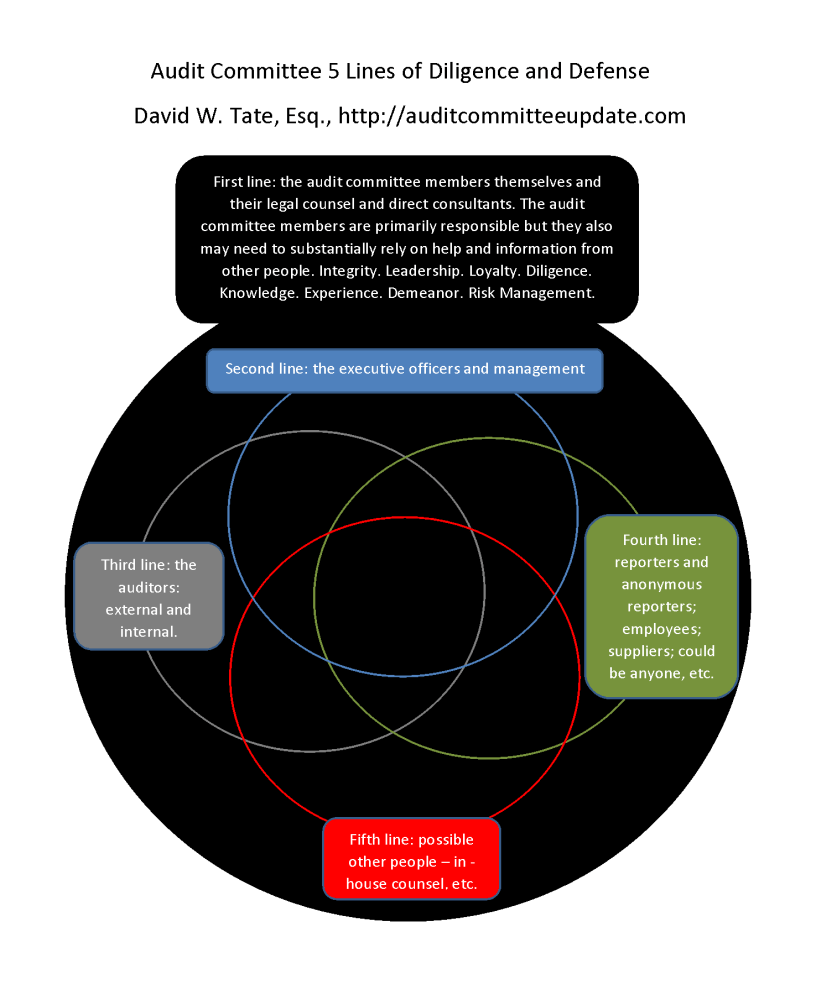
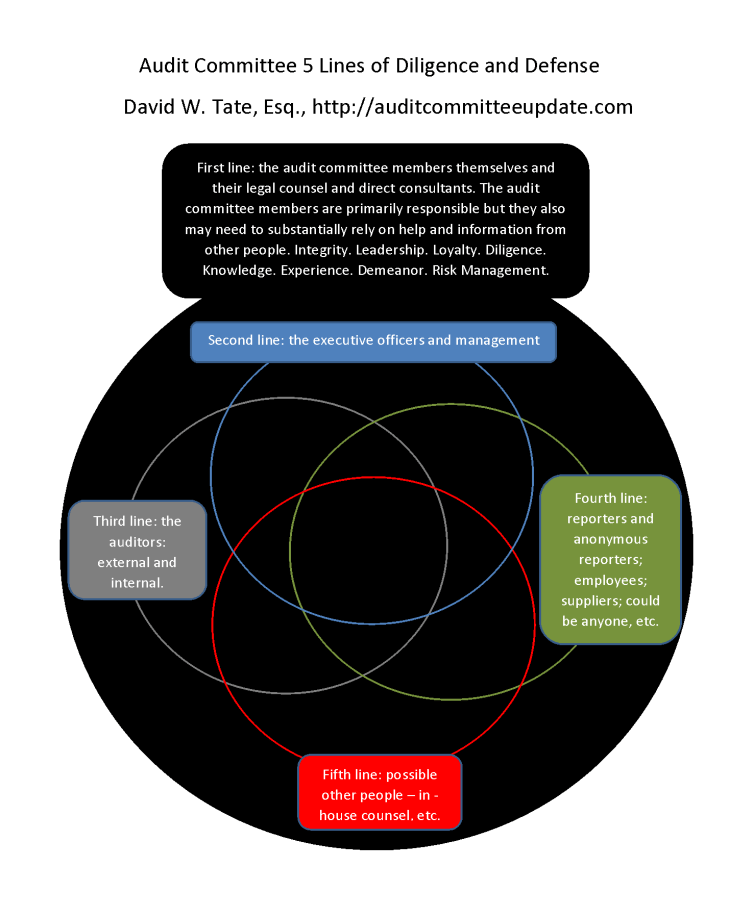
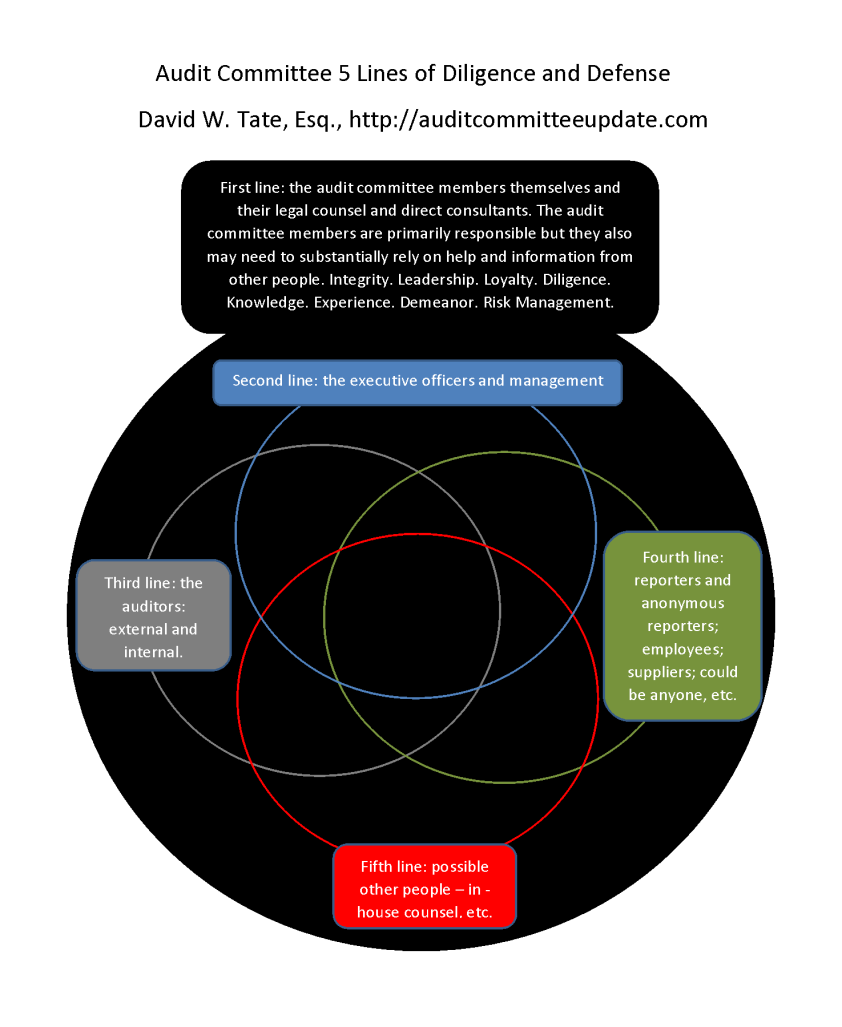
Audit Committee 5 Lines of Diligence and Defense – It’s the People

Audit Committee 5 Lines of Defense 07182016

Really Massive Changes in Accounting, Auditing, Reporting and Communicating – The End Of Accounting?

Although I practice as an attorney, I previously practiced as a CPA and I have experienced several times over the years when there were significant changes occurring in the accounting practice and profession. But right now, I believe that I am witnessing multiple massive changes that have been long in the making. The following is a link to an Accounting Today article which does a pretty good job of discussing some of the changes, and also includes a question whether this is the end of accounting – click on the following link, CLICK HERE

It’s not like these changes are screaming at you in the headlines, but the cumulative effect is significant, new changes are continuing and will continue, and perhaps more important, the reasons for the changes are permanent.

For a long, long time the value of the audit and of the audit report have been questioned.

For a long, long time, the value of the information provided by an accounting that is prepared in conformity with generally accepted accounting principles has been questioned.

Different stakeholders also have different needs, and speed at which the flow of information is needed and expected is ever-increasing. Audited financial statements, for example, don’t tell you very much about the future investment or business generating value of the entity or of the transactions reported, or of the risks that are associated.

So now, for example, in addition to GAAP accounting we have non-GAAP accounting and reporting, we are seeing an increased ability to audit all transactions by computer software, GAAP is moving from the more detailed and specific rules based approach back to the more principles based approach that was in place when I first became a CPA, and non-GAAP measurements or criteria are becoming or should become more important such as some of the governance criteria (integrity, tone-at-the-top, culture, etc.), sustainability, transparency, risk management, and more emphasis on internal controls such as COSO.

However, I don’t agree with the suggestion or question in the title to the above linked article – it’s not the end of accounting. Traditional accounting serves a useful purpose – can you imagine what a free for all it would be without traditional accounting? There would be absolutely no checks or balances. There would be a “zero” reliability factor, and no comparability between different entities or industries.

But there is no question that the changes that have occurred and that continue to occur in accounting and auditing create both opportunities and risks for investors, financial institutions and other stakeholders, executive, financial, accounting and audit officers and professionals, boards, and audit and risk committees. The people who will excel are the people who will embrace and become expert in these changes. It’s a lifetime of learning to stay ahead and relevant.

Best to you. Dave Tate, Esq.

The following is a link to my Tate’s Excellent Audit Committee Guide, updated January 2016, CLICK HERE