New ISO Anti-Bribery Standard – Will It Give Companies An Absolute Defense?

ISO has published its new international anti-bribery standard, ISO 37001. You can find select information about the new standard HERE and at http://http://www.iso.org/iso/home/standards/management-standards/iso37001.htm .

The short PowerPoint presentation in part says:

The Standard benefits an organization by providing:

  • Minimum requirements and supporting guidance for implementing or benchmarking an anti-bribery management system
  • Assurance to management, investors, employees, customers, and other stakeholders that an organization is taking reasonable steps to prevent bribery
  • Evidence in the event of an investigation that an organization has taken reasonable steps to prevent bribery.

SO HERE’S AN INTERESTING QUESTION: will compliance with the standard give the company a free pass on bribery liability with the SEC and other state and federal entities and agencies if in fact a bribery occurs? I bet not. However, consider that generally liability does not result unless the person or entity charged has breached or failed to satisfy the applicable standard or duty of care (except in select situations, e.g., such as strict liability or products liability, etc.), and that breach or failure causes damages. Thus, if the applicable standard becomes ISO 37001, and if that standard is met or satisfied, it certainly is arguable that no fault or liability should result if a bribery occurs.

Best to you, Dave Tate, Esq., San Francisco and California. See also Tate’s Excellent Audit Committee Guide (updated October 2016), tates-excellent-audit-committee-guide-10202016-final-with-appendix-a

The Business Judgment Rule – a short animation (for fun, but also correct):

Audit Committee 5 Lines of Defense 07182016

DTatePicture_Square

Updated Tate’s Excellent Audit Committee Guide – Attached – Use It – Pass It Along – Free

Below is a link to my updated Tate’s Excellent Audit Committee Guide (updated October 20, 2016). Please use it, and pass it to other people who would be interested, such as audit committee members, directors, officers, accountants, internal and external auditors, in-house counsel, compliance professionals, and other people.

I do note that as I was updating these materials, and going through the entire Guide, it definitely hit me that all of the specifically enacted statutes, regulations, rules and pronouncements definitely could cause an audit committee member to not be able to see the forest for the tress. So let’s also not forget to look at the situation as a whole.

Although the Guide is 186 pages, I do expect some significant updates soon, and perhaps prior to the end of 2016. Many of the updates will be posted to this blog first, and then to the Guide. I am looking forward to the COSO enterprise risk management (ERM) updated framework.

Best to you. Dave Tate, Esq., San Francisco and California.

Here is a link to the updated Tate’s Excellent Audit Committee Guide (updated October 20, 2016), tates-excellent-audit-committee-guide-10202016-final-with-appendix-a

Audit Committee 5 Lines of Defense 07182016

The business judgment rule – an animated video:


DTatePicture_Square

Sustainability Disclosures – From PWC – Audit Committee Need to Know?

I’m forwarding this along – sustainability disclosure guidance from PWC – click on the following link for the materials and the discussion, CLICK HERE

And I am thinking that there could be a need for increasing audit committee member expertise in the sustainability disclosure area.

Below is a snapshot from the PWC website, followed by a link to Tate’s Excellent Audit Committee Guide (updated January 2016), followed by the Audit Committee 5 Lines of Diligence and Defense. Thank you. Dave Tate, Esq., San Francisco and California.

PWC Sustainability Disclosure Guidance


See also my Tate’s Excellent Audit Committee Guide, updated January 2016, Tate’s Excellent Audit Committee Guide 01032016 with Appendix A Final

Audit Committee 5 Lines of Defense 07182016

DTatePicture_Square


Trade Secrets And How To Protect Them – Royse Law Firm Webinar – Very Important For Every Business

Below is a link to a detailed and very useful webinar from my friends at the Royse Law Firm discussing trade secrets and how to protect them – this is a very important topic for every business and entity. Click on the following link for the discussion:

New PCAOB Guidance On Form AP – Yes, To My Surprise, Some Of This Is Interesting

I have previously commented briefly about the new audit partner disclosure requirement – essentially, my comment was that I did not really see what the big deal is about this. But on June 28, 2016, the PCAOB issued staff guidance for Form AP, and as a result, I have to step back a little my initial comments. The following is a link to the PCAOB guidance, and Form AP, CLICK HERE

I still don’t believe in the broad view that it is a big deal to name the audit partner, however, I am now seeing that it might be possible to do a tally on how many audits a particular person (identified by a specific numeric code for that particular person) is listed as the audit partner, and it would not surprise me if someone in the future, or even the PCAOB, or the SEC, or plaintiffs’ counsel in a litigation case for auditor liability, questions the number of audits on which someone can effectively perform as the primary audit partner?

Further, if my reading of the Form AP, and the guidance, are correct, it appears that the Form requires the auditor/auditing firm to provide the numbers of hours spent performing the audit, and it appears that to some extent those hours need to be further divided or broken down into some of the different important audit areas or programs.  This information could be useful for a number of purposes. It would allow a comparison of audit fee to hours spent between different entities and industries (and how much is being charged per hour). It gives the regulatory entities, such as the PCAOB and the SEC useful information to evaluate audit effectiveness. If admissible in court, it could be used to argue in particular cases whether the auditor spent enough time on a particular audit area or program. And the information about the different audit firms involved in the audit and their time spent might be similarly interesting.

And all of this might be of interest to the audit committee in its hiring, evaluation and retention of the audit firm, assuming, of course, that someone or some entity compiles and reports this information in a useful format.

Best, Dave Tate, Esq., San Francisco and California

Click on the following for my Tate’s Excellent Audit Committee Guide, Tate’s Excellent Audit Committee Guide 01032016 with Appendix A Final

See also my trust, estate, conservatorship, power of attorney, and elder abuse litigation blog at http://californiaestatetrust.com

Audit Committee 5 Lines of Defense 07182016

DTatePicture_Square

Basic Insurance for Start-Up Companies – Priya Cherian Huskins, Esq., Woodruff Sawyer

Passing this along, Basic Insurance for Start-Up Companies, the following is a worthwhile read from the D&O Notebook, Priya Cherian Huskins, Esq., Woodruff Sawyer, click on the below link/box for the discussion, enjoy,

https://wsandco.com/do-notebook/startup-insurance/

Best, Dave Tate, Esq., San Francisco and California.

TATE’S EXCELLENT AUDIT COMMITTEE GUIDE updated January 2016, click on the following link, http://wp.me/p75iWX-q

Audit Committee 5 Lines of Defense 07182016


DTatePicture_Square

Audit Committee 5 Lines of Diligence and Defense – It’s the People

Audit Committee 5 Lines of Defense 07182016

Really Massive Changes in Accounting, Auditing, Reporting and Communicating – The End Of Accounting?

Although I practice as an attorney, I previously practiced as a CPA and I have experienced several times over the years when there were significant changes occurring in the accounting practice and profession. But right now, I believe that I am witnessing multiple massive changes that have been long in the making. The following is a link to an Accounting Today article which does a pretty good job of discussing some of the changes, and also includes a question whether this is the end of accounting – click on the following link, CLICK HERE

It’s not like these changes are screaming at you in the headlines, but the cumulative effect is significant, new changes are continuing and will continue, and perhaps more important, the reasons for the changes are permanent.

For a long, long time the value of the audit and of the audit report have been questioned.

For a long, long time, the value of the information provided by an accounting that is prepared in conformity with generally accepted accounting principles has been questioned.

Different stakeholders also have different needs, and speed at which the flow of information is needed and expected is ever-increasing. Audited financial statements, for example, don’t tell you very much about the future investment or business generating value of the entity or of the transactions reported, or of the risks that are associated.

So now, for example, in addition to GAAP accounting we have non-GAAP accounting and reporting, we are seeing an increased ability to audit all transactions by computer software, GAAP is moving from the more detailed and specific rules based approach back to the more principles based approach that was in place when I first became a CPA, and non-GAAP measurements or criteria are becoming or should become more important such as some of the governance criteria (integrity, tone-at-the-top, culture, etc.), sustainability, transparency, risk management, and more emphasis on internal controls such as COSO.

However, I don’t agree with the suggestion or question in the title to the above linked article – it’s not the end of accounting. Traditional accounting serves a useful purpose – can you imagine what a free for all it would be without traditional accounting? There would be absolutely no checks or balances. There would be a “zero” reliability factor, and no comparability between different entities or industries.

But there is no question that the changes that have occurred and that continue to occur in accounting and auditing create both opportunities and risks for investors, financial institutions and other stakeholders, executive, financial, accounting and audit officers and professionals, boards, and audit and risk committees. The people who will excel are the people who will embrace and become expert in these changes. It’s a lifetime of learning to stay ahead and relevant.

Best to you. Dave Tate, Esq.

The following is a link to my Tate’s Excellent Audit Committee Guide, updated January 2016, CLICK HERE

Director (Prudent) Note Taking, Discouraged or Not – Forward From Woodruff-Sawyer and Priya Cherian Huskins With Comments

Here is a link to a good discussion by Priya Cherian Huskins, Esq. at Woodruff-Sawyer about director note taking (not minute taking, but note taking), which can also apply to note taking in general in many situations, CLICK HERE. I agree with Ms. Huskins.

There should be policies and procedures or guidelines to be followed, but a director should be allowed to take notes, and should not be told that he or she cannot take notes. It is a matter of the director performing his or her oversight function in the manner that he or she believes is prudent and necessary. If I was told that as a director or audit committee member that I could not take notes that I thought were necessary and helpful to me and my oversight, I would question that instruction or request, and consider declining the position if it was forced.

Best, Dave Tate, Esq. (San Francisco/California)

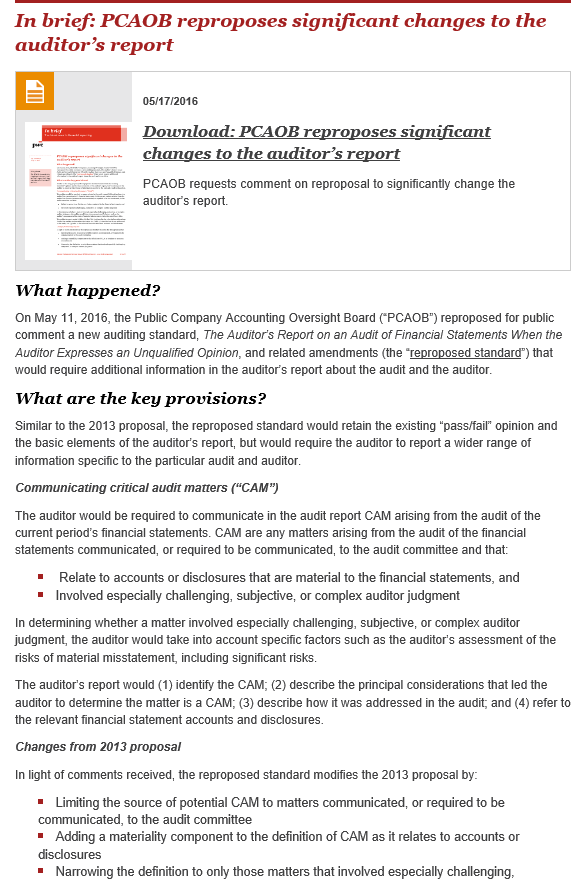
PCAOB Proposes Significant Changes to the Audit Report – From PWC

The PCAOB has again proposed changes to the standard audit report in which the PCAOB proposes that the report disclose additional information, for example about communications to the audit committee and about judgment or estimate related issues. Here is the link to a discussion by PWC, CLICK HERE. Comments about the proposal are due by August 2016.

This is a modified version of a prior PCAOB proposal. I’m not particularly convinced that the proposal requires a detailed discussion by me at this time as, similar to legislation, the proposal will change over time and whether or not it will ever be enacted is uncertain. However, given that this is a second serious attempt to enact a change in the audit report for audits performed and that are subject to PCAOB oversight, I must believe that this attempt will have an increased chance of being enacted.

I continue to believe that the current audit report suffers from significant limitations that reduce or limit its usefulness and relevancy for investors. I question the number of audits that would be performed if not for the statutory requirement? And we are seeing other efforts to increase discussions and disclosures that are thought to be useful to investors, such as the activities of the Sustainability Accounting Standards Board and other activities by the PCAOB.

In general, these activities also should benefit the external and internal audit professions as they will make their activities even more relevant, and also likely increase their workload.

One other thought: where are audit committees on this? I believe that in general they should support these efforts: on the one hand these activities might increase audit committee complexity and workload, but on the other hand, as the audit committee is significantly dependent on information that is provided by other people (because the audit committee is not involved in the day-to-day activities of the business, and its role is diligent and informed “oversight”), this information and these disclosures tend to provide the audit committee with additional information that might help in the audit committee member’s oversight effectiveness.

Best, Dave Tate, Esq. (San Francisco/California), and here is a link to my audit committee guide, CLICK HERE

PCAOB proposes changes to audit report