Basic Insurance for Start-Up Companies – Priya Cherian Huskins, Esq., Woodruff Sawyer

Passing this along, Basic Insurance for Start-Up Companies, the following is a worthwhile read from the D&O Notebook, Priya Cherian Huskins, Esq., Woodruff Sawyer, click on the below link/box for the discussion, enjoy,

https://wsandco.com/do-notebook/startup-insurance/

Best, Dave Tate, Esq., San Francisco and California.

TATE’S EXCELLENT AUDIT COMMITTEE GUIDE updated January 2016, click on the following link, http://wp.me/p75iWX-q

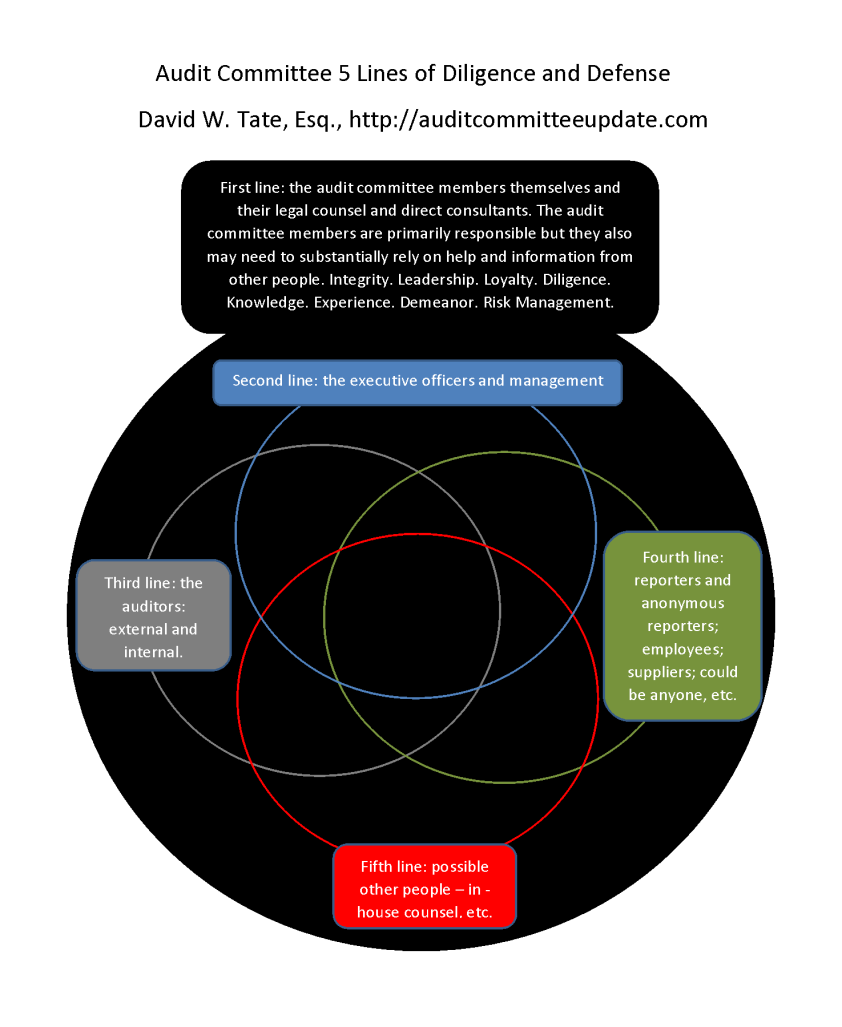
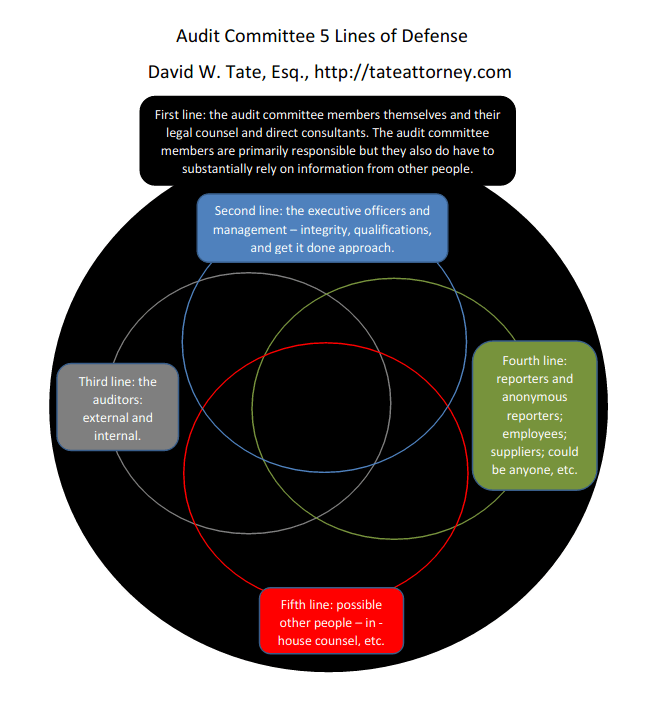
Audit Committee 5 Lines of Defense 07182016


DTatePicture_Square

Top Ten Mistakes Startups Make – And How To Avoid Them – Royse Law Firm – You’ll Like This Webinar Video

The following is a link to a webinar by the Royse Law Firm about the top 10 mistakes that startups make and how to avoid them. This is an excellent webinar, full of useful information. I view the webinar from a risk management perspective, and from a litigation perspective as mistakes do tend to lead to litigation. Enjoy. Click on the following arrow for the webinar video:


Dave Tate, Esq. San Francisco and California. See also Tate’s Excellent Audit Committee Guide updated January 2016, Tate’s Excellent Audit Committee Guide 01032016 with Appendix A Final

Audit Committee 5 Lines of Defense 07182016

DTatePicture_Square

Audit Committee 5 Lines of Diligence and Defense – It’s the People

Audit Committee 5 Lines of Defense 07182016

Really Massive Changes in Accounting, Auditing, Reporting and Communicating – The End Of Accounting?

Although I practice as an attorney, I previously practiced as a CPA and I have experienced several times over the years when there were significant changes occurring in the accounting practice and profession. But right now, I believe that I am witnessing multiple massive changes that have been long in the making. The following is a link to an Accounting Today article which does a pretty good job of discussing some of the changes, and also includes a question whether this is the end of accounting – click on the following link, CLICK HERE

It’s not like these changes are screaming at you in the headlines, but the cumulative effect is significant, new changes are continuing and will continue, and perhaps more important, the reasons for the changes are permanent.

For a long, long time the value of the audit and of the audit report have been questioned.

For a long, long time, the value of the information provided by an accounting that is prepared in conformity with generally accepted accounting principles has been questioned.

Different stakeholders also have different needs, and speed at which the flow of information is needed and expected is ever-increasing. Audited financial statements, for example, don’t tell you very much about the future investment or business generating value of the entity or of the transactions reported, or of the risks that are associated.

So now, for example, in addition to GAAP accounting we have non-GAAP accounting and reporting, we are seeing an increased ability to audit all transactions by computer software, GAAP is moving from the more detailed and specific rules based approach back to the more principles based approach that was in place when I first became a CPA, and non-GAAP measurements or criteria are becoming or should become more important such as some of the governance criteria (integrity, tone-at-the-top, culture, etc.), sustainability, transparency, risk management, and more emphasis on internal controls such as COSO.

However, I don’t agree with the suggestion or question in the title to the above linked article – it’s not the end of accounting. Traditional accounting serves a useful purpose – can you imagine what a free for all it would be without traditional accounting? There would be absolutely no checks or balances. There would be a “zero” reliability factor, and no comparability between different entities or industries.

But there is no question that the changes that have occurred and that continue to occur in accounting and auditing create both opportunities and risks for investors, financial institutions and other stakeholders, executive, financial, accounting and audit officers and professionals, boards, and audit and risk committees. The people who will excel are the people who will embrace and become expert in these changes. It’s a lifetime of learning to stay ahead and relevant.

Best to you. Dave Tate, Esq.

The following is a link to my Tate’s Excellent Audit Committee Guide, updated January 2016, CLICK HERE

Jail for Officers’ Alleged Failure to Ensure Food Product Safety

The new Eighth Circuit decision in U.S. v. DeCoster, discussing the responsible corporate officer doctrine, is an important case for corporate officers, managing agents and board members as the Eighth Circuit upheld jail time for the corporate officers’ alleged failure to ensure the safety of food that was sold to the public (i.e., egg safety, and salmonella).

In addition to typical criminal wrongdoing, for some time corporate and corporate officer criminal punishment, including jail time, has been expanded to include situations of environmental contamination (representing potentially an injury to the environment and also to public health).

The DeCoster case reflects a continuing march toward expanding possible corporate and corporate officer criminal punishment, including jail time, for injury to public physical health (in this case, food safety), even when there is a lack of evidence of the corporate officer’s actual and direct wrongdoing. In summary, in these cases the criminal wrongdoing arises from the corporate officer’s executive or managing agent status or standing and authority, and his or her alleged failure to sufficiently ensure the safety of the product (food) that is sold by the corporation or business to the general public. The following is a link to a good discussion of the case on the D & O Diary, CLICK HERE.  Obviously the implications are important for general public product and service providers, particularly those that offer products or services that could cause or involve a resulting injury to the physical health of the public.

Best, Dave Tate, Esq. (San Francisco)

Audit Committee of the Future – From the CAQ

Below is a link to a paper by the Center for Audit Quality entitled The Audit Committee of the Future. Although the discussion paper is a disappointment (too basic, and lack of meaningful insight) as the CAQ usually has worthwhile materials, in the list of five ways to enhance the audit committee, I thought that one of the five ways is worth noting for its subject matter (but again, not for the discussion insight). The following is the discussion about fostering robust communication and engagement:

“Fostering robust communication and engagement: In addition to enhancing communication with investors and other parties via disclosure, panelists agreed that audit committees need to focus strongly on developing healthy channels of internal communication. “That’s an important skill set for the chairman of the audit committee,” said one, “how to make sure you’re having those periodic meetings outside the boardroom with the auditor, with the internal auditor, with the CFO, with the controller.” Of course, the onus on fostering communication does not fall on the audit committee chair alone. “It’s important to have all parties around the table fully engaged,” said one participant. Others emphasized the need for external auditors to engage in dialogue, particularly if a sense emerges that the audit committee is not asking the right questions. “You need an audit firm to speak up,” said a panelist.”

Obviously the above comments can be expanded upon greatly, including, for example, discussions about agenda setting, risk management and internal controls, critical decision making processes, investigations, and follow up.

Here is a link to the CAQ paper

Click to access caq_insights_audit_committee_future.pdf

And the following is a link to Tate’s Excellent Audit Committee Guide, updated January 2016. Enjoy. CLICK HERE FOR THE POST CONTAINING A LINK TO THE AUDIT COMMITTEE GUIDE

Best, Dave Tate, Esq., San Francisco and California, http://auditcommitteeupdate.com

Audit Committee 5 Lines of Defense 02132016 David W. Tate, Esq.

DTatePicture_Square

Auditors – Derivatives – Auditing v. Risk Management, Big Difference – Reporting v. Evaluation

I have been reading an email thread by some very good auditors and risk management professionals. It struck a chord with me. The discussion was about derivatives in general.

One participant posted recent comments or possible comments by Warren Buffett about the difficulties of evaluating derivative transactions and banks and companies that hold derivative contracts or instruments.

Another participant differentiated auditing and risk management in the context of derivatives – stating that the external auditor audits to determine whether the derivative transaction has been properly accounted for within the context of generally accepted accounting principles.

But the auditor’s clean opinion really doesn’t tell management, or the board, or the audit committee, or the investor how the derivative will behave or react in different situations, or the risk associated with the derivative. Of course, that audit weakness also is true with respect to all audited transactions – the auditor is only telling you that within GAAP and GAAS, and the determined level of materiality, the transactions have been properly recorded. Although proper accounting is important, the risk associated is equally and perhaps more important.

A few of my other posts have discussed derivatives – here is a link to a post about derivatives and audit committees http://wp.me/p75iWX-h.

And, as audit committees have oversight of risk management or certain aspects of risk management (which is too vague of a term (i.e., risk management), and lacking in specifics for my liking, see also http://wp.me/p75iWX-1F re risk management, audit committees, and AC charters ), as an audit committee member should you evaluate whether you and your committee, and management, are sufficiently on top of the derivative issue and the risks that they might present to your entity and its shareholders, and to you and your reputation? I’m not anti-derivative – they can be helpful and prudent – I’m simply saying that as part of your oversight and diligence you should consider whether you and your organization are sufficiently on top of the issue and understand the risks that the different derivative instruments and transactions present.

And here is a link to my audit committee guide, updated January 2016, http://wp.me/p75iWX-q

Thanks for reading. Dave Tate, Esq. (San Francisco/California)

DTatePicture_Square


Extra Protection for Independent Directors: Wealth Security Policy | Woodruff-Sawyer & Co.

A question that often comes up for independent directors at public companies, private companies and even nonprofits is: What happens if the company has nothing left to protect me? Maybe …

Click on the following link for the full article: wsandco.com

Dave Tate, Esq. comment – a very important topic for audit committee members and independent directors, from Priya Cherian Huskins at Woodruff-Sawyer. Enjoy. Dave Tate, Esq., San Francisco and throughout California – see also my blog for a link to Tate’s Excellent Audit Committee Guide, updated January 2016.