Updated Tate’s Excellent Audit Committee Guide – Attached – Use It – Pass It Along – Free

Below is a link to my updated Tate’s Excellent Audit Committee Guide (updated October 20, 2016). Please use it, and pass it to other people who would be interested, such as audit committee members, directors, officers, accountants, internal and external auditors, in-house counsel, compliance professionals, and other people.

I do note that as I was updating these materials, and going through the entire Guide, it definitely hit me that all of the specifically enacted statutes, regulations, rules and pronouncements definitely could cause an audit committee member to not be able to see the forest for the tress. So let’s also not forget to look at the situation as a whole.

Although the Guide is 186 pages, I do expect some significant updates soon, and perhaps prior to the end of 2016. Many of the updates will be posted to this blog first, and then to the Guide. I am looking forward to the COSO enterprise risk management (ERM) updated framework.

Best to you. Dave Tate, Esq., San Francisco and California.

Here is a link to the updated Tate’s Excellent Audit Committee Guide (updated October 20, 2016), tates-excellent-audit-committee-guide-10202016-final-with-appendix-a

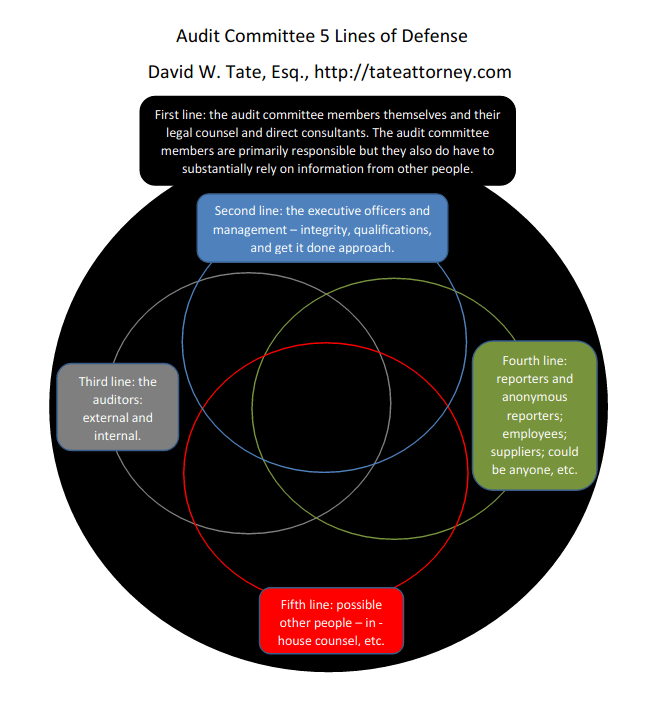
Audit Committee 5 Lines of Defense 07182016

The business judgment rule – an animated video:


DTatePicture_Square

Forwarding a worthwhile paper discussing objective based risk management

I am forwarding a link to a short article by Tim Leech and Lauren Hanlon discussing, as they say, Paradigm paralysis in ERM & internal audit. I am providing you with this article because of the discussion between risk management that first and primarily identifies risk, and one that first starts with the objectives of the enterprise, and then follows with the risks to those objectives.

You might also be aware that soon, perhaps next month in September, COSO will be making available its eagerly awaited ERM update, which could be an important development.

Below is the link to the Leech/Hanlon paper (I do also note that they lost me a little with the sample summary report on the second page of the paper – I prefer reports that very easily speak for themselves – but I have found that sometimes professionals with Tim’s experience tend to write in a manner that is not always the most easy or simple to understand). This is a worthwhile paper – please read it.  Dave Tate, Esq., San Francisco and California.

Click to access Risk-Oversight-Solutions-Paradigm-Paralysis-in-ERM-IA-Tim-Leech-Lauren-Hanlon.pdf

Top Ten Mistakes Startups Make – And How To Avoid Them – Royse Law Firm – You’ll Like This Webinar Video

The following is a link to a webinar by the Royse Law Firm about the top 10 mistakes that startups make and how to avoid them. This is an excellent webinar, full of useful information. I view the webinar from a risk management perspective, and from a litigation perspective as mistakes do tend to lead to litigation. Enjoy. Click on the following arrow for the webinar video:


Dave Tate, Esq. San Francisco and California. See also Tate’s Excellent Audit Committee Guide updated January 2016, Tate’s Excellent Audit Committee Guide 01032016 with Appendix A Final

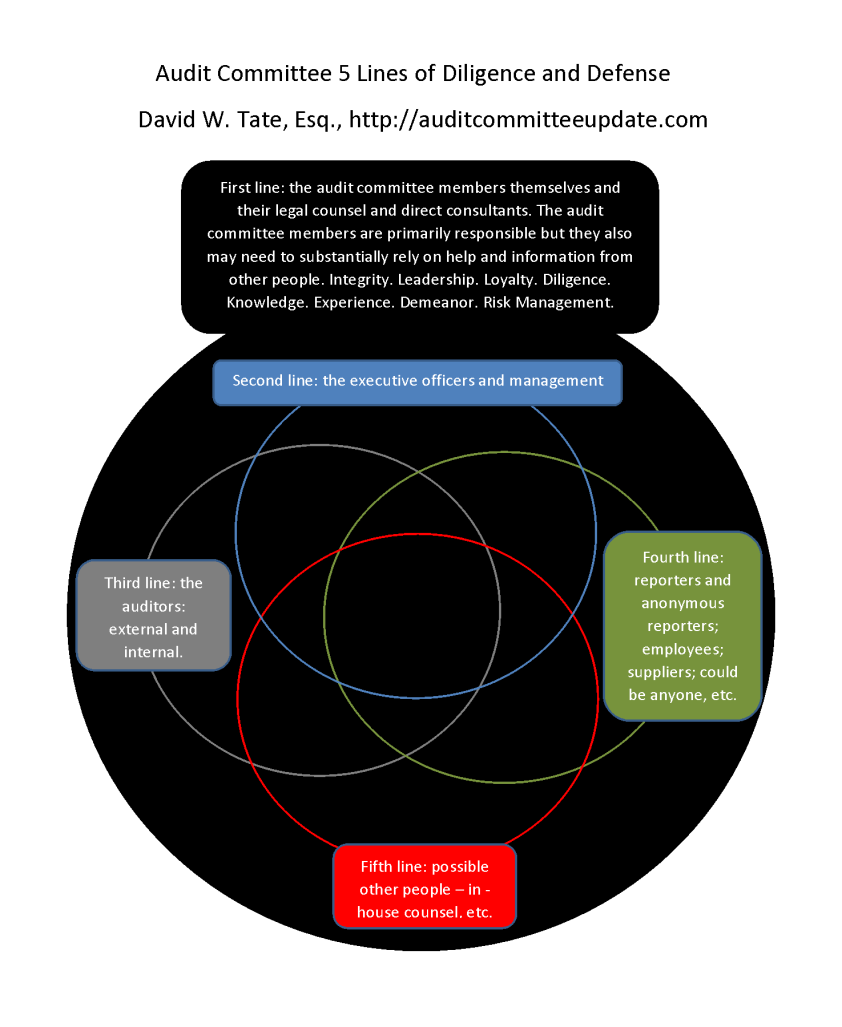
Audit Committee 5 Lines of Defense 07182016

DTatePicture_Square

Audit Committee of the Future – From the CAQ

Below is a link to a paper by the Center for Audit Quality entitled The Audit Committee of the Future. Although the discussion paper is a disappointment (too basic, and lack of meaningful insight) as the CAQ usually has worthwhile materials, in the list of five ways to enhance the audit committee, I thought that one of the five ways is worth noting for its subject matter (but again, not for the discussion insight). The following is the discussion about fostering robust communication and engagement:

“Fostering robust communication and engagement: In addition to enhancing communication with investors and other parties via disclosure, panelists agreed that audit committees need to focus strongly on developing healthy channels of internal communication. “That’s an important skill set for the chairman of the audit committee,” said one, “how to make sure you’re having those periodic meetings outside the boardroom with the auditor, with the internal auditor, with the CFO, with the controller.” Of course, the onus on fostering communication does not fall on the audit committee chair alone. “It’s important to have all parties around the table fully engaged,” said one participant. Others emphasized the need for external auditors to engage in dialogue, particularly if a sense emerges that the audit committee is not asking the right questions. “You need an audit firm to speak up,” said a panelist.”

Obviously the above comments can be expanded upon greatly, including, for example, discussions about agenda setting, risk management and internal controls, critical decision making processes, investigations, and follow up.

Here is a link to the CAQ paper

Click to access caq_insights_audit_committee_future.pdf

And the following is a link to Tate’s Excellent Audit Committee Guide, updated January 2016. Enjoy. CLICK HERE FOR THE POST CONTAINING A LINK TO THE AUDIT COMMITTEE GUIDE

Best, Dave Tate, Esq., San Francisco and California, http://auditcommitteeupdate.com

Audit Committee 5 Lines of Defense 02132016 David W. Tate, Esq.

DTatePicture_Square

New California Case Discussing Whether The Business Judgment Rule Defense Exists Where There Might Have Been A Breach Of A Duty That Was Required By Governance Document Provisions

I have linked below a pdf of a new California Appellate Court case (Palm Springs Villas II Homeowners Association, Inc. v. Erna Parth), discussing, under California law, whether the business judgment rule defense exists, at least for the purpose of a motion for summary judgment, when there is or might be evidence that the defendant director or officer did not satisfy duties required of her under the California statutory business judgment rule and entity governance document provisions. The decision is important for several reasons, at least including, that the decision, whether or not you agree with it, is well-written and contains good discussions about the requirements on a motion for summary judgment and other cases discussing the applicability of the California statutory business judgment rule and the related defense, and the decision should apply to both California corporate and nonprofit entities, and possibly also to California partnerships, unincorporated association entities, and religious entities.

In other words, if you are a California entity director or officer, you should read this decision, which will help to explain some of your duties and responsibilities, and that limitations might apply to your business judgment rule defense. And I should also say that it really should not come as a surprise that a California Appellate Court could hold that the business judgment rule defense might not apply in an appropriate factual situation where there might be evidence for example that a director or officer might not have sufficiently satisfied due diligence, investigation or authorization requirements prior to taking actions, even if there is no evidence of intentional wrongdoing or neglect.

Click on the following link for a pdf of the appellate decision in Palm Springs Villas II Homeowners Association, Inc. v. Parth, Palm Springs Villas v. Parth – discussing the business judgment rule defense in light of possible violations of governance documents – California law

You can also see similar discussions and issues in various cases out of Delaware and under the federal securities laws. Directors and officers really need to understand and satisfy the business judgment rule in addition to other duties, and understand and satisfy the applicable provisions that are in governance documents such as by-laws, charters and CC&Rs. You will find a further discussion about the business judgment rule in my detailed Tate’s Excellent Audit Committee Guide, updated January 2016, which you can view and print if you wish from the following blog post, at no cost and without having to provide any information about yourself – click on the following link for the post containing the link to the guide CLICK HERE

Best to you, Dave Tate, Esq., San Francisco Bay Area and throughout California

DTatePicture_SquareAudit Committee 5 Lines of Defense 02132016 David W. Tate, Esq.

What Insight Do Audit Committees Receive From Internal Audit – Not Enough Or Much – KPMG Survey

What insight to audit committees receive from IA

The above chart is from a new KPMG survey of audit committee chairs and CFOs. You can find the survey at

Click to access GM-OTS-1653_SeekingValueThrough_IAB_V1.pdf

.

The survey and the above chart identify ongoing challenges for internal audit to provide and prove enough value to audit committee members and CFOs. It is well-documented that these challenges have existed for years – basically forever. But let’s not over generalize – one size doesn’t fit all, and certainly there are internal audit functions that are up-to-speed and that are providing good value.

If there is a problem in this area, you must also ask the audit committee members, not just the audit committee chair but also the individual members who aren’t the chair, why they aren’t getting the information that they need from internal audit? There’s either a lack of common understanding, and that lack of understanding might also be the fault of the audit committee members if they are not expressing themselves sufficiently, or there is a problem with the internal audit function, or its funding, or the qualifications of its members. In theory, it also is possible that the audit committee or the CFO simply are asking internal audit to perform a task or to provide information that is unreasonable; however, that is like saying “I can’t do that for you,” which of course is a very bad approach.

You can also see Tate’s Excellent Audit Committee Guide (updated January 3, 2016), at http://wp.me/p75iWX-q

Dave Tate, Esq., San Francisco and California, http://auditcommitteeupdate.com

Audit Committee 5 Lines of Defense 02132016 David W. Tate, Esq.

DTatePicture_Square

Internal Auditors Not Giving Enough Risk Insights

CFOs and audit committee chairs are not getting enough insights into corporate risk management from their companies internal audit function, according to a new survey.

Click on the following link for the article: www.accountingtoday.com

Dave Tate, Esq. comment. The results of this survey really shouldn’t be surprising. There isn’t even agreement on what risk management is or a recommended process.

Risk management is a collaborative effort. If I’m on a board risk committee or on audit committee that has been delegated initial risk management oversight, yes, I’m going to request and expect executive management and internal audit to not only provide comments and evaluations about risk management, and also about the processes that are being used, and that should be updated and used.

However, as a risk or audit committee member, I’m also going to provide my comments about what I need to see and receive in that regard so that I am comfortable that what I am receiving allows me to perform my oversight responsibilities. Okay, so if internal audit isn’t giving enough risk insight as the article indicates, why is that, and what must be done to correct that dynamic? Those are questions that the risk or audit committee members must ask and act upon to satisfy their responsibilities as required by the business judgment rule, statutes, regulations, rules and the committee charter.

How Can Internal Audit Support the Growing Responsibilities of the Audit Committee?

Recent 2015 audit surveys report some interesting findings about the current role of audit committees. They highlight not only how complex the world of risk management and oversight has become in the corporate world, but also the enormous breadth of responsibilities that the audit committee is expected to bear.

Click on the following link for the article: corporatecomplianceinsights.com

Dave Tate, Esq. comments: although this is a very brief article, the topics and issues listed are large and complex. The article also offers no help at resolution. But, these issues are here to stay for boards and audit committees. Every internal audit function is different – some are qualified or partially qualified to help with these issues, whereas some are not. For some additional information, see Tate’s Excellent Audit Committee Guide (January 3, 2016, version, 183 pages) at http://wp.me/p75iWX-q.


Best. Dave Tate, Esq. (San Francisco and California. See also my other blog re trust, estate, conservatorship, power of attorney and elder abuse litigation and contentious administrations at http://californiaestatetrust.com, and my website at http://tateattorney.com.

Do You Have a Contrarian on Your Team?

A divergent opinion can lead to more creative and better decisions.

Click on the following for the article: www.gsb.stanford.edu

Dave Tate, Esq. comments – good for thought – every board and management situation is different anyway – but also, did anyone say that there shouldn’t be or can’t be contrarian views on a board or committee? Look at the business judgment rule – there’s nothing there about all having to agree. One vote per person. My website: http://tateattorney.com.

Audit Committee 5 Lines of Defense

Audit Committee 5 Lines of Defense 02132016 David W. Tate, Esq.