PCAOB Rules to Improve Transparency by Disclosing Engagement Partner Name and Information about Other Audit Firms are Approved by SEC

Short and brief, the following is a link to the PCAOB site if you want to read more about this new change (Click Here), but in truth, I just don’t see why this took so much effort and time to approve. I don’t see this as a big deal. Do you? Am I missing something? In any event, I’m passing this along.

Best, Dave Tate, Esq. (San Francisco / California)

Auditors – Derivatives – Auditing v. Risk Management, Big Difference – Reporting v. Evaluation

I have been reading an email thread by some very good auditors and risk management professionals. It struck a chord with me. The discussion was about derivatives in general.

One participant posted recent comments or possible comments by Warren Buffett about the difficulties of evaluating derivative transactions and banks and companies that hold derivative contracts or instruments.

Another participant differentiated auditing and risk management in the context of derivatives – stating that the external auditor audits to determine whether the derivative transaction has been properly accounted for within the context of generally accepted accounting principles.

But the auditor’s clean opinion really doesn’t tell management, or the board, or the audit committee, or the investor how the derivative will behave or react in different situations, or the risk associated with the derivative. Of course, that audit weakness also is true with respect to all audited transactions – the auditor is only telling you that within GAAP and GAAS, and the determined level of materiality, the transactions have been properly recorded. Although proper accounting is important, the risk associated is equally and perhaps more important.

A few of my other posts have discussed derivatives – here is a link to a post about derivatives and audit committees http://wp.me/p75iWX-h.

And, as audit committees have oversight of risk management or certain aspects of risk management (which is too vague of a term (i.e., risk management), and lacking in specifics for my liking, see also http://wp.me/p75iWX-1F re risk management, audit committees, and AC charters ), as an audit committee member should you evaluate whether you and your committee, and management, are sufficiently on top of the derivative issue and the risks that they might present to your entity and its shareholders, and to you and your reputation? I’m not anti-derivative – they can be helpful and prudent – I’m simply saying that as part of your oversight and diligence you should consider whether you and your organization are sufficiently on top of the issue and understand the risks that the different derivative instruments and transactions present.

And here is a link to my audit committee guide, updated January 2016, http://wp.me/p75iWX-q

Thanks for reading. Dave Tate, Esq. (San Francisco/California)

DTatePicture_Square


New 9-Page Letter Guidance From The US DoJ On FCPA Enhanced Enforcement, Self-Reporting And Cooperation

The following is a link to a new 9-page letter from the US Department of Justice providing guidance about enhanced Foreign Corrupt Practices Act enforcement, self-reporting, and the actions that are necessary for individuals and businesses to obtain cooperation status. The letter is only 9-pages – in this post I’m not going to summarize the letter because you can (and should) read the letter in about the same amount of time. Audit committee members need to read and understand this letter, and then be sure that the company has proper policies and procedures in place.

Here is the letter, April 5, 2016, US Dept. of Justice New FCPA Enforcement Plan and Guidance, and https://www.justice.gov/opa/file/838386/download.

Enjoy. Dave Tate, Esq. (San Francisco/California), and see also Tate’s Excellent Audit Committee Guide at Tate’s Excellent Audit Committee Guide 01032016 with Appendix A Final

Who Acts For The Board Of Directors On Arranging D&O Coverage – A Disturbing Discussion

The following is a link to a short, disturbing video discussion about D&O insurance coverage, who arranges that coverage, and the director’s input into that process and purchase. If this is the typical after-the-fact scenario . . . CLICK HERE FOR THE VIDEO DISCUSSION AND THEN CLICK ON THE VIDEO START BUTTON

Who speaks for the board on D&O coverage

New Governance Guidance Stretches Thinking on Ethics, Risk, and More

​The King IV draft code has much to say about governance, risk management, compliance, and assurance. Click on the following link for the discussion by Norman Marks and see my comments below: iaonline.theiia.org

This article by Norman Marks discusses parts of the new King IV code that concentrate on culture, ethics and risk. It’s interesting for thought with respect to your own organization. It is and has been long well-known that all three corporate areas, culture, ethics and risk management, are instrumental to business performance and legal compliance.

And although these areas are discussed, and significant strides have been made in or discussed about risk management during the past couple of years, there still are no universally recognized standards or criteria to evaluate or audit how the business is doing in these areas.

I have long been surprised that the auditing professions, external and internal, have not jumped on these areas and also governance.

See also Tate’s Excellent Audit Committee Guide at CLICK HERE

Best, Dave Tate, Esq. (San Francisco and California), http://auditcommitteeupdate.com, http://californiaestatetrust.com, http://tateattorney.com

DTatePicture_Square

The Kroll 2016 Anti-Bribery And Corruption Report – Worthwhile Reading for D&O And Audit Committees

Below are a couple of snapshots from the Kroll 2016 Anti-Bribery and Corruption Report. The Report is worthwhile reading for audit committees, officers, directors and corporate counsel if for no other reason than to jog the thought process. The Report is 36 pages, but the below snapshots, for example, should by themselves prompt some diligence and compliance thoughts. Below the snapshots I have provided a link to the Report, along with a link to Tate’s Excellent Audit Committee Guide.

Kroll 2016 Anti-Bribery and Corruption Report Slide 1

Kroll 2016 Anti-Bribery and Corruption Report Slide 2

Kroll 2016 Anti-Bribery and Corruption Report Slide 3

The following page from Kroll contains a link to the full report – you don’t need to provide any additional information, simply click the link on the page, http://www.kroll.com/en-us/intelligence-center/press-releases/2016-anti-bribery-corruption-report-Toronto

See also Tate’s Excellent Audit Committee Guide, updated January 3, 2016, at http://wp.me/p75iWX-q

Dave Tate, Esq., San Francisco and California

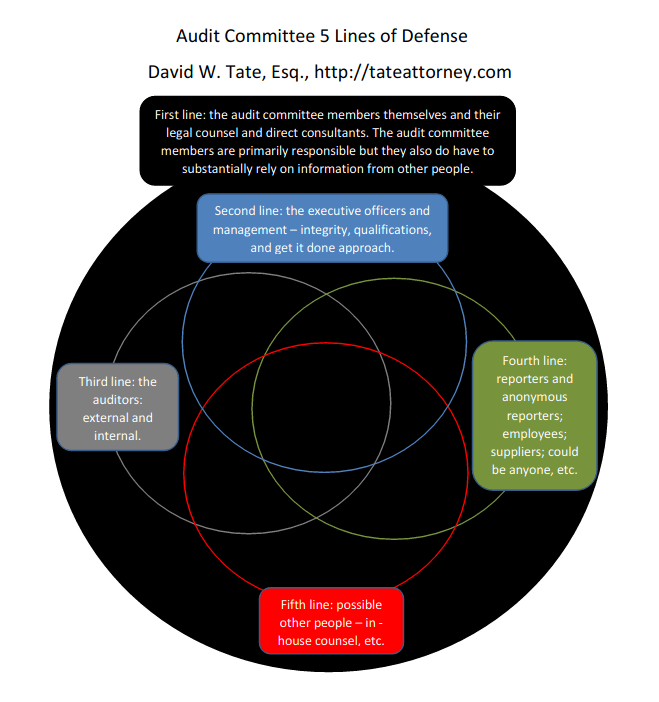
Audit Committee 5 Lines of Defense 02132016 David W. Tate, Esq.


DTatePicture_Square

What Insight Do Audit Committees Receive From Internal Audit – Not Enough Or Much – KPMG Survey

What insight to audit committees receive from IA

The above chart is from a new KPMG survey of audit committee chairs and CFOs. You can find the survey at

Click to access GM-OTS-1653_SeekingValueThrough_IAB_V1.pdf

.

The survey and the above chart identify ongoing challenges for internal audit to provide and prove enough value to audit committee members and CFOs. It is well-documented that these challenges have existed for years – basically forever. But let’s not over generalize – one size doesn’t fit all, and certainly there are internal audit functions that are up-to-speed and that are providing good value.

If there is a problem in this area, you must also ask the audit committee members, not just the audit committee chair but also the individual members who aren’t the chair, why they aren’t getting the information that they need from internal audit? There’s either a lack of common understanding, and that lack of understanding might also be the fault of the audit committee members if they are not expressing themselves sufficiently, or there is a problem with the internal audit function, or its funding, or the qualifications of its members. In theory, it also is possible that the audit committee or the CFO simply are asking internal audit to perform a task or to provide information that is unreasonable; however, that is like saying “I can’t do that for you,” which of course is a very bad approach.

You can also see Tate’s Excellent Audit Committee Guide (updated January 3, 2016), at http://wp.me/p75iWX-q

Dave Tate, Esq., San Francisco and California, http://auditcommitteeupdate.com

Audit Committee 5 Lines of Defense 02132016 David W. Tate, Esq.

DTatePicture_Square

Extra Protection for Independent Directors: Wealth Security Policy | Woodruff-Sawyer & Co.

A question that often comes up for independent directors at public companies, private companies and even nonprofits is: What happens if the company has nothing left to protect me? Maybe …

Click on the following link for the full article: wsandco.com

Dave Tate, Esq. comment – a very important topic for audit committee members and independent directors, from Priya Cherian Huskins at Woodruff-Sawyer. Enjoy. Dave Tate, Esq., San Francisco and throughout California – see also my blog for a link to Tate’s Excellent Audit Committee Guide, updated January 2016.

Fuzzy-Math Accounting Gets Fresh SEC Scrutiny

It’s generally accepted that a lot of accounting isn’t, well, generally accepted . . . click on the following link for the article: www.accountingtoday.com

Dave Tate, Esq. comments. Fuzzy-math v. fuzzy-reporting v. fuzzy-presentation v. fuzzy-accounting?  I don’t necessarily agree with the “fuzzy” or that “a lot of accounting isn’t, well, generally accepted.” Viewing the issue as an attorney, CPA and audit committee member, each situation must be evaluated on a case-by-case basis. If the rules aren’t absolute, or are vague, discretionary or subject to interpretation, you are going to have these differences, and it doesn’t mean that the company did anything wrong – it might simply mean that the SEC has a viewpoint that is different than the company and the company’s external auditor. The accounting/auditing pronouncement authorities are shifting to a more “principles” based accounting approach, and away from some of the exact rules. I have previously commented that this “principles” based approach, which was the approach at the time when I first became a CPA, also may lead to more uncertainty and discretion. Most likely these situations will be increasing in numbers.