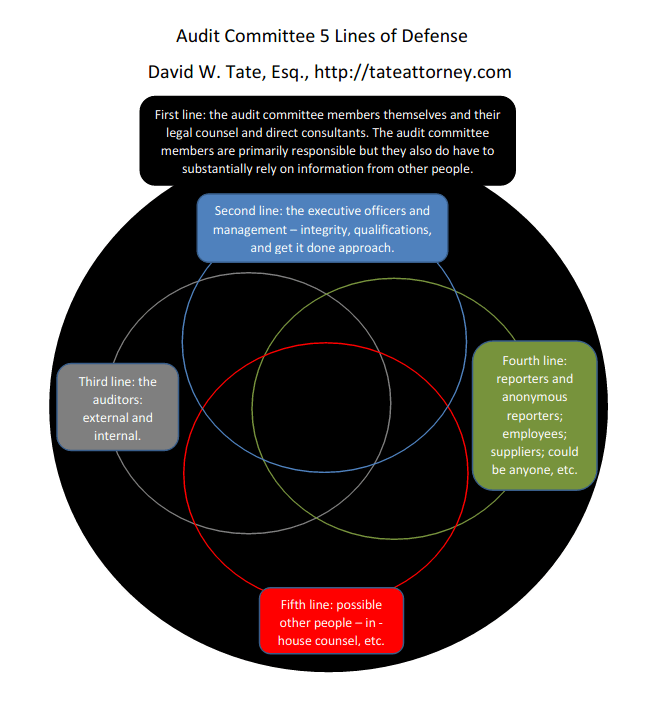
Audit Committee 5 Lines of Diligence and Defense – It’s the People

Audit Committee 5 Lines of Defense 07182016

Really Massive Changes in Accounting, Auditing, Reporting and Communicating – The End Of Accounting?

Although I practice as an attorney, I previously practiced as a CPA and I have experienced several times over the years when there were significant changes occurring in the accounting practice and profession. But right now, I believe that I am witnessing multiple massive changes that have been long in the making. The following is a link to an Accounting Today article which does a pretty good job of discussing some of the changes, and also includes a question whether this is the end of accounting – click on the following link, CLICK HERE

It’s not like these changes are screaming at you in the headlines, but the cumulative effect is significant, new changes are continuing and will continue, and perhaps more important, the reasons for the changes are permanent.

For a long, long time the value of the audit and of the audit report have been questioned.

For a long, long time, the value of the information provided by an accounting that is prepared in conformity with generally accepted accounting principles has been questioned.

Different stakeholders also have different needs, and speed at which the flow of information is needed and expected is ever-increasing. Audited financial statements, for example, don’t tell you very much about the future investment or business generating value of the entity or of the transactions reported, or of the risks that are associated.

So now, for example, in addition to GAAP accounting we have non-GAAP accounting and reporting, we are seeing an increased ability to audit all transactions by computer software, GAAP is moving from the more detailed and specific rules based approach back to the more principles based approach that was in place when I first became a CPA, and non-GAAP measurements or criteria are becoming or should become more important such as some of the governance criteria (integrity, tone-at-the-top, culture, etc.), sustainability, transparency, risk management, and more emphasis on internal controls such as COSO.

However, I don’t agree with the suggestion or question in the title to the above linked article – it’s not the end of accounting. Traditional accounting serves a useful purpose – can you imagine what a free for all it would be without traditional accounting? There would be absolutely no checks or balances. There would be a “zero” reliability factor, and no comparability between different entities or industries.

But there is no question that the changes that have occurred and that continue to occur in accounting and auditing create both opportunities and risks for investors, financial institutions and other stakeholders, executive, financial, accounting and audit officers and professionals, boards, and audit and risk committees. The people who will excel are the people who will embrace and become expert in these changes. It’s a lifetime of learning to stay ahead and relevant.

Best to you. Dave Tate, Esq.

The following is a link to my Tate’s Excellent Audit Committee Guide, updated January 2016, CLICK HERE

Jail for Officers’ Alleged Failure to Ensure Food Product Safety

The new Eighth Circuit decision in U.S. v. DeCoster, discussing the responsible corporate officer doctrine, is an important case for corporate officers, managing agents and board members as the Eighth Circuit upheld jail time for the corporate officers’ alleged failure to ensure the safety of food that was sold to the public (i.e., egg safety, and salmonella).

In addition to typical criminal wrongdoing, for some time corporate and corporate officer criminal punishment, including jail time, has been expanded to include situations of environmental contamination (representing potentially an injury to the environment and also to public health).

The DeCoster case reflects a continuing march toward expanding possible corporate and corporate officer criminal punishment, including jail time, for injury to public physical health (in this case, food safety), even when there is a lack of evidence of the corporate officer’s actual and direct wrongdoing. In summary, in these cases the criminal wrongdoing arises from the corporate officer’s executive or managing agent status or standing and authority, and his or her alleged failure to sufficiently ensure the safety of the product (food) that is sold by the corporation or business to the general public. The following is a link to a good discussion of the case on the D & O Diary, CLICK HERE.  Obviously the implications are important for general public product and service providers, particularly those that offer products or services that could cause or involve a resulting injury to the physical health of the public.

Best, Dave Tate, Esq. (San Francisco)

Audit Committee of the Future – From the CAQ

Below is a link to a paper by the Center for Audit Quality entitled The Audit Committee of the Future. Although the discussion paper is a disappointment (too basic, and lack of meaningful insight) as the CAQ usually has worthwhile materials, in the list of five ways to enhance the audit committee, I thought that one of the five ways is worth noting for its subject matter (but again, not for the discussion insight). The following is the discussion about fostering robust communication and engagement:

“Fostering robust communication and engagement: In addition to enhancing communication with investors and other parties via disclosure, panelists agreed that audit committees need to focus strongly on developing healthy channels of internal communication. “That’s an important skill set for the chairman of the audit committee,” said one, “how to make sure you’re having those periodic meetings outside the boardroom with the auditor, with the internal auditor, with the CFO, with the controller.” Of course, the onus on fostering communication does not fall on the audit committee chair alone. “It’s important to have all parties around the table fully engaged,” said one participant. Others emphasized the need for external auditors to engage in dialogue, particularly if a sense emerges that the audit committee is not asking the right questions. “You need an audit firm to speak up,” said a panelist.”

Obviously the above comments can be expanded upon greatly, including, for example, discussions about agenda setting, risk management and internal controls, critical decision making processes, investigations, and follow up.

Here is a link to the CAQ paper

Click to access caq_insights_audit_committee_future.pdf

And the following is a link to Tate’s Excellent Audit Committee Guide, updated January 2016. Enjoy. CLICK HERE FOR THE POST CONTAINING A LINK TO THE AUDIT COMMITTEE GUIDE

Best, Dave Tate, Esq., San Francisco and California, http://auditcommitteeupdate.com

Audit Committee 5 Lines of Defense 02132016 David W. Tate, Esq.

DTatePicture_Square

GAO – A Framework for Managing Fraud Risks in Federal Programs

A friend forwarded this to me – the GAO July 2015, materials “A Framework for Managing Fraud Risks in Federal Programs.” If you, and your executive officers, board and audit and risk committees are not up on these materials, and if you have involvement in federal programs or funding, now would be a good time to read this. But I also have to wonder if the federal government itself follows this framework? Immediately below is a snapshot of the first page of the materials, and then I have provided a link to the full materials just below the snapshot. Dave Tate, Esq.

GAO - A Framework for Managing Fraud Risks in Federal Programs

Click on the following link for the full materials: CLICK HERE

New California Case Discussing Whether The Business Judgment Rule Defense Exists Where There Might Have Been A Breach Of A Duty That Was Required By Governance Document Provisions

I have linked below a pdf of a new California Appellate Court case (Palm Springs Villas II Homeowners Association, Inc. v. Erna Parth), discussing, under California law, whether the business judgment rule defense exists, at least for the purpose of a motion for summary judgment, when there is or might be evidence that the defendant director or officer did not satisfy duties required of her under the California statutory business judgment rule and entity governance document provisions. The decision is important for several reasons, at least including, that the decision, whether or not you agree with it, is well-written and contains good discussions about the requirements on a motion for summary judgment and other cases discussing the applicability of the California statutory business judgment rule and the related defense, and the decision should apply to both California corporate and nonprofit entities, and possibly also to California partnerships, unincorporated association entities, and religious entities.

In other words, if you are a California entity director or officer, you should read this decision, which will help to explain some of your duties and responsibilities, and that limitations might apply to your business judgment rule defense. And I should also say that it really should not come as a surprise that a California Appellate Court could hold that the business judgment rule defense might not apply in an appropriate factual situation where there might be evidence for example that a director or officer might not have sufficiently satisfied due diligence, investigation or authorization requirements prior to taking actions, even if there is no evidence of intentional wrongdoing or neglect.

Click on the following link for a pdf of the appellate decision in Palm Springs Villas II Homeowners Association, Inc. v. Parth, Palm Springs Villas v. Parth – discussing the business judgment rule defense in light of possible violations of governance documents – California law

You can also see similar discussions and issues in various cases out of Delaware and under the federal securities laws. Directors and officers really need to understand and satisfy the business judgment rule in addition to other duties, and understand and satisfy the applicable provisions that are in governance documents such as by-laws, charters and CC&Rs. You will find a further discussion about the business judgment rule in my detailed Tate’s Excellent Audit Committee Guide, updated January 2016, which you can view and print if you wish from the following blog post, at no cost and without having to provide any information about yourself – click on the following link for the post containing the link to the guide CLICK HERE

Best to you, Dave Tate, Esq., San Francisco Bay Area and throughout California

DTatePicture_SquareAudit Committee 5 Lines of Defense 02132016 David W. Tate, Esq.

Director (Prudent) Note Taking, Discouraged or Not – Forward From Woodruff-Sawyer and Priya Cherian Huskins With Comments

Here is a link to a good discussion by Priya Cherian Huskins, Esq. at Woodruff-Sawyer about director note taking (not minute taking, but note taking), which can also apply to note taking in general in many situations, CLICK HERE. I agree with Ms. Huskins.

There should be policies and procedures or guidelines to be followed, but a director should be allowed to take notes, and should not be told that he or she cannot take notes. It is a matter of the director performing his or her oversight function in the manner that he or she believes is prudent and necessary. If I was told that as a director or audit committee member that I could not take notes that I thought were necessary and helpful to me and my oversight, I would question that instruction or request, and consider declining the position if it was forced.

Best, Dave Tate, Esq. (San Francisco/California)

PCAOB Proposes Significant Changes to the Audit Report – From PWC

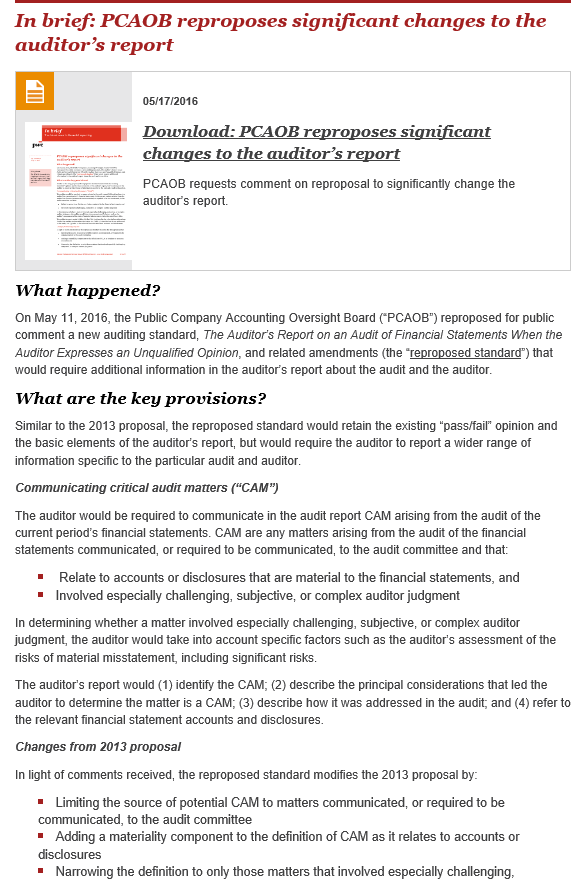
The PCAOB has again proposed changes to the standard audit report in which the PCAOB proposes that the report disclose additional information, for example about communications to the audit committee and about judgment or estimate related issues. Here is the link to a discussion by PWC, CLICK HERE. Comments about the proposal are due by August 2016.

This is a modified version of a prior PCAOB proposal. I’m not particularly convinced that the proposal requires a detailed discussion by me at this time as, similar to legislation, the proposal will change over time and whether or not it will ever be enacted is uncertain. However, given that this is a second serious attempt to enact a change in the audit report for audits performed and that are subject to PCAOB oversight, I must believe that this attempt will have an increased chance of being enacted.

I continue to believe that the current audit report suffers from significant limitations that reduce or limit its usefulness and relevancy for investors. I question the number of audits that would be performed if not for the statutory requirement? And we are seeing other efforts to increase discussions and disclosures that are thought to be useful to investors, such as the activities of the Sustainability Accounting Standards Board and other activities by the PCAOB.

In general, these activities also should benefit the external and internal audit professions as they will make their activities even more relevant, and also likely increase their workload.

One other thought: where are audit committees on this? I believe that in general they should support these efforts: on the one hand these activities might increase audit committee complexity and workload, but on the other hand, as the audit committee is significantly dependent on information that is provided by other people (because the audit committee is not involved in the day-to-day activities of the business, and its role is diligent and informed “oversight”), this information and these disclosures tend to provide the audit committee with additional information that might help in the audit committee member’s oversight effectiveness.

Best, Dave Tate, Esq. (San Francisco/California), and here is a link to my audit committee guide, CLICK HERE

PCAOB proposes changes to audit report

Third-Party Risks and Internal Audit – and Bring in Legal

The following is a link to a short video discussion about auditing third-party risks from the Institute of Internal Auditors, CLICK HERE FOR THE VIDEO.

The discussion is interesting for what it says, and what it doesn’t say. Of course it’s only a short video and does not purport to cover anywhere near the entire topic, and the video also is only part I. The discussion also focuses only on negative risks, e.g., the risk of negative catastrophe such as from cyber breach, but what about a more positive risk such as a resulting shortage of product materials because new product demand surpasses the highest estimates?

Internal audit and other people who are involved in third-party risk need to avoid working in silos. The video doesn’t mention the audit committee, or internal audit’s charter, or the involvement of legal counsel, for example. What about the risk of faulty or dangerous product produced or materials used by a third-party vendor? The discussion does touch on evaluating whether to end or terminate the contract with a third-party vendor – how does internal audit do that – bring in legal right?

In any event, I’m just using the video to prompt some discussions, which certainly was the intent of the video.

Best, Dave Tate, Esq. (San Francisco / California), and click on the following link for my audit committee guide – and please tell other people who would be interested, CLICK HERE FOR A BLOG POST WITH A LINK TO THE GUIDE – JUST CLICK THE LINK – YOU DON’T NEED TO PROVIDE ANY INFORMATION

Comments on the DoJ Fraud Section Plan and Guidance

Recently, on April 8, 2016, I wrote a post about the new DoJ Fraud Section’s Foreign Corrupt Practices Act Enforcement Plan and Guidance. Here is a link to that post and the Plan and Guidance CLICK HERE.

I did not at that time provide comments about the Plan and Guidance, which is only 9 pages in length. Whereas audit committees definitely should read and understand the Plan and Guidance, and take it into consideration for the purpose of pre-policies, processes and practices, and then also if an event or occurrence happens, my additional overview comments are as follows.

As you read through the Plan and Guidance, unfortunately I believe that you will find that for the most part it vaguely says that you should conduct an investigation of everything and everyone who might be relevant to the event or occurrence, that you should self report everything that you find (except for attorney-client information and materials, but of course the Fraud Section might argue about what qualifies as being attorney-client privileged), and that the Fraud Section will then consider what benefits it will grant, if any, to you for doing so. In that regard, I have to say that the Plan and Guidance is noncommittal, vague and overly broad, and might be considered heavy-handed, and as such isn’t particularly helpful or not nearly as helpful as it might have been.

The Plan and Guidance also only applies to the Fraud Section – thus, it does not apply to any of the other numbers of governmental entities, divisions, departments or sections that might also be looking into the event or occurrence. But, please do read and understand the Plan and Guidance anyway.

And the following is a link to my Excellent Audit Committee Guide – read it and pass it around, CLICK HERE.

Best, Dave Tate, Esq. (San Francisco/California)