Who Evaluates the Chief Audit Executive (CAE)?

At the bottom of this post is a screen shot from the new publication Ethics and Pressure, Balancing the Internal Audit Profession, published primarily from the 2015 global practitioner survey of internal auditors worldwide. This is a really big survey. What do you think of the screen shot? Is it appropriate for management to evaluate the chief audit executive (“CAE”)? I say “yes,” of course.

I note however, that the writer also says “Exhibit 9 indicates that this responsibility [i.e., the responsibility for evaluating the performance of the CAE] is generally split evenly between management and the board. The big exception is in North America, where 61% of CAE’s are formally evaluated by management. Often however, these evaluations are reviewed by an audit committee.”

Let me just say, and I read a fair amount of materials from or relating to the internal audit profession, these sentences from the writer probably speak volumes. Do you mean to say that the audit committee isn’t always also doing its own evaluation of internal audit? I really hope that’s not what the writer is saying.

If you are on an audit committee, do you evaluate the performance of the CAE and of the internal audit function (if you have an internal audit function)? I certainly hope so. I mean, regardless of how internal audit operates with management, as an audit committee member aren’t you interacting with internal audit also, and isn’t internal audit helping you to satisfy your due diligence responsibilities? If not, you really need to sit down and think about how the audit committee is using internal audit.

And, if you are an internal audit CAE or member, if the audit committee isn’t sufficiently interested in you to evaluate your performance and how you help or don’t help the audit committee, then you are really missing the boat with a significant entity (i.e., the audit committee) that you should be helping.

In fact, most of the materials that I read from internal audit miss the boat, in my opinion. Yes, management’s use and interaction with internal audit is very important, but the audit committee really should value and make use of the availability of internal audit to help the audit committee satisfy it’s duties. If this isn’t happening, both the audit committee and internal audit are missing out on a tremendous opportunity. It might also be argued that both are failing to satisfy their responsibilities.

Here’s the screen shot from the survey and discussion:

who-evaluates-the-cae

The FCPA Blog – Richard Bistrong: The dangerous charm of agents – a very well-written scenario

Below is a link to an article from The FCPA Blog (The Foreign Corrupt Practices Act Blog). The article discusses a hypothetical (or perhaps actual) scenario that can happen to any corporate representative on any day. The following is a copy and paste from the beginning of the article (to get you interested in reading the remainder):

“What is it about agents, fixers, and intermediaries that makes them so attractive while potentially toxic to multinationals?

If you haven’t spent extended time with them, it’s hard to understand.

So here’s what I shared last week at the FCPA Blog NYC Conference.

During our session called The Other Side of the Sting, Getting Stung, Dick Cassin asked, “What’s it like working with intermediaries, on a personal level?”

That’s not something we often hear about. In most of my readings, agents are abstract concepts, part of an “issue” about potential ethical and legal hazards. But there’s often something much deeper going on.

Most top agents are extremely kind, courteous and gracious people. Let me add overly polite. When their clients come to see them at far off locales, either for the first time or over the course of an engagement, the agents are wonderful hosts. From arrival at an airport until departure, the client is treated as an honored guest, often even invited for a meal or two at the agent’s home.”

And here is the link to the entire article: CLICK HERE

Read the remainder of the short article. You can envision this scenario happening all the time, or not at all. The point is that there always is a risk. The agent might simply be being nice, and hospitable, or in accord with country or community customs. So, yes, obviously you all know that you need/must have a robust compliance and disciplinary program that is outwardly supported by executive and mid-management, and the board members, on down to all employees and throughout the entire organization, and the organizations suppliers and affiliates, but also keep in mind that some of these situations, if they turn wrongful, might also only be prevented or stopped and remedied by an engrained corporate culture of integrity and honesty.

Best to you, Dave Tate, Esq., San Francisco and California

Click on the following for Tate’s Excellent Audit Committee Guide, Tate’s Excellent Audit Committee Guide 10202016 with Appendix A

The Business Judgment Rule (animation, for fun, but it’s correct):

https://youtu.be/XTSJHpFbz1s

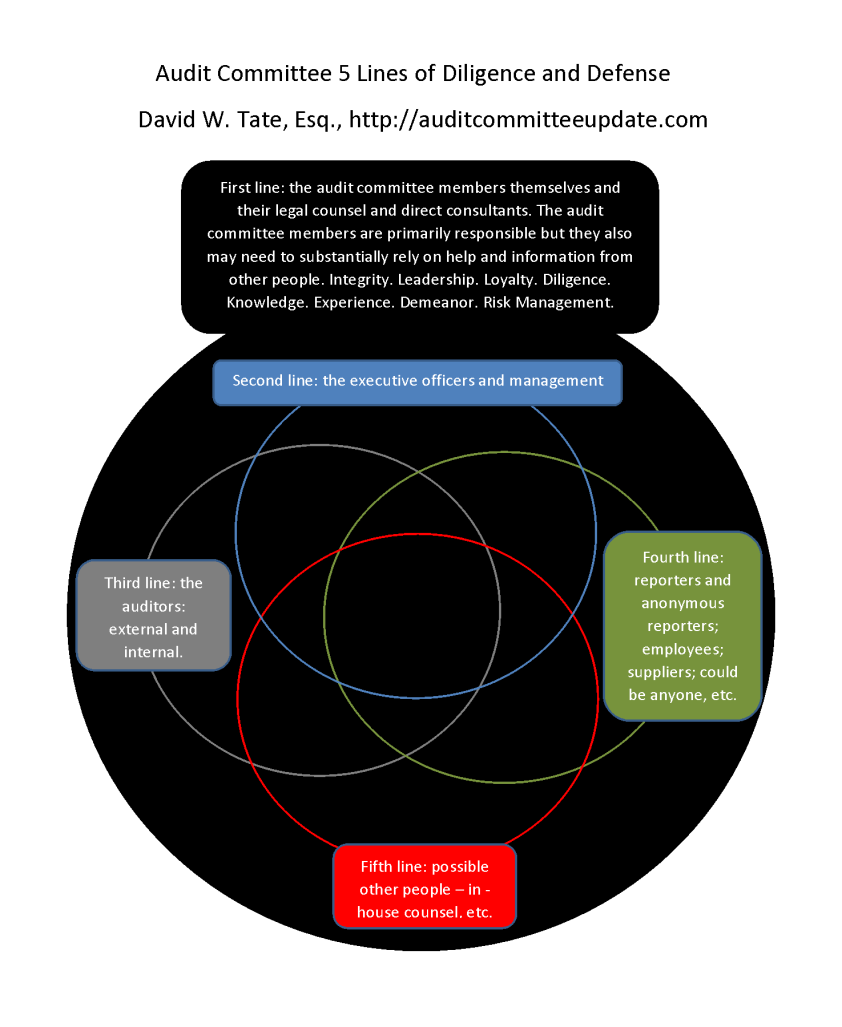
Audit Committee 5 Lines of Defense 07182016

DTatePicture_Square

New ISO Anti-Bribery Standard – Will It Give Companies An Absolute Defense?

ISO has published its new international anti-bribery standard, ISO 37001. You can find select information about the new standard HERE and at http://http://www.iso.org/iso/home/standards/management-standards/iso37001.htm .

The short PowerPoint presentation in part says:

The Standard benefits an organization by providing:

  • Minimum requirements and supporting guidance for implementing or benchmarking an anti-bribery management system
  • Assurance to management, investors, employees, customers, and other stakeholders that an organization is taking reasonable steps to prevent bribery
  • Evidence in the event of an investigation that an organization has taken reasonable steps to prevent bribery.

SO HERE’S AN INTERESTING QUESTION: will compliance with the standard give the company a free pass on bribery liability with the SEC and other state and federal entities and agencies if in fact a bribery occurs? I bet not. However, consider that generally liability does not result unless the person or entity charged has breached or failed to satisfy the applicable standard or duty of care (except in select situations, e.g., such as strict liability or products liability, etc.), and that breach or failure causes damages. Thus, if the applicable standard becomes ISO 37001, and if that standard is met or satisfied, it certainly is arguable that no fault or liability should result if a bribery occurs.

Best to you, Dave Tate, Esq., San Francisco and California. See also Tate’s Excellent Audit Committee Guide (updated October 2016), tates-excellent-audit-committee-guide-10202016-final-with-appendix-a

The Business Judgment Rule – a short animation (for fun, but also correct):

https://youtu.be/XTSJHpFbz1s

Audit Committee 5 Lines of Defense 07182016

DTatePicture_Square

Updated Tate’s Excellent Audit Committee Guide – Attached – Use It – Pass It Along – Free

Below is a link to my updated Tate’s Excellent Audit Committee Guide (updated October 20, 2016). Please use it, and pass it to other people who would be interested, such as audit committee members, directors, officers, accountants, internal and external auditors, in-house counsel, compliance professionals, and other people.

I do note that as I was updating these materials, and going through the entire Guide, it definitely hit me that all of the specifically enacted statutes, regulations, rules and pronouncements definitely could cause an audit committee member to not be able to see the forest for the tress. So let’s also not forget to look at the situation as a whole.

Although the Guide is 186 pages, I do expect some significant updates soon, and perhaps prior to the end of 2016. Many of the updates will be posted to this blog first, and then to the Guide. I am looking forward to the COSO enterprise risk management (ERM) updated framework.

Best to you. Dave Tate, Esq., San Francisco and California.

Here is a link to the updated Tate’s Excellent Audit Committee Guide (updated October 20, 2016), tates-excellent-audit-committee-guide-10202016-final-with-appendix-a

Audit Committee 5 Lines of Defense 07182016

The business judgment rule – an animated video:


DTatePicture_Square

Sustainability Disclosures – From PWC – Audit Committee Need to Know?

I’m forwarding this along – sustainability disclosure guidance from PWC – click on the following link for the materials and the discussion, CLICK HERE

And I am thinking that there could be a need for increasing audit committee member expertise in the sustainability disclosure area.

Below is a snapshot from the PWC website, followed by a link to Tate’s Excellent Audit Committee Guide (updated January 2016), followed by the Audit Committee 5 Lines of Diligence and Defense. Thank you. Dave Tate, Esq., San Francisco and California.

PWC Sustainability Disclosure Guidance


See also my Tate’s Excellent Audit Committee Guide, updated January 2016, Tate’s Excellent Audit Committee Guide 01032016 with Appendix A Final

Audit Committee 5 Lines of Defense 07182016

DTatePicture_Square


Trade Secrets And How To Protect Them – Royse Law Firm Webinar – Very Important For Every Business

Below is a link to a detailed and very useful webinar from my friends at the Royse Law Firm discussing trade secrets and how to protect them – this is a very important topic for every business and entity. Click on the following link for the discussion:

Disparate Impact – U.S. Supreme Court – Texas Dept. of Hous. & Cmty. Affairs – Plaintiff Must Establish Causation

This is a bit of a side topic for this blog, but not entirely as it deals with a disparate impact claim, typically made in the context of employment or housing discrimination litigation, but possibly relevant in other areas also. It is useful to keep in mind that in Texas Dept. of Hous & Cmty. Affairs v. Inclusive Communities Project the U.S. Supreme Court held that the plaintiff must establish causation. Relevant wording from the Court is as follows:

Disparate Impact - Texas Dept. Hous. & Cmty. Affairs, - U.S. Supreme Court

Best, Dave Tate, Esq., San Francisco and California.

Tate’s Excellent Audit Committee Guide, updated January 3, 2016, CLICK HERE FOR THE PDF LINK.

Audit Committee 5 Lines of Defense 07182016

DTatePicture_Square

Basic Insurance for Start-Up Companies – Priya Cherian Huskins, Esq., Woodruff Sawyer

Passing this along, Basic Insurance for Start-Up Companies, the following is a worthwhile read from the D&O Notebook, Priya Cherian Huskins, Esq., Woodruff Sawyer, click on the below link/box for the discussion, enjoy,

https://wsandco.com/do-notebook/startup-insurance/

Best, Dave Tate, Esq., San Francisco and California.

TATE’S EXCELLENT AUDIT COMMITTEE GUIDE updated January 2016, click on the following link, http://wp.me/p75iWX-q

Audit Committee 5 Lines of Defense 07182016


DTatePicture_Square

Top Ten Mistakes Startups Make – And How To Avoid Them – Royse Law Firm – You’ll Like This Webinar Video

The following is a link to a webinar by the Royse Law Firm about the top 10 mistakes that startups make and how to avoid them. This is an excellent webinar, full of useful information. I view the webinar from a risk management perspective, and from a litigation perspective as mistakes do tend to lead to litigation. Enjoy. Click on the following arrow for the webinar video:


Dave Tate, Esq. San Francisco and California. See also Tate’s Excellent Audit Committee Guide updated January 2016, Tate’s Excellent Audit Committee Guide 01032016 with Appendix A Final

Audit Committee 5 Lines of Defense 07182016

DTatePicture_Square

Really Massive Changes in Accounting, Auditing, Reporting and Communicating – The End Of Accounting?

Although I practice as an attorney, I previously practiced as a CPA and I have experienced several times over the years when there were significant changes occurring in the accounting practice and profession. But right now, I believe that I am witnessing multiple massive changes that have been long in the making. The following is a link to an Accounting Today article which does a pretty good job of discussing some of the changes, and also includes a question whether this is the end of accounting – click on the following link, CLICK HERE

It’s not like these changes are screaming at you in the headlines, but the cumulative effect is significant, new changes are continuing and will continue, and perhaps more important, the reasons for the changes are permanent.

For a long, long time the value of the audit and of the audit report have been questioned.

For a long, long time, the value of the information provided by an accounting that is prepared in conformity with generally accepted accounting principles has been questioned.

Different stakeholders also have different needs, and speed at which the flow of information is needed and expected is ever-increasing. Audited financial statements, for example, don’t tell you very much about the future investment or business generating value of the entity or of the transactions reported, or of the risks that are associated.

So now, for example, in addition to GAAP accounting we have non-GAAP accounting and reporting, we are seeing an increased ability to audit all transactions by computer software, GAAP is moving from the more detailed and specific rules based approach back to the more principles based approach that was in place when I first became a CPA, and non-GAAP measurements or criteria are becoming or should become more important such as some of the governance criteria (integrity, tone-at-the-top, culture, etc.), sustainability, transparency, risk management, and more emphasis on internal controls such as COSO.

However, I don’t agree with the suggestion or question in the title to the above linked article – it’s not the end of accounting. Traditional accounting serves a useful purpose – can you imagine what a free for all it would be without traditional accounting? There would be absolutely no checks or balances. There would be a “zero” reliability factor, and no comparability between different entities or industries.

But there is no question that the changes that have occurred and that continue to occur in accounting and auditing create both opportunities and risks for investors, financial institutions and other stakeholders, executive, financial, accounting and audit officers and professionals, boards, and audit and risk committees. The people who will excel are the people who will embrace and become expert in these changes. It’s a lifetime of learning to stay ahead and relevant.

Best to you. Dave Tate, Esq.

The following is a link to my Tate’s Excellent Audit Committee Guide, updated January 2016, CLICK HERE