Basic Insurance for Start-Up Companies – Priya Cherian Huskins, Esq., Woodruff Sawyer

Passing this along, Basic Insurance for Start-Up Companies, the following is a worthwhile read from the D&O Notebook, Priya Cherian Huskins, Esq., Woodruff Sawyer, click on the below link/box for the discussion, enjoy,

https://wsandco.com/do-notebook/startup-insurance/

Best, Dave Tate, Esq., San Francisco and California.

TATE’S EXCELLENT AUDIT COMMITTEE GUIDE updated January 2016, click on the following link, http://wp.me/p75iWX-q

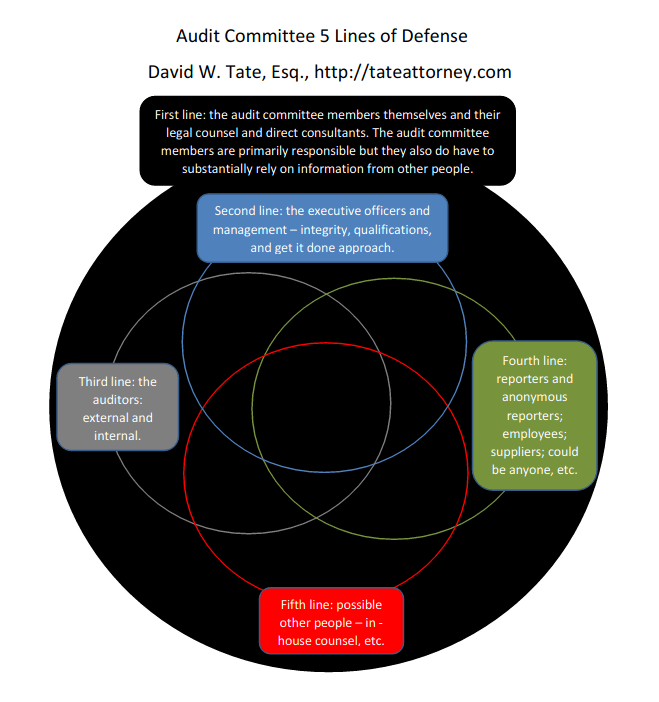
Audit Committee 5 Lines of Defense 07182016


DTatePicture_Square

Jail for Officers’ Alleged Failure to Ensure Food Product Safety

The new Eighth Circuit decision in U.S. v. DeCoster, discussing the responsible corporate officer doctrine, is an important case for corporate officers, managing agents and board members as the Eighth Circuit upheld jail time for the corporate officers’ alleged failure to ensure the safety of food that was sold to the public (i.e., egg safety, and salmonella).

In addition to typical criminal wrongdoing, for some time corporate and corporate officer criminal punishment, including jail time, has been expanded to include situations of environmental contamination (representing potentially an injury to the environment and also to public health).

The DeCoster case reflects a continuing march toward expanding possible corporate and corporate officer criminal punishment, including jail time, for injury to public physical health (in this case, food safety), even when there is a lack of evidence of the corporate officer’s actual and direct wrongdoing. In summary, in these cases the criminal wrongdoing arises from the corporate officer’s executive or managing agent status or standing and authority, and his or her alleged failure to sufficiently ensure the safety of the product (food) that is sold by the corporation or business to the general public. The following is a link to a good discussion of the case on the D & O Diary, CLICK HERE.  Obviously the implications are important for general public product and service providers, particularly those that offer products or services that could cause or involve a resulting injury to the physical health of the public.

Best, Dave Tate, Esq. (San Francisco)

What Insight Do Audit Committees Receive From Internal Audit – Not Enough Or Much – KPMG Survey

What insight to audit committees receive from IA

The above chart is from a new KPMG survey of audit committee chairs and CFOs. You can find the survey at

Click to access GM-OTS-1653_SeekingValueThrough_IAB_V1.pdf

.

The survey and the above chart identify ongoing challenges for internal audit to provide and prove enough value to audit committee members and CFOs. It is well-documented that these challenges have existed for years – basically forever. But let’s not over generalize – one size doesn’t fit all, and certainly there are internal audit functions that are up-to-speed and that are providing good value.

If there is a problem in this area, you must also ask the audit committee members, not just the audit committee chair but also the individual members who aren’t the chair, why they aren’t getting the information that they need from internal audit? There’s either a lack of common understanding, and that lack of understanding might also be the fault of the audit committee members if they are not expressing themselves sufficiently, or there is a problem with the internal audit function, or its funding, or the qualifications of its members. In theory, it also is possible that the audit committee or the CFO simply are asking internal audit to perform a task or to provide information that is unreasonable; however, that is like saying “I can’t do that for you,” which of course is a very bad approach.

You can also see Tate’s Excellent Audit Committee Guide (updated January 3, 2016), at http://wp.me/p75iWX-q

Dave Tate, Esq., San Francisco and California, http://auditcommitteeupdate.com

Audit Committee 5 Lines of Defense 02132016 David W. Tate, Esq.

DTatePicture_Square

Internal Auditors Not Giving Enough Risk Insights

CFOs and audit committee chairs are not getting enough insights into corporate risk management from their companies internal audit function, according to a new survey.

Click on the following link for the article: www.accountingtoday.com

Dave Tate, Esq. comment. The results of this survey really shouldn’t be surprising. There isn’t even agreement on what risk management is or a recommended process.

Risk management is a collaborative effort. If I’m on a board risk committee or on audit committee that has been delegated initial risk management oversight, yes, I’m going to request and expect executive management and internal audit to not only provide comments and evaluations about risk management, and also about the processes that are being used, and that should be updated and used.

However, as a risk or audit committee member, I’m also going to provide my comments about what I need to see and receive in that regard so that I am comfortable that what I am receiving allows me to perform my oversight responsibilities. Okay, so if internal audit isn’t giving enough risk insight as the article indicates, why is that, and what must be done to correct that dynamic? Those are questions that the risk or audit committee members must ask and act upon to satisfy their responsibilities as required by the business judgment rule, statutes, regulations, rules and the committee charter.

I will be attending the NACD No. California Feb. 24, Shareholder Activism program – will you be there – say hello

For my contacts, I will be attending the February 24, 2016, NACD Northern California program about shareholder activism in San Francisco from 5:30-7:30 at night. If any of my contacts will also be attending, please be sure to say hello.

Dave Tate, Esq., San Francisco and California, WEBSITE AND BLOGS, and click on the following for Tate’s Excellent Audit Committee Guide updated January 3, 2016

How Can Internal Audit Support the Growing Responsibilities of the Audit Committee?

Recent 2015 audit surveys report some interesting findings about the current role of audit committees. They highlight not only how complex the world of risk management and oversight has become in the corporate world, but also the enormous breadth of responsibilities that the audit committee is expected to bear.

Click on the following link for the article: corporatecomplianceinsights.com

Dave Tate, Esq. comments: although this is a very brief article, the topics and issues listed are large and complex. The article also offers no help at resolution. But, these issues are here to stay for boards and audit committees. Every internal audit function is different – some are qualified or partially qualified to help with these issues, whereas some are not. For some additional information, see Tate’s Excellent Audit Committee Guide (January 3, 2016, version, 183 pages) at http://wp.me/p75iWX-q.


Best. Dave Tate, Esq. (San Francisco and California. See also my other blog re trust, estate, conservatorship, power of attorney and elder abuse litigation and contentious administrations at http://californiaestatetrust.com, and my website at http://tateattorney.com.

Do You Have a Contrarian on Your Team?

A divergent opinion can lead to more creative and better decisions.

Click on the following for the article: www.gsb.stanford.edu

Dave Tate, Esq. comments – good for thought – every board and management situation is different anyway – but also, did anyone say that there shouldn’t be or can’t be contrarian views on a board or committee? Look at the business judgment rule – there’s nothing there about all having to agree. One vote per person. My website: http://tateattorney.com.

Audit Committee 5 Lines of Defense

Audit Committee 5 Lines of Defense 02132016 David W. Tate, Esq.

Making crisis simulations matter | Deloitte | Focus on | Crisis Management Services

This issue of Focus on discusses the importance of crisis simulation and how to manage a maturity-based approach. It offers insights for getting started as well as examples of simulations in action.

Click on the following link for Deloitte’s discussion (I’m a Deloitte alum): www2.deloitte.com

Dave Tate, Esq. comments – I’m passing this along as food for thought. It is fairly basic, but I like the second paragraph, which you might want to use to help you consider simulations that might be useful from the audit committee, board, and management perspectives. And here is the link to my website which contains links to my two blogs (this blog, and the blog for trust, estate and elder abuse litigation): http://tateattorney.com.

Trados: What Happens When Venture Capital Interests and Director Fiduciary Duties Collide | Woodruff-Sawyer & Co.

Some sales of private companies are terrific events. Big valuations can lead to all investors getting paid, not to mention dancing and high-fives all around. But what happens when the sale is a sad one?

Click on the following link for the article: wsandco.com

Dave Tate, Esq. comments. This is a Woodruff Sawyer December 2014, article, but it remains timely for director of private company fiduciary duties. It’s a very good read. And I have to add, obviously after reading this, if you are a private company director, you need to be sure that you have a good lawyer.