‘Internal audit is crucial to assessing impact of corporate culture’

Internal audit’s mandate is much broader than external audit’s, says Richard Chambers of Institute of Internal Auditors

Click on the following link for the article: www.thehindubusinessline.com

Dave Tate, Esq. comment.


I’m going to disagree with Mr. Chambers on this one. I believe it is better for external audit to be auditing this issue – which is an issue that external audit already should be taking into consideration when designing the audit and the extent to which management and the accounting and internal control functions can be relied upon.


Although internal audit could be assigned a task or project relating to culture, on this topic I would keep the task or project very specific. Internal audit does also work and interact with management and executive management – assessing culture might detrimentally impact those relationships. I would however recommend that internal audit be more involved in risk management, which could involve culture but in a different context.


Audit committee, D&O, risk management, etc. blog: http://auditcommitteeupdate.com

Website: http://tateattorney.com

Trust, estate, conservatorship and elder abuse litigation blog: http://californiaestatetrust.com


How Can Internal Audit Support the Growing Responsibilities of the Audit Committee?

Recent 2015 audit surveys report some interesting findings about the current role of audit committees. They highlight not only how complex the world of risk management and oversight has become in the corporate world, but also the enormous breadth of responsibilities that the audit committee is expected to bear.

Click on the following link for the article: corporatecomplianceinsights.com

Dave Tate, Esq. comments: although this is a very brief article, the topics and issues listed are large and complex. The article also offers no help at resolution. But, these issues are here to stay for boards and audit committees. Every internal audit function is different – some are qualified or partially qualified to help with these issues, whereas some are not. For some additional information, see Tate’s Excellent Audit Committee Guide (January 3, 2016, version, 183 pages) at http://wp.me/p75iWX-q.


Best. Dave Tate, Esq. (San Francisco and California. See also my other blog re trust, estate, conservatorship, power of attorney and elder abuse litigation and contentious administrations at http://californiaestatetrust.com, and my website at http://tateattorney.com.

Do You Have a Contrarian on Your Team?

A divergent opinion can lead to more creative and better decisions.

Click on the following for the article: www.gsb.stanford.edu

Dave Tate, Esq. comments – good for thought – every board and management situation is different anyway – but also, did anyone say that there shouldn’t be or can’t be contrarian views on a board or committee? Look at the business judgment rule – there’s nothing there about all having to agree. One vote per person. My website: http://tateattorney.com.

Audit Committee 5 Lines of Defense

Audit Committee 5 Lines of Defense 02132016 David W. Tate, Esq.

Making crisis simulations matter | Deloitte | Focus on | Crisis Management Services

This issue of Focus on discusses the importance of crisis simulation and how to manage a maturity-based approach. It offers insights for getting started as well as examples of simulations in action.

Click on the following link for Deloitte’s discussion (I’m a Deloitte alum): www2.deloitte.com

Dave Tate, Esq. comments – I’m passing this along as food for thought. It is fairly basic, but I like the second paragraph, which you might want to use to help you consider simulations that might be useful from the audit committee, board, and management perspectives. And here is the link to my website which contains links to my two blogs (this blog, and the blog for trust, estate and elder abuse litigation): http://tateattorney.com.

What do you do if you are an audit committee member or a director and you don’t know a relevant subject matter area?

The answer to this question might seem easy – you could say (1) “learn the area” or you might say (2) “reply upon other people” or you might say (3) “learn the area and rely on other people.” But learning the area even with a good faith effort isn’t necessarily easy or quick, and you need to ask whether relying on other people will satisfy your responsibilities? Many audit committee and board relevant subject matter areas are difficult or complicated.

Based on the business judgment rule, I recommend the third approach. I say that because you might well in part rely upon other people, but you must do so intelligently, and I would ask, other than simple complete trust or deferral, can you intelligently rely on other people if you don’t have sufficient background to gather information and ask questions, let alone evaluate the information and make decisions?

Let me also add, if it’s a specific subject matter area in which you have an oversight responsibility, such as, for example, for audit committees, oversight of the independent or external audit and of the external auditor, oversight of internal controls, oversight of the internal audit function, oversight of significant accounting practices, policies and principles, and oversight of anonymous reporting, and there are also many other specific areas, then for those areas you really do need to have or obtain (yes, it can be okay to “obtain”) the necessary background knowledge about those areas as they are core areas of your responsibility.

Below is a summary of the business judgment rule that I have taken from Tate’s Excellent Audit Committee Guide (in the Guide I have stated the rule in three different ways, because the business judgment rule is so important), and you can find the January 3, 2016, version of the Guide (183 pages) at the following link (note, I do try to update the Guide every 2-3 months, and please tell other people about this blog and the Guide as they are only worthwhile if people read them) – the link for the January 2016 version of the Guide is  http://wp.me/p75iWX-q

  1. THE BUSINESS JUDGMENT RULE

The business judgment rule provides a director with a defense to personal liability, holding that as a general principle of law, a director, including a director who serves as a member of a board committee, who satisfies the business judgment rule has satisfied his or her duties. Thus, the business judgment rule provides one standard of care, although other standards may very well also apply to specific tasks and responsibilities. I have started with the business judgment rule because it provides a very good overall approach for directors and audit committee members to follow, although lacking in specific detail. In some states the business judgment rule is codified by statute while in other states the rule is established by case law (see, i.e., Cal. Corp. Code §309 for California corporations, Del. Gen. Corp. Law §141 for Delaware corporations, in addition to relevant case law). The rule also applies to directors as board committee members.

In summary, as a general principle the business judgment rule provides that a director should undertake his or her duties:

-In good faith, with honesty and without self-dealing, conflict or improper personal benefit;

-In a manner that the committee member believes to be in the best interests of the corporation and its shareholders; and

-With the care, including reasonable inquiry, that an ordinarily prudent person in a like position would use under similar circumstances.

Reliance Upon Other People Under the Business Judgment Rule

In the course and scope of performing his or her duties, a director must necessarily obtain information from and rely upon other people. The director is not involved in the day-to-day operations of the business. The director provides an oversight function. Pursuant to the business judgment rule, a director is entitled to rely on information, opinions, reports or statements, including financial statements and other financial data, prepared or presented by any of the following:

-Officers or employees of the corporation whom the director believes to be reliable and competent in the relevant matters;

-Legal counsel, independent accountants or other persons as to matters that the director believes are within the person’s professional or expert competence; or

-A committee of the board on which the director does not serve, as to matters within that committee’s designated authority, so long as the director acts in good faith, after reasonable inquiry as warranted by the circumstances, and without knowledge that would cause reliance to be unwarranted.

* * * * *

Tate’s Excellent Audit Committee Guide – updated 1/3/2016 – 183 pages – read, use it, and pass it along

Hello all. Tate’s Excellent Audit Committee Guide is updated – click on the following link for the pdf of the January 3, 2016, updated Tate’s Excellent Audit Committee Guide. Please read and use it, and pass it along to other people who would be interested,

Click to access tates-excellent-audit-committee-guide-01032016-with-appendix-a-final.pdf

Going forward, I have also made this blog, http://auditcommitteeupdate.com, my blog for audit committee, D&O, civil litigation, risk, compliance, business, etc. posts. My prior blog, http://directorofficernews.com, still exists, so you can still access that blog or the numerous past posts.

Dave Tate, Esq., and CPA in California (inactive), San Francisco and throughout California. My other blog for trust, estate, conservatorship and elder abuse litigation is http://californiaestatetrust.com

DTatePicture_Square

Audit Committee Oversight of Derivatives – Not Just For Funds – Check Your Entity’s Oversight

You may have seen this month news about new SEC rules relating to the use of derivatives by registered investment companies. Related to the derivatives topic, I found a Wall Street Journal article about restatements and Commissioner Luis A. Aguilar’s December 11, 2015, speech about derivatives interesting from an audit committee perspective.

In particular, I have pasted below a snapshot from the Wall Street Journal article discussing common causes of restatements – you will note that derivatives are listed (click on the snapshot to enlarge).

Frankly, although revenue recognition is well-known as the big cause of restatement, I had not considered the importance of derivatives as a top five cause. Every public entity is different of course, however, the Wall Street Journal statistics suggest that all audit committee members, not just those of registered investment companies take into consideration the extent to which their entity is involved in derivatives and related accounting, and consider whether oversight in the derivative area is appropriate, and whether each audit committee member is sufficiently knowledgeable about derivatives and their accounting, or needs some additional continuing education.

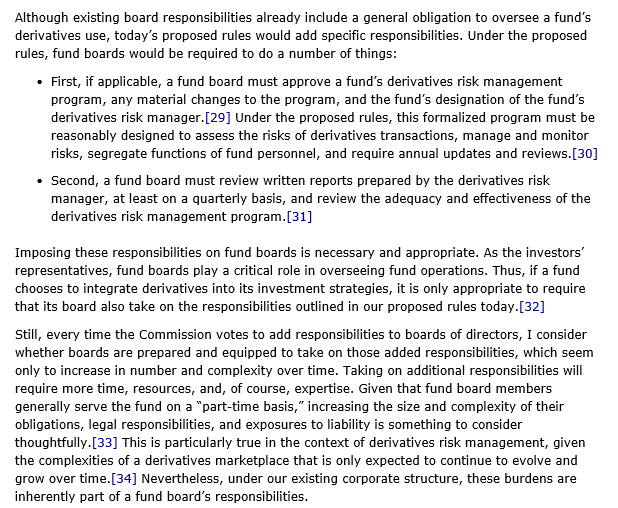
Accounting for derivatives is complicated – I myself have pulled the derivative accounting materials off the shelf for another refresher. I have also pasted below a snapshot from some of Commissioner’s speech which I found interesting.

Immediately below is the snapshot from the Wall Street Journal article listing accounting standards or areas most commonly involved in financial restatements for the recent period 2011-2012.

WSJ Major Causes of Restatements

The following is a snapshot from some of SEC Commissioner Aguilar’s December 11, 2015, speech about accounting for derivatives in the context of registered investment companies.

2015-12-29_7-09-19 from Aguilar derivatives speech

Commissioner Aguilar also commented about the extent of the global derivatives market: “Meanwhile, the global derivatives market remains huge, at an amount estimated in excess of $630 trillion in notional value worldwide.[4]” You can see Commissioner Aguilar’s speech at: 

http://www.sec.gov/news/statement/protecting-investors-through-proactive-regulation-derivatives.html

It would not surprise me if derivatives and accounting for derivatives take on greater importance for audit committee oversight in the future, for all companies that have significant derivative activities and not just for registered investment companies.

Enjoy, and onward.

Tate’s Excellent Audit Committee Guide (updated October 24, 2015, 172 pages) – click on the following link – please use and pass along to other people who would be interested – https://auditcommitteeupdate.files.wordpress.com/2015/10/tates-excellent-audit-committee-guide-10242015.pdf

Dave Tate, Esq. and California CPA (inactive), San Francisco and throughout California

DTatePicture_Square