Deloitte’s Audit Committee Brief December 2015

Deloitte Audit Committee Brief December 2015

I’m passing this information along – worthwhile reading for audit committees – the following is a link to Deloitte’s Audit Committee Brief for December 2015, http://www2.deloitte.com/content/dam/Deloitte/us/Documents/center-for-corporate-governance/us-ccg-acbrief-december-2015-121615.pdf

Food for thought for audit committees.

Dave Tate, Esq. and licensed CPA in California (inactive), San Francisco/California

DTatePicture_Square

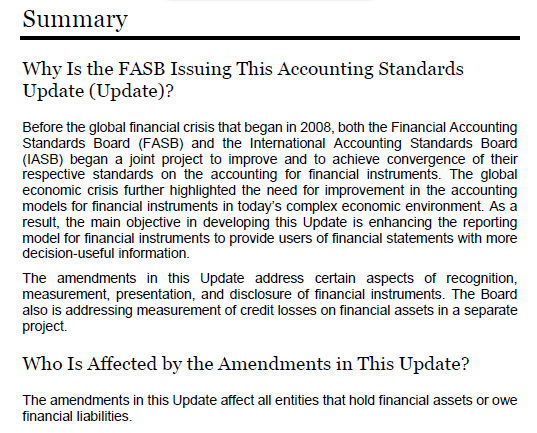
FASB issues new financial instruments recognition and measurement standard

FASB 2016-01 Financial Instruments

FASB issued a standard Tuesday that makes targeted changes to existing GAAP for the recognition and measurement of financial instruments. Click on the following link from the article in the Journal of Accountancy (and the article also has a link to the new Accounting Standard): www.journalofaccountancy.com

Dave Tate, Esq. comments (San Francisco/California). Close on the heals of news of new derivative accounting and reporting rules for audit committees to oversee (see my January 2, 2016, post HERE), the FASB has issued new Accounting Standards Update No. 2016-01 for Financial Instruments. This standard covering recognition and measurement is 226 pages. Have fun reading and understanding these changes. This has been in the works for a long time – it has taken years to write – the effort began before the 2008 financial crisis. The new standard is effective for fiscal years beginning after December 15, 2017; however, audit committees and auditors already should be aware that there is a spotlight on financial instruments. Audit committees need to be on their toes on this.

DTatePicture_Square

The Top Ten D&O Stories of 2015 | The D&O Diary

It was an eventful year in the world of directors’ and officers’ liability in 2015. Many of the year’s key events significantly changed the D&O liabili

Sourced through Scoop.it from: www.dandodiary.com

Dave Tate, Esq. comments – not much to say here – if you know the D&O Diary blog, you know that it contains regular and important D&O insurance and liability posts for directors – here are the top 10 D&O Diary stories from 2015 – if you are a director, you should review these.

Dave Tate, Esq. San Francisco and California, link for Tate’s Excellent Audit Committee Guide (pdf) http://wp.me/p75iWX-q

Report: Clinton emails among ‘incomplete’ record searches – read this – an important reminder for business

From Yahoo News: WASHINGTON (AP) — The State Department’s search for documents during Secretary of State Hillary Clinton’s tenure contributed to “inaccurate and incomplete” responses under federal open records laws, including the existence of her private email account, the agency’s watchdog will report Thursday.

Click on the following link for the full article from the AP – you should read this for the discussion that it provides and then consider your business records: news.yahoo.com

Dave Tate, Esq. comments. No, I’m not wading into politics – I’m posting this because it is a good reminder that businesses and their executive officers, board and committee (audit, etc.) members, and other employees (managerial, supervisory, important, staff, etc.) need to have and maintain email, text message, phone message and other digital and verbal document and material retention policies and procedures, and the ability to search, retrieve and produce those materials, not just for business accounts but also for outside and personal accounts. This is very, very important. Your response to a situation and your case can be prejudiced, and you can be fined or punished or sanctioned big time for this failure, monetarily and with other sanctions such as issue sanctions or preclusions or presumptions in court.

Dave Tate, Esq. (San Francisco and California), for Tate’s Excellent Audit Committee Guide (pdf), click on the following link, http://wp.me/p75iWX-q


The Next Frontier for Boards, Oversight of Risk Culture

The Next Frontier for Boards, Oversight of Risk Culture

Click on the following link for the full Harvard Law School Forum article: corpgov.law.harvard.edu

Dave Tate, Esq. comments. I am posting this because it is a good discussion – but you will note the date (July 13, 2015) – six months later would anyone still continue to argue that board oversight of risk culture is a new frontier? And it really wasn’t or shouldn’t have been a new frontier in July 2015 – the topic and the requirement has been around for longer than that, but perhaps boards were slow to take it on.

I would argue that “risk culture” is or can be two separate and distinct topics, or one combined topic. At least to me, “risk” is not necessarily the same topic as “culture.” When we talk about risk, we have to define what type or area of risk. Similarly, we need to define what type or area of culture. And culture is not necessarily the same as processes and procedures. See, for example, the second paragraph of the Harvard Law School Forum article  in which the author discussed comments by SEC Chair Mary Jo White.

Types of risk or culture that we typically see in the news, for example, include product safety, workplace and work condition safety, environmental safety, financial and accounting internal controls, financial fraud, tone at the top/integrity, and pressure or culture on people to cheat or cut corners. And, of course, many other areas.

You can see my updated audit committee guide at my January 3, 2016, blog post. At part V. Committee Functions and Responsibilities you can see that at least some aspect of risk has already been an audit committee responsibility. I do argue that boards and audit committees need to clarify the extent of the audit committee’s responsibility for risk oversight.

And on a related point, evaluation of risk culture also should be taken into consideration when the external auditor is designing the independent audit – a poor or weakened risk culture, or at least as it pertains to accounting and related controls, increases the risk of fraud and accounting errors and irregularities.

That’s all for now. Enjoy the Harvard Law School Forum article.

Dave Tate, Esq., and CPA in California (inactive), San Francisco and throughout California

Key U.S. Cybersecurity Provisions Signed into Law

Click on the following link for the article from the iapp about key new cybersecurity laws and provisions: iapp.org

Dave Tate, Esq. comments. I am passing this along as a lot of audit committees are involved in risk management and that includes or for some audit committees can include cybersecurity. Enjoy.

SEC Officials Question Increased Demands on Audit Committee Members | JD Supra


In a December 9 address at the 2015 AICPA National Conference on SEC and PCAOB Developments, SEC Chair Mary Jo White discussed the “heavy demands” placed on audit committees. In…

Click on the following link for the full article: www.jdsupra.com

Dave Tate, Esq. comments. Agree. The demands on audit committees are high. But how would you change that? Decrease the statutory and stock exchange audit committee required responsibilities? I don’t hear anyone suggesting a reduction. The article does mention the time requirements of risk management oversight – we could definitely use additional discussion and understanding about the extent of audit committee responsibilities for risk management oversight, and audit committee charter review – there is a need for stakeholder understanding about the extent of audit committee responsibilities in risk management. The following is a link to my January 3, 2016, updated Tate’s Excellent Audit Committee Guide – at the last 10 pages I have attached two audit committee charters with some comments – you can see the extent of the audit committee responsibilities. See http://wp.me/p75iWX-q for the January 3, 2016, updated Tate’s Excellent Audit Committee Guide (183 pages).

Ten Trends in SEC Enforcement Actions

Click on the following link for the article: corpgov.law.harvard.edu

Dave Tate, Esq. comments. Here is a worthwhile, detailed article by Jonathan N. Eisenberg, K&L Gates LLP, posted in the Harvard Law School Forum on Corporate Governance and Financial Regulation. I would add an increased emphasis on personal responsibility, but it’s too early to determine the extent to which the SEC is going to push on this. See also http://wp.me/p75iWX-q for the January 3, 2016, updated Tate’s Excellent Audit Committee Guide (183 pages).

Tate’s Excellent Audit Committee Guide – updated 1/3/2016 – 183 pages – read, use it, and pass it along

Hello all. Tate’s Excellent Audit Committee Guide is updated – click on the following link for the pdf of the January 3, 2016, updated Tate’s Excellent Audit Committee Guide. Please read and use it, and pass it along to other people who would be interested,

Click to access tates-excellent-audit-committee-guide-01032016-with-appendix-a-final.pdf

Going forward, I have also made this blog, http://auditcommitteeupdate.com, my blog for audit committee, D&O, civil litigation, risk, compliance, business, etc. posts. My prior blog, http://directorofficernews.com, still exists, so you can still access that blog or the numerous past posts.

Dave Tate, Esq., and CPA in California (inactive), San Francisco and throughout California. My other blog for trust, estate, conservatorship and elder abuse litigation is http://californiaestatetrust.com

DTatePicture_Square

Audit Committee Oversight of Derivatives – Not Just For Funds – Check Your Entity’s Oversight

You may have seen this month news about new SEC rules relating to the use of derivatives by registered investment companies. Related to the derivatives topic, I found a Wall Street Journal article about restatements and Commissioner Luis A. Aguilar’s December 11, 2015, speech about derivatives interesting from an audit committee perspective.

In particular, I have pasted below a snapshot from the Wall Street Journal article discussing common causes of restatements – you will note that derivatives are listed (click on the snapshot to enlarge).

Frankly, although revenue recognition is well-known as the big cause of restatement, I had not considered the importance of derivatives as a top five cause. Every public entity is different of course, however, the Wall Street Journal statistics suggest that all audit committee members, not just those of registered investment companies take into consideration the extent to which their entity is involved in derivatives and related accounting, and consider whether oversight in the derivative area is appropriate, and whether each audit committee member is sufficiently knowledgeable about derivatives and their accounting, or needs some additional continuing education.

Accounting for derivatives is complicated – I myself have pulled the derivative accounting materials off the shelf for another refresher. I have also pasted below a snapshot from some of Commissioner’s speech which I found interesting.

Immediately below is the snapshot from the Wall Street Journal article listing accounting standards or areas most commonly involved in financial restatements for the recent period 2011-2012.

WSJ Major Causes of Restatements

The following is a snapshot from some of SEC Commissioner Aguilar’s December 11, 2015, speech about accounting for derivatives in the context of registered investment companies.
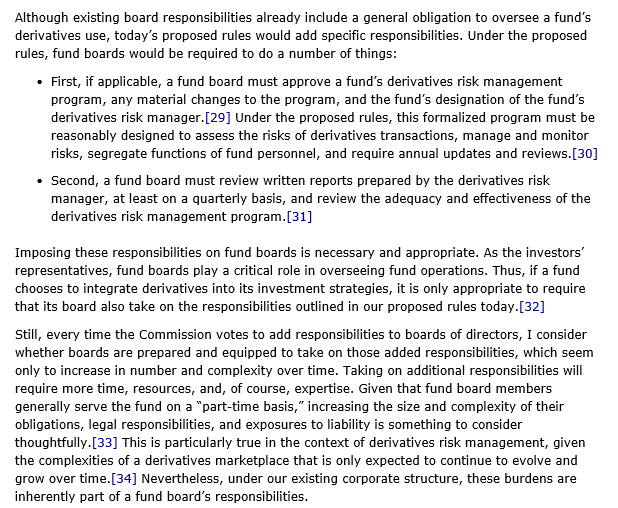
2015-12-29_7-09-19 from Aguilar derivatives speech

Commissioner Aguilar also commented about the extent of the global derivatives market: “Meanwhile, the global derivatives market remains huge, at an amount estimated in excess of $630 trillion in notional value worldwide.[4]” You can see Commissioner Aguilar’s speech at: 

http://www.sec.gov/news/statement/protecting-investors-through-proactive-regulation-derivatives.html

It would not surprise me if derivatives and accounting for derivatives take on greater importance for audit committee oversight in the future, for all companies that have significant derivative activities and not just for registered investment companies.

Enjoy, and onward.

Tate’s Excellent Audit Committee Guide (updated October 24, 2015, 172 pages) – click on the following link – please use and pass along to other people who would be interested – https://auditcommitteeupdate.files.wordpress.com/2015/10/tates-excellent-audit-committee-guide-10242015.pdf

Dave Tate, Esq. and California CPA (inactive), San Francisco and throughout California

DTatePicture_Square