Director (Prudent) Note Taking, Discouraged or Not – Forward From Woodruff-Sawyer and Priya Cherian Huskins With Comments

Here is a link to a good discussion by Priya Cherian Huskins, Esq. at Woodruff-Sawyer about director note taking (not minute taking, but note taking), which can also apply to note taking in general in many situations, CLICK HERE. I agree with Ms. Huskins.

There should be policies and procedures or guidelines to be followed, but a director should be allowed to take notes, and should not be told that he or she cannot take notes. It is a matter of the director performing his or her oversight function in the manner that he or she believes is prudent and necessary. If I was told that as a director or audit committee member that I could not take notes that I thought were necessary and helpful to me and my oversight, I would question that instruction or request, and consider declining the position if it was forced.

Best, Dave Tate, Esq. (San Francisco/California)

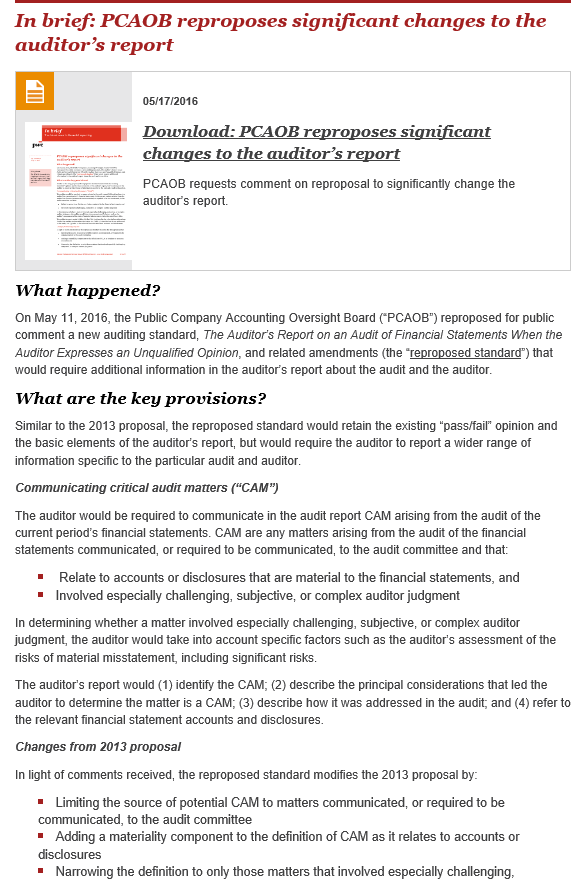
PCAOB Proposes Significant Changes to the Audit Report – From PWC

The PCAOB has again proposed changes to the standard audit report in which the PCAOB proposes that the report disclose additional information, for example about communications to the audit committee and about judgment or estimate related issues. Here is the link to a discussion by PWC, CLICK HERE. Comments about the proposal are due by August 2016.

This is a modified version of a prior PCAOB proposal. I’m not particularly convinced that the proposal requires a detailed discussion by me at this time as, similar to legislation, the proposal will change over time and whether or not it will ever be enacted is uncertain. However, given that this is a second serious attempt to enact a change in the audit report for audits performed and that are subject to PCAOB oversight, I must believe that this attempt will have an increased chance of being enacted.

I continue to believe that the current audit report suffers from significant limitations that reduce or limit its usefulness and relevancy for investors. I question the number of audits that would be performed if not for the statutory requirement? And we are seeing other efforts to increase discussions and disclosures that are thought to be useful to investors, such as the activities of the Sustainability Accounting Standards Board and other activities by the PCAOB.

In general, these activities also should benefit the external and internal audit professions as they will make their activities even more relevant, and also likely increase their workload.

One other thought: where are audit committees on this? I believe that in general they should support these efforts: on the one hand these activities might increase audit committee complexity and workload, but on the other hand, as the audit committee is significantly dependent on information that is provided by other people (because the audit committee is not involved in the day-to-day activities of the business, and its role is diligent and informed “oversight”), this information and these disclosures tend to provide the audit committee with additional information that might help in the audit committee member’s oversight effectiveness.

Best, Dave Tate, Esq. (San Francisco/California), and here is a link to my audit committee guide, CLICK HERE

PCAOB proposes changes to audit report

Third-Party Risks and Internal Audit – and Bring in Legal

The following is a link to a short video discussion about auditing third-party risks from the Institute of Internal Auditors, CLICK HERE FOR THE VIDEO.

The discussion is interesting for what it says, and what it doesn’t say. Of course it’s only a short video and does not purport to cover anywhere near the entire topic, and the video also is only part I. The discussion also focuses only on negative risks, e.g., the risk of negative catastrophe such as from cyber breach, but what about a more positive risk such as a resulting shortage of product materials because new product demand surpasses the highest estimates?

Internal audit and other people who are involved in third-party risk need to avoid working in silos. The video doesn’t mention the audit committee, or internal audit’s charter, or the involvement of legal counsel, for example. What about the risk of faulty or dangerous product produced or materials used by a third-party vendor? The discussion does touch on evaluating whether to end or terminate the contract with a third-party vendor – how does internal audit do that – bring in legal right?

In any event, I’m just using the video to prompt some discussions, which certainly was the intent of the video.

Best, Dave Tate, Esq. (San Francisco / California), and click on the following link for my audit committee guide – and please tell other people who would be interested, CLICK HERE FOR A BLOG POST WITH A LINK TO THE GUIDE – JUST CLICK THE LINK – YOU DON’T NEED TO PROVIDE ANY INFORMATION

Comments on the DoJ Fraud Section Plan and Guidance

Recently, on April 8, 2016, I wrote a post about the new DoJ Fraud Section’s Foreign Corrupt Practices Act Enforcement Plan and Guidance. Here is a link to that post and the Plan and Guidance CLICK HERE.

I did not at that time provide comments about the Plan and Guidance, which is only 9 pages in length. Whereas audit committees definitely should read and understand the Plan and Guidance, and take it into consideration for the purpose of pre-policies, processes and practices, and then also if an event or occurrence happens, my additional overview comments are as follows.

As you read through the Plan and Guidance, unfortunately I believe that you will find that for the most part it vaguely says that you should conduct an investigation of everything and everyone who might be relevant to the event or occurrence, that you should self report everything that you find (except for attorney-client information and materials, but of course the Fraud Section might argue about what qualifies as being attorney-client privileged), and that the Fraud Section will then consider what benefits it will grant, if any, to you for doing so. In that regard, I have to say that the Plan and Guidance is noncommittal, vague and overly broad, and might be considered heavy-handed, and as such isn’t particularly helpful or not nearly as helpful as it might have been.

The Plan and Guidance also only applies to the Fraud Section – thus, it does not apply to any of the other numbers of governmental entities, divisions, departments or sections that might also be looking into the event or occurrence. But, please do read and understand the Plan and Guidance anyway.

And the following is a link to my Excellent Audit Committee Guide – read it and pass it around, CLICK HERE.

Best, Dave Tate, Esq. (San Francisco/California)

PCAOB Rules to Improve Transparency by Disclosing Engagement Partner Name and Information about Other Audit Firms are Approved by SEC

Short and brief, the following is a link to the PCAOB site if you want to read more about this new change (Click Here), but in truth, I just don’t see why this took so much effort and time to approve. I don’t see this as a big deal. Do you? Am I missing something? In any event, I’m passing this along.

Best, Dave Tate, Esq. (San Francisco / California)

Auditors – Derivatives – Auditing v. Risk Management, Big Difference – Reporting v. Evaluation

I have been reading an email thread by some very good auditors and risk management professionals. It struck a chord with me. The discussion was about derivatives in general.

One participant posted recent comments or possible comments by Warren Buffett about the difficulties of evaluating derivative transactions and banks and companies that hold derivative contracts or instruments.

Another participant differentiated auditing and risk management in the context of derivatives – stating that the external auditor audits to determine whether the derivative transaction has been properly accounted for within the context of generally accepted accounting principles.

But the auditor’s clean opinion really doesn’t tell management, or the board, or the audit committee, or the investor how the derivative will behave or react in different situations, or the risk associated with the derivative. Of course, that audit weakness also is true with respect to all audited transactions – the auditor is only telling you that within GAAP and GAAS, and the determined level of materiality, the transactions have been properly recorded. Although proper accounting is important, the risk associated is equally and perhaps more important.

A few of my other posts have discussed derivatives – here is a link to a post about derivatives and audit committees http://wp.me/p75iWX-h.

And, as audit committees have oversight of risk management or certain aspects of risk management (which is too vague of a term (i.e., risk management), and lacking in specifics for my liking, see also http://wp.me/p75iWX-1F re risk management, audit committees, and AC charters ), as an audit committee member should you evaluate whether you and your committee, and management, are sufficiently on top of the derivative issue and the risks that they might present to your entity and its shareholders, and to you and your reputation? I’m not anti-derivative – they can be helpful and prudent – I’m simply saying that as part of your oversight and diligence you should consider whether you and your organization are sufficiently on top of the issue and understand the risks that the different derivative instruments and transactions present.

And here is a link to my audit committee guide, updated January 2016, http://wp.me/p75iWX-q

Thanks for reading. Dave Tate, Esq. (San Francisco/California)

DTatePicture_Square