Questions to Consider to Facilitate Dispute and Conflict Resolution – Dave Tate, Esq.

David W. Tate, Esq., San Francisco and California – dave@tateattorney.com

I have provided a link below to my paper “Questions to Consider to Facilitate Dispute and Conflict Resolution, and a snapshot of the paper’s first page. I have also provided below a link to a recent blog post with a short video summarizing my mediator services. Enjoy, and have a good day.  Dave Tate, Esq.

The following is a link to my paper “Questions to Consider to Facilitate Dispute and Conflict Resolution: QUESTIONS TO CONSIDER TO FACILITATE DISPUTE AND CONFLICT RESOLUTION, David Tate, Esq. 05242020

The following is a link to my blog post with a short video summarizing my mediator services: https://wp.me/p75iWX-x7

The following is a snapshot of the first page to my paper “Questions to Consider to Facilitate Dispute and Conflict Resolution:


Mediation and Conflict Resolution Hexagon Matrix to Help Achieve Resolution and Settlement


Best to you, Dave Tate, Esq. (San Francisco and California) – dave@tateattorney.com

———————————————————————-

Remember, every case and situation is different. It is important to obtain and evaluate all of the evidence that is available, and to apply that evidence to the applicable standards and laws. You do need to consult with an attorney and other professionals about your particular situation. This post is not a solicitation for legal or other services inside of or outside of California, and, of course, this post only is a summary of information that changes from time to time, and does not apply to any particular situation or to your specific situation. So . . . you cannot rely on this post for your situation or as legal or other professional advice or representation.

Thank you for reading this post. I ask that you also pass it along to other people who would be interested as it is through collaboration that great things and success occur more quickly. And please also subscribe to this blog and my other blog (see below), and connect with me on LinkedIn and Twitter.

Best to you, David Tate, Esq. (and inactive California CPA) – practicing in California only.

I am also the Chair of the Business Law Section of the Bar Association of San Francisco.

Blogs

Trust, estate/probate, power of attorney, conservatorship, elder and dependent adult abuse, nursing home and care, disability, discrimination, personal injury, responsibilities and rights, and other related litigation, and contentious administrations http://californiaestatetrust.com

Business, D&O, board, director, audit committee, shareholder, founder, owner, and investor litigation, governance and governance committee, responsibilities and rights, compliance, investigations, and risk management  http://auditcommitteeupdate.com

My law practice primarily involves the following areas and issues:

Trust, Estate, Probate Court, Elder and Dependent Adult, and Disability Disputes and Litigation

      • Trust and estate disputes and litigation, and contentious administrations representing fiduciaries, beneficiaries and families; elder abuse; power of attorney disputes; elder care and nursing home abuse; conservatorships; claims to real and personal property; and other related disputes and litigation.

Business, Business-Related, and Workplace Disputes and Litigation: Private, Closely Held, and Family Businesses; Public Companies; Nonprofit Entities; and Governmental Entities

      • Business v. business disputes including breach of contract; unlawful, unfair and fraudulent business practices; fraud, deceit and misrepresentation; unfair competition; licensing agreements, breach of the covenant of good faith and fair dealing; etc.
      • Misappropriation of trade secrets.
      • M&A disputes.
      • Founder, officer, director and board, investor, shareholder, creditor, VC, control, governance, decision making, fiduciary duty, conflict of interest, independence, voting, etc., disputes.
      • Buy-sell disputes.
      • Funding and share dilution disputes.
      • Accounting, lost profits, and royalty disputes and damages.
      • Insurance coverage and bad faith.
      • Access to corporate and business records disputes.
      • Employee, employer and workplace disputes and processes, discrimination, whistleblower and retaliation, harassment, defamation, etc.

Investigations, Governance, and Responsibilities and Rights

      • Corporate, business, nonprofit and governmental internal investigations.
      • Board, audit committee, governance committee, and special committee governance and processes, disputes, conflicts of interest, independence, culture, ethics, etc.; and advising audit committees, governance committees, officers, directors, and boards.

Mediator Services and Conflict Resolution

* * * * *


Mediation and Conflict Resolution Hexagon Matrix to Help Achieve Resolution and Settlement – Dave Tate, Esq.

David W. Tate, Esq., San Francisco and California – dave@tateattorney.com

I have found that obtaining the best understanding from and about the parties and stakeholders with respect to their views pertaining to the six primary areas that are identified in my mediation and conflict resolution hexagon matrix will greatly increase the likelihood of reaching a resolution and settlement. Of course there are sub-parts to each of the six areas – however, the hexagon matrix does help to provide focus.

Best to you, Dave Tate, Esq. (San Francisco and California) – dave@tateattorney.com

———————————————————————-

Remember, every case and situation is different. It is important to obtain and evaluate all of the evidence that is available, and to apply that evidence to the applicable standards and laws. You do need to consult with an attorney and other professionals about your particular situation. This post is not a solicitation for legal or other services inside of or outside of California, and, of course, this post only is a summary of information that changes from time to time, and does not apply to any particular situation or to your specific situation. So . . . you cannot rely on this post for your situation or as legal or other professional advice or representation.

Thank you for reading this post. I ask that you also pass it along to other people who would be interested as it is through collaboration that great things and success occur more quickly. And please also subscribe to this blog and my other blog (see below), and connect with me on LinkedIn and Twitter.

Best to you, David Tate, Esq. (and inactive California CPA) – practicing in California only.

I am also the Chair of the Business Law Section of the Bar Association of San Francisco.

Blogs

Trust, estate/probate, power of attorney, conservatorship, elder and dependent adult abuse, nursing home and care, disability, discrimination, personal injury, responsibilities and rights, and other related litigation, and contentious administrations http://californiaestatetrust.com

Business, D&O, board, director, audit committee, shareholder, founder, owner, and investor litigation, governance and governance committee, responsibilities and rights, compliance, investigations, and risk management  http://auditcommitteeupdate.com

My law practice primarily involves the following areas and issues:

Trust, Estate, Probate Court, Elder and Dependent Adult, and Disability Disputes and Litigation

      • Trust and estate disputes and litigation, and contentious administrations representing fiduciaries, beneficiaries and families; elder abuse; power of attorney disputes; elder care and nursing home abuse; conservatorships; claims to real and personal property; and other related disputes and litigation.

Business, Business-Related, and Workplace Disputes and Litigation: Private, Closely Held, and Family Businesses; Public Companies; Nonprofit Entities; and Governmental Entities

      • Business v. business disputes including breach of contract; unlawful, unfair and fraudulent business practices; fraud, deceit and misrepresentation; unfair competition; licensing agreements, breach of the covenant of good faith and fair dealing; etc.
      • Misappropriation of trade secrets.
      • M&A disputes.
      • Founder, officer, director and board, investor, shareholder, creditor, VC, control, governance, decision making, fiduciary duty, conflict of interest, independence, voting, etc., disputes.
      • Buy-sell disputes.
      • Funding and share dilution disputes.
      • Accounting, lost profits, and royalty disputes and damages.
      • Insurance coverage and bad faith.
      • Access to corporate and business records disputes.
      • Employee, employer and workplace disputes and processes, discrimination, whistleblower and retaliation, harassment, defamation, etc.

Investigations, Governance, and Responsibilities and Rights

      • Corporate, business, nonprofit and governmental internal investigations.
      • Board, audit committee, governance committee, and special committee governance and processes, disputes, conflicts of interest, independence, culture, ethics, etc.; and advising audit committees, governance committees, officers, directors, and boards.

Mediator Services and Conflict Resolution

* * * * *



Dave Tate, Esq. – expanding my mediator and conflict resolution part of the practice – video

David W. Tate, Esq., San Francisco and California – dave@tateattorney.com

To all of my friends, colleagues and connections – I am expanding my mediator and conflict resolution practice, and, as you see below, continuing to experiment with video. Below is a video discussing my mediator and conflict resolution qualifications and experience. The goal is to make the mediator and conflict resolution engagements up to 20% or so of my practice. The remainder of my practice will remain the same – heavy duty litigation and trials, governance, administrations, and investigations. Thank you, and please do pass the word to people who would be interested.

Best to you, Dave Tate, Esq. (San Francisco and California) – dave@tateattorney.com

———————————————————————-

Remember, every case and situation is different. It is important to obtain and evaluate all of the evidence that is available, and to apply that evidence to the applicable standards and laws. You do need to consult with an attorney and other professionals about your particular situation. This post is not a solicitation for legal or other services inside of or outside of California, and, of course, this post only is a summary of information that changes from time to time, and does not apply to any particular situation or to your specific situation. So . . . you cannot rely on this post for your situation or as legal or other professional advice or representation.

Thank you for reading this post. I ask that you also pass it along to other people who would be interested as it is through collaboration that great things and success occur more quickly. And please also subscribe to this blog and my other blog (see below), and connect with me on LinkedIn and Twitter.

Best to you, David Tate, Esq. (and inactive California CPA) – practicing in California only.

I am also the Chair of the Business Law Section of the Bar Association of San Francisco.

Blogs

Trust, estate/probate, power of attorney, conservatorship, elder and dependent adult abuse, nursing home and care, disability, discrimination, personal injury, responsibilities and rights, and other related litigation, and contentious administrations http://californiaestatetrust.com

Business, D&O, board, director, audit committee, shareholder, founder, owner, and investor litigation, governance and governance committee, responsibilities and rights, compliance, investigations, and risk management  http://auditcommitteeupdate.com

My law practice primarily involves the following areas and issues:

Trust, Estate, Probate Court, Elder and Dependent Adult, and Disability Disputes and Litigation

      • Trust and estate disputes and litigation, and contentious administrations representing fiduciaries, beneficiaries and families; elder abuse; power of attorney disputes; elder care and nursing home abuse; conservatorships; claims to real and personal property; and other related disputes and litigation.

Business, Business-Related, and Workplace Disputes and Litigation: Private, Closely Held, and Family Businesses; Public Companies; Nonprofit Entities; and Governmental Entities

      • Business v. business disputes including breach of contract; unlawful, unfair and fraudulent business practices; fraud, deceit and misrepresentation; unfair competition; licensing agreements, breach of the covenant of good faith and fair dealing; etc.
      • Misappropriation of trade secrets.
      • M&A disputes.
      • Founder, officer, director and board, investor, shareholder, creditor, VC, control, governance, decision making, fiduciary duty, conflict of interest, independence, voting, etc., disputes.
      • Buy-sell disputes.
      • Funding and share dilution disputes.
      • Accounting, lost profits, and royalty disputes and damages.
      • Insurance coverage and bad faith.
      • Access to corporate and business records disputes.
      • Employee, employer and workplace disputes and processes, discrimination, whistleblower and retaliation, harassment, defamation, etc.

Investigations, Governance, and Responsibilities and Rights

      • Corporate, business, nonprofit and governmental internal investigations.
      • Board, audit committee, governance committee, and special committee governance and processes, disputes, conflicts of interest, independence, culture, ethics, etc.; and advising audit committees, governance committees, officers, directors, and boards.

Mediator Services and Conflict Resolution

* * * * *
 

Committee Members – Be Mindful Of What You Say Or Might Imply Outside Of (Or Inside) The Meeting

David W. Tate, Esq., San Francisco and California – dave@tateattorney.com

I would put the following in the categories of: Committee members – (1) be mindful of what you say or might imply outside of a meeting; (2) be mindful of what you say or might imply in public; (3) be mindful of what you say or might imply to the press; and (4) be mindful and constructive in what you say or might imply about a matter that was discussed and about another committee member.

For this example let’s assume the following hypothetical which is not too uncommon: an article is written by a journalist about the actions and decision of a committee, and later outside-of-the-meeting, public comments that the journalist attributes as being said to the journalist by two of the members of the committee. In this hypothetical the subject matter, the people and their titles, and the entity are not important; thus, I have not included or commented about them. Also remember that representations including alleged quotes in an article are the journalist’s view of what occurred and what was said to her or him – unless we were present, we would not know what was actually said in the meeting, or the entirety of what was said to the journalist – trust, and trust in the journalist are so important. Nevertheless, however, always be mindful of what you say because some version or part of what you say might be presented in public print or video.

The hypothetical attributes the first comment to Member #1 as she or he discusses her or his view of how the subject matter in the meeting should be viewed. The situation attributes the next two comments to Member #2 at least in part in reply. Of course, it is unlikely that the comments were made to the journalist in that timing sequence, i.e., one comment immediately made one after the other. Consider the differences in approaches, and also the possible perspective and optics from the view of the committee as a whole.

I am sure that many of us, perhaps most of us, have experienced or heard about similar situations in relation to activities in which we have been involved. For the purpose of this post, I am viewing the hypothetical from the perspective of Member #1’s comment when compared to Member #2’s comments, and their two different approaches from an argument or debate perspective, and also as interactions (and possibly impacting future interactions) between two members of the same committee. I considered adding a few comments from the perspective of 10,000 feet about interactions between members of a committee, debate and negotiation styles and strategies, and argument and argument reasoning fallacies. However, as this post already is long enough, I leave those considerations to you and merely note that Member #1’s approach is reflective and broad, whereas Member #2’s approach is directed toward Member #1 and in a personal manner. In this type of situation, I would also recommend that the committee discuss and review its policies and procedures pertaining to statements that are made both inside and outside of meetings.

Best to you, Dave Tate, Esq. (San Francisco and California) – dave@tateattorney.com

———————————————————————-

Remember, every case and situation is different. It is important to obtain and evaluate all of the evidence that is available, and to apply that evidence to the applicable standards and laws. You do need to consult with an attorney and other professionals about your particular situation. This post is not a solicitation for legal or other services inside of or outside of California, and, of course, this post only is a summary of information that changes from time to time, and does not apply to any particular situation or to your specific situation. So . . . you cannot rely on this post for your situation or as legal or other professional advice or representation.

Thank you for reading this post. I ask that you also pass it along to other people who would be interested as it is through collaboration that great things and success occur more quickly. And please also subscribe to this blog and my other blog (see below), and connect with me on LinkedIn and Twitter.

Best to you, David Tate, Esq. (and inactive California CPA) – practicing in California only.

I am also the Chair of the Business Law Section of the Bar Association of San Francisco.

Blogs

Trust, estate/probate, power of attorney, conservatorship, elder and dependent adult abuse, nursing home and care, disability, discrimination, personal injury, responsibilities and rights, and other related litigation, and contentious administrations http://californiaestatetrust.com

Business, D&O, board, director, audit committee, shareholder, founder, owner, and investor litigation, governance and governance committee, responsibilities and rights, compliance, investigations, and risk management  http://auditcommitteeupdate.com

My law practice primarily involves the following areas and issues:

Trust, Estate, Probate Court, Elder and Dependent Adult, and Disability Disputes and Litigation

      • Trust and estate disputes and litigation, and contentious administrations representing fiduciaries, beneficiaries and families; elder abuse; power of attorney disputes; elder care and nursing home abuse; conservatorships; claims to real and personal property; and other related disputes and litigation.

Business, Business-Related, and Workplace Disputes and Litigation: Private, Closely Held, and Family Businesses; Public Companies; Nonprofit Entities; and Governmental Entities

      • Business v. business disputes including breach of contract; unlawful, unfair and fraudulent business practices; fraud, deceit and misrepresentation; unfair competition; licensing agreements, breach of the covenant of good faith and fair dealing; etc.
      • Misappropriation of trade secrets.
      • M&A disputes.
      • Founder, officer, director and board, investor, shareholder, creditor, VC, control, governance, decision making, fiduciary duty, conflict of interest, independence, voting, etc., disputes.
      • Buy-sell disputes.
      • Funding and share dilution disputes.
      • Accounting, lost profits, and royalty disputes and damages.
      • Insurance coverage and bad faith.
      • Access to corporate and business records disputes.
      • Employee, employer and workplace disputes and processes, discrimination, whistleblower and retaliation, harassment, defamation, etc.

Investigations, Governance, and Responsibilities and Rights

      • Corporate, business, nonprofit and governmental internal investigations.
      • Board, audit committee, governance committee, and special committee governance and processes, disputes, conflicts of interest, independence, culture, ethics, etc.; and advising audit committees, governance committees, officers, directors, and boards.

Mediations and Services as a Mediator

* * * * *


Independence Of Government Department As Investigator And Attorney General As Counsel Raised (In This Example – In Regard To The NY Nursing Home Investigation)

David W. Tate, Esq., San Francisco and California – dave@tateattorney.com

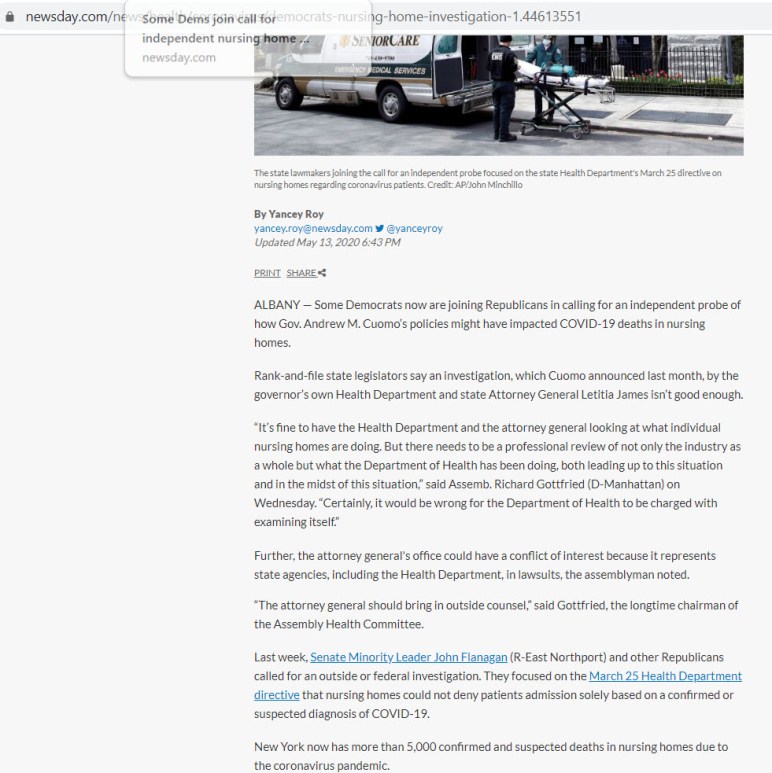
Investigator independence or lack of conflict of interest, and the independence or lack of conflict of interest of legal counsel representing the investigator are important and can carry significant legal ramifications, in addition to the optics that are presented and possible issues of investigation trustworthiness in the particular situation.

As I have written, these are issues that should be considered and vetted while initially forming the investigation team, and throughout the investigation as the issues and the situations that are being investigated, and the people and stakeholders who are at issue or who are involved can change and expand or grow.

See pasted below a snapshot of an article out of New York discussing an investigation of nursing homes that was recently ordered by the Governor. The investigation is being done by the state Health Department which is being represented by the Attorney General’s Office. Some people have questioned whether the Health Department and the Attorney General are the appropriate departments or offices to be involved in the investigation in this circumstance. In addition to the departments or offices that are involved, I will add that interpersonal relationships can also be or become an issue.

While the Health Department certainly is an appropriate department to conduct a nursing home investigation, and the Attorney General’s Office appropriately represents the Health Department, as it has been noted, in the current investigation it is possible that the policies of the Governor and/or the policies and procedures of the Health Department with respect to COVID-19 and nursing home residents might be or become in play. And as also noted, the situation could be akin to the investigator and its counsel investigating their own policies and procedures or those of their boss. These are issues or possible issues to consider in every investigation depending on the facts and circumstances of the particular situation, and as the fact and circumstances might change over time and during the course of the investigation.

Best to you, Dave Tate, Esq. (San Francisco and California) – dave@tateattorney.com

———————————————————————-

Remember, every case and situation is different. It is important to obtain and evaluate all of the evidence that is available, and to apply that evidence to the applicable standards and laws. You do need to consult with an attorney and other professionals about your particular situation. This post is not a solicitation for legal or other services inside of or outside of California, and, of course, this post only is a summary of information that changes from time to time, and does not apply to any particular situation or to your specific situation. So . . . you cannot rely on this post for your situation or as legal or other professional advice or representation.

Thank you for reading this post. I ask that you also pass it along to other people who would be interested as it is through collaboration that great things and success occur more quickly. And please also subscribe to this blog and my other blog (see below), and connect with me on LinkedIn and Twitter.

Best to you, David Tate, Esq. (and inactive California CPA) – practicing in California only.

I am also the Chair of the Business Law Section of the Bar Association of San Francisco.

Blogs

Trust, estate/probate, power of attorney, conservatorship, elder and dependent adult abuse, nursing home and care, disability, discrimination, personal injury, responsibilities and rights, and other related litigation, and contentious administrations http://californiaestatetrust.com

Business, D&O, board, director, audit committee, shareholder, founder, owner, and investor litigation, governance and governance committee, responsibilities and rights, compliance, investigations, and risk management  http://auditcommitteeupdate.com

My law practice primarily involves the following areas and issues:

Trust, Estate, Probate Court, Elder and Dependent Adult, and Disability Disputes and Litigation

      • Trust and estate disputes and litigation, and contentious administrations representing fiduciaries, beneficiaries and families; elder abuse; power of attorney disputes; elder care and nursing home abuse; conservatorships; claims to real and personal property; and other related disputes and litigation.

Business, Business-Related, and Workplace Disputes and Litigation: Private, Closely Held, and Family Businesses; Public Companies; Nonprofit Entities; and Governmental Entities

      • Business v. business disputes including breach of contract; unlawful, unfair and fraudulent business practices; fraud, deceit and misrepresentation; unfair competition; licensing agreements, breach of the covenant of good faith and fair dealing; etc.
      • Misappropriation of trade secrets.
      • M&A disputes.
      • Founder, officer, director and board, investor, shareholder, creditor, VC, control, governance, decision making, fiduciary duty, conflict of interest, independence, voting, etc., disputes.
      • Buy-sell disputes.
      • Funding and share dilution disputes.
      • Accounting, lost profits, and royalty disputes and damages.
      • Insurance coverage and bad faith.
      • Access to corporate and business records disputes.
      • Employee, employer and workplace disputes and processes, discrimination, whistleblower and retaliation, harassment, defamation, etc.

Investigations, Governance, and Responsibilities and Rights

      • Corporate, business, nonprofit and governmental internal investigations.
      • Board, audit committee, governance committee, and special committee governance and processes, disputes, conflicts of interest, independence, culture, ethics, etc.; and advising audit committees, governance committees, officers, directors, and boards.

Mediations and Services as a Mediator

* * * * *


FASB ASU 2014-15 – Management’s Responsibility To Evaluate Going Concern, And Possible Disclosure Under GAAP

David W. Tate, Esq., San Francisco and California – dave@tateattorney.com

In light of COVID-19 and shutdowns you might have been seeing recent discussions about possible business or entity going concern issues (that is, if there is substantial doubt whether they will be remaining as a viable entity within the requisite period of time) and the auditor’s responsibilities relating to those issues. Indeed, I have written blog posts on this issue.

I am passing this along for additional information, i.e., this post is not a full discussion or really even a partial discussion, FASB ASU (Accounting Standards Update) 2014-15, Disclosure of Uncertainties about an Entity’s Ability to Continue as a Going Concern, provides that under Generally Accepted Accounting Principles (GAAP) management itself also has a responsibility to evaluate whether there is a going concern issue and to make a disclosure if the requisite criteria are met. Now, I readily acknowledge that I will need to read up on ASU 2014-15, but in this time of COVID-19 and shutdowns and other limitations it does seem that management’s evaluation of a possible going concern issue under GAAP might (or might not) become relevant in a variety of situations which might also have legal ramifications (and, by the way, needing to read up on an issue is not uncommon for attorneys, and I am comfortable acknowledging that when appropriate – ASU 2014-15 is 39 pages and has many nuances to it). ASU 2014-15 provides that the amendments in that Update are effective for the annual period ending after December 15, 2016, and for annual periods and interim periods thereafter, although early application is permitted.

For your information and reading, here is a link to ASU 2014-15: https://www.fasb.org/jsp/FASB/Document_C/DocumentPage?cid=1176164329772&acceptedDisclaimer=true

Best to you, Dave Tate, Esq. (San Francisco and California) – dave@tateattorney.com

———————————————————————-

Remember, every case and situation is different. It is important to obtain and evaluate all of the evidence that is available, and to apply that evidence to the applicable standards and laws. You do need to consult with an attorney and other professionals about your particular situation. This post is not a solicitation for legal or other services inside of or outside of California, and, of course, this post only is a summary of information that changes from time to time, and does not apply to any particular situation or to your specific situation. So . . . you cannot rely on this post for your situation or as legal or other professional advice or representation.

Thank you for reading this post. I ask that you also pass it along to other people who would be interested as it is through collaboration that great things and success occur more quickly. And please also subscribe to this blog and my other blog (see below), and connect with me on LinkedIn and Twitter.

Best to you, David Tate, Esq. (and inactive California CPA) – practicing in California only.

I am also the Chair of the Business Law Section of the Bar Association of San Francisco.

Blogs

Trust, estate/probate, power of attorney, conservatorship, elder and dependent adult abuse, nursing home and care, disability, discrimination, personal injury, responsibilities and rights, and other related litigation, and contentious administrations http://californiaestatetrust.com

Business, D&O, board, director, audit committee, shareholder, founder, owner, and investor litigation, governance and governance committee, responsibilities and rights, compliance, investigations, and risk management  http://auditcommitteeupdate.com

My law practice primarily involves the following areas and issues:

Trust, Estate, Probate Court, Elder and Dependent Adult, and Disability Disputes and Litigation

      • Trust and estate disputes and litigation, and contentious administrations representing fiduciaries, beneficiaries and families; elder abuse; power of attorney disputes; elder care and nursing home abuse; conservatorships; claims to real and personal property; and other related disputes and litigation.

Business, Business-Related, and Workplace Disputes and Litigation: Private, Closely Held, and Family Businesses; Public Companies; Nonprofit Entities; and Governmental Entities

      • Business v. business disputes including breach of contract; unlawful, unfair and fraudulent business practices; fraud, deceit and misrepresentation; unfair competition; licensing agreements, breach of the covenant of good faith and fair dealing; etc.
      • Misappropriation of trade secrets.
      • M&A disputes.
      • Founder, officer, director and board, investor, shareholder, creditor, VC, control, governance, decision making, fiduciary duty, conflict of interest, independence, voting, etc., disputes.
      • Buy-sell disputes.
      • Funding and share dilution disputes.
      • Accounting, lost profits, and royalty disputes and damages.
      • Insurance coverage and bad faith.
      • Access to corporate and business records disputes.
      • Employee, employer and workplace disputes and processes, discrimination, whistleblower and retaliation, harassment, defamation, etc.

Investigations, Governance, and Responsibilities and Rights

      • Corporate, business, nonprofit and governmental internal investigations.
      • Board, audit committee, governance committee, and special committee governance and processes, disputes, conflicts of interest, independence, culture, ethics, etc.; and advising audit committees, governance committees, officers, directors, and boards.

Mediations and Services as a Mediator

* * * * *


COVID-19 – California Employers More At Risk For Workers Compensation Than Employee Lawsuits – Forwarded From Weintraub Tobin – Plus Serious & Willful

David W. Tate, Esq., San Francisco and California – dave@tateattorney.com

I have forwarded below a link to an article by Brendan Begley of Weintraub Tobin discussing COVID-19 exposing California employers more to workers compensation claims than to employee lawsuits (but of course, filing any lawsuit is very easy to do, whereas prevailing is a different matter). However, and importantly, Brendan also references serious and willful claims, which are not covered by workers compensation and for which employers also should be aware. Regardless of lawsuits and liability exposure, all employers and boards should of course be mindful of employee safety and risk management issues and processes.

California Employers Likely Immune To Employee COVID-19 Lawsuits, But More Susceptible To COVID-19 Workers-Compensation Claims

Best to you, Dave Tate, Esq. (San Francisco and California) – dave@tateattorney.com

———————————————————————-

Remember, every case and situation is different. It is important to obtain and evaluate all of the evidence that is available, and to apply that evidence to the applicable standards and laws. You do need to consult with an attorney and other professionals about your particular situation. This post is not a solicitation for legal or other services inside of or outside of California, and, of course, this post only is a summary of information that changes from time to time, and does not apply to any particular situation or to your specific situation. So . . . you cannot rely on this post for your situation or as legal or other professional advice or representation.

Thank you for reading this post. I ask that you also pass it along to other people who would be interested as it is through collaboration that great things and success occur more quickly. And please also subscribe to this blog and my other blog (see below), and connect with me on LinkedIn and Twitter.

Best to you, David Tate, Esq. (and inactive California CPA) – practicing in California only.

I am also the Chair of the Business Law Section of the Bar Association of San Francisco.

Blogs

Trust, estate/probate, power of attorney, conservatorship, elder and dependent adult abuse, nursing home and care, disability, discrimination, personal injury, responsibilities and rights, and other related litigation, and contentious administrations http://californiaestatetrust.com

Business, D&O, board, director, audit committee, shareholder, founder, owner, and investor litigation, governance and governance committee, responsibilities and rights, compliance, investigations, and risk management  http://auditcommitteeupdate.com

My law practice primarily involves the following areas and issues:

Trust, Estate, Probate Court, Elder and Dependent Adult, and Disability Disputes and Litigation

      • Trust and estate disputes and litigation, and contentious administrations representing fiduciaries, beneficiaries and families; elder abuse; power of attorney disputes; elder care and nursing home abuse; conservatorships; claims to real and personal property; and other related disputes and litigation.

Business, Business-Related, and Workplace Disputes and Litigation: Private, Closely Held, and Family Businesses; Public Companies; Nonprofit Entities; and Governmental Entities

      • Business v. business disputes including breach of contract; unlawful, unfair and fraudulent business practices; fraud, deceit and misrepresentation; unfair competition; licensing agreements, breach of the covenant of good faith and fair dealing; etc.
      • Misappropriation of trade secrets.
      • M&A disputes.
      • Founder, officer, director and board, investor, shareholder, creditor, VC, control, governance, decision making, fiduciary duty, conflict of interest, independence, voting, etc., disputes.
      • Buy-sell disputes.
      • Funding and share dilution disputes.
      • Accounting, lost profits, and royalty disputes and damages.
      • Insurance coverage and bad faith.
      • Access to corporate and business records disputes.
      • Employee, employer and workplace disputes and processes, discrimination, whistleblower and retaliation, harassment, defamation, etc.

Investigations, Governance, and Responsibilities and Rights

      • Corporate, business, nonprofit and governmental internal investigations.
      • Board, audit committee, governance committee, and special committee governance and processes, disputes, conflicts of interest, independence, culture, ethics, etc.; and advising audit committees, governance committees, officers, directors, and boards.

Mediations and Services as a Mediator

* * * * *

Nonprofit Board Disruption – Forwarding From Dr. Eugene Fram, With A Few Of My Comments

David W. Tate, Esq., San Francisco and California – dave@tateattorney.com

I have provided below a link to an article by Dr. Eugene Fram titled “Nonprofit Board Disruption – A Board Member’s Reflections. Gene’s discussion is very pertinent in this time of disruption, including personal, physical, and economic disruption, and perhaps sometimes also with related mental or emotional discomfort.

The term “disruption” has different meanings, i.e., there are different levels and types of disruption. For example, there can be disruption in the sense that something isn’t going as planned, which might also be viewed as something that is disruptive in the context of the ongoing operational risk management which all nonprofits should be doing as a matter of ongoing business. But, of course, disruption such as the type that we are currently seeing and experiencing can also be debilitating or result in a shake-up of the entity or of the industry short-term or long-term.

Reaching answers, and decision making right now aren’t easy. As Gene writes, sometimes disruption is worked through, but sometimes not. Different people have different skill sets, personalities, levels of experience, and communication abilities or propensities. It can be hard to keep board members, the CEO, and perhaps other stakeholders on a constructive and successful path. If it becomes necessary, sometimes it can be beneficial to get help from people who can assist or facilitate with the process.

Immediately below is the link to Dr. Fram’s discussion:

Nonprofit Board Disruption—A Board Member’s Reflections

Best to you, Dave Tate, Esq. (San Francisco and California) – dave@tateattorney.com

———————————————————————-

Remember, every case and situation is different. It is important to obtain and evaluate all of the evidence that is available, and to apply that evidence to the applicable standards and laws. You do need to consult with an attorney and other professionals about your particular situation. This post is not a solicitation for legal or other services inside of or outside of California, and, of course, this post only is a summary of information that changes from time to time, and does not apply to any particular situation or to your specific situation. So . . . you cannot rely on this post for your situation or as legal or other professional advice or representation.

Thank you for reading this post. I ask that you also pass it along to other people who would be interested as it is through collaboration that great things and success occur more quickly. And please also subscribe to this blog and my other blog (see below), and connect with me on LinkedIn and Twitter.

Best to you, David Tate, Esq. (and inactive California CPA) – practicing in California only.

I am also the Chair of the Business Law Section of the Bar Association of San Francisco.

Blogs

Trust, estate/probate, power of attorney, conservatorship, elder and dependent adult abuse, nursing home and care, disability, discrimination, personal injury, responsibilities and rights, and other related litigation, and contentious administrations http://californiaestatetrust.com

Business, D&O, board, director, audit committee, shareholder, founder, owner, and investor litigation, governance and governance committee, responsibilities and rights, compliance, investigations, and risk management  http://auditcommitteeupdate.com

My law practice primarily involves the following areas and issues:

Trust, Estate, Probate Court, Elder and Dependent Adult, and Disability Disputes and Litigation

      • Trust and estate disputes and litigation, and contentious administrations representing fiduciaries, beneficiaries and families; elder abuse; power of attorney disputes; elder care and nursing home abuse; conservatorships; claims to real and personal property; and other related disputes and litigation.

Business, Business-Related, and Workplace Disputes and Litigation: Private, Closely Held, and Family Businesses; Public Companies; Nonprofit Entities; and Governmental Entities

      • Business v. business disputes including breach of contract; unlawful, unfair and fraudulent business practices; fraud, deceit and misrepresentation; unfair competition; licensing agreements, breach of the covenant of good faith and fair dealing; etc.
      • Misappropriation of trade secrets.
      • M&A disputes.
      • Founder, officer, director and board, investor, shareholder, creditor, VC, control, governance, decision making, fiduciary duty, conflict of interest, independence, voting, etc., disputes.
      • Buy-sell disputes.
      • Funding and share dilution disputes.
      • Accounting, lost profits, and royalty disputes and damages.
      • Insurance coverage and bad faith.
      • Access to corporate and business records disputes.
      • Employee, employer and workplace disputes and processes, discrimination, whistleblower and retaliation, harassment, defamation, etc.

Investigations, Governance, and Responsibilities and Rights

      • Corporate, business, nonprofit and governmental internal investigations.
      • Board, audit committee, governance committee, and special committee governance and processes, disputes, conflicts of interest, independence, culture, ethics, etc.; and advising audit committees, governance committees, officers, directors, and boards.

Mediations and Services as a Mediator

* * * * *

Tesla Files Complaint v. Alameda County – Should More Businesses Also File Their Complaints – Are Settlements Possible?

David W. Tate, Esq., San Francisco and California – dave@tateattorney.com

The following is a link to a copy of Tesla’s Complaint against Alameda County in which Tesla challenges Alameda County’s ongoing business limitation order as it applies to Tesla and the business that Tesla operates as that business is described by Tesla: Tesla v Alameda County Complaint copy. Tesla’s Complaint is brought only on behalf of itself and is fairly limited in the claims and arguments that are asserted.

On a procedural basis Tesla could have brought its current claims and also could have challenged the County on additional alternative grounds such as, for example, every business operates under its own facts and circumstances, different businesses have different COVID-19 risks, and different businesses can or might be able to address those risks in different manners that are as effective, such as, for example, grocery stores which have been allowed to be open and have workers. At this point Tesla also has accepted or at least has not challenged the orders from the Governor or whether the Governor has the authority to issue those orders. In the alternative however, Tesla can also challenge the actions of the Governor – for example, also argue that the Governor’s actions are a violation of the Fourteenth Amendment to the U.S. Constitution, or are arbitrary, or are speculative, or are not based on verifiable facts or evidence, or cannot be applied the same to the different counties in the State or different businesses throughout the State each of which counties and businesses has its own set of facts and circumstances.

Each plaintiff must evaluate which claims to allege that it believes will put it in the best position to succeed in its objectives and to prevail. It might well be that Tesla really would simply prefer to reach a resolution with Alameda County that will allow Tesla to open and operate its entire factory or perhaps only certain most important parts of the factory. There might well be more issues at stake for Alameda County – currently as Tesla’s operations are limited, what does Tesla have to lose by filing its Complaint? The County, however, has had its authority and actions challenged and could lose or partially lose on both accounts not just with respect to Tesla but also perhaps with respect to other businesses. On the other hand, based on Tesla’s pleadings, what if the Court does not view the Governor’s order as being the law of the land, or as limiting the specific actions that Alameda County took and ordered, or what if the Court is of a view that gives deference to governmental actions particularly when it can at least be argued that those actions involve widespread public health and safety circumstances, or what if the Court doesn’t view the County’s actions as being taken without at least some sufficient reasonable basis, or what if the Court is of a view that the County should be given an opportunity to tweak, modify or remedy its actions or orders, or what if the Court disagrees with Tesla’s description of its operating business as being (solely?) solar and batteries? There are good reasons for Alameda County and Tesla to both try to the extent possible to resolve this dispute – at least at this point Tesla’s Compliant is written only on behalf of itself and not on behalf of all businesses or on behalf of all businesses that are similarly situated, which in theory makes settlement between the two parties less complicated, but also keeps the option and threat of possible amendment viable.

I am not writing this post to evaluate Tesla’s claims, nor can I based on the information that I have. However, I have previously written that I would have expected and I believe that we should expect to see from the various governmental entities detailed explanations wherein they in detail argue or persuade that they have the legal authority to take the actions that they have taken. Tesla does in part discuss this in its Complaint with respect to Alameda County. The following is a link to my prior post in which I discuss some of these topics and in that post I have included a link to an eight page paper in which the authors discuss legal aspects of state powers to order isolation, quarantine, health and inspection laws to interrupt or prevent the spread of disease – click on the following link for my prior post: https://wp.me/p75iWX-uf

Best to you, Dave Tate, Esq. (San Francisco and California) – dave@tateattorney.com

———————————————————————-

Remember, every case and situation is different. It is important to obtain and evaluate all of the evidence that is available, and to apply that evidence to the applicable standards and laws. You do need to consult with an attorney and other professionals about your particular situation. This post is not a solicitation for legal or other services inside of or outside of California, and, of course, this post only is a summary of information that changes from time to time, and does not apply to any particular situation or to your specific situation. So . . . you cannot rely on this post for your situation or as legal or other professional advice or representation.

Thank you for reading this post. I ask that you also pass it along to other people who would be interested as it is through collaboration that great things and success occur more quickly. And please also subscribe to this blog and my other blog (see below), and connect with me on LinkedIn and Twitter.

Best to you, David Tate, Esq. (and inactive California CPA) – practicing in California only.

I am also the Chair of the Business Law Section of the Bar Association of San Francisco.

Blogs

Trust, estate/probate, power of attorney, conservatorship, elder and dependent adult abuse, nursing home and care, disability, discrimination, personal injury, responsibilities and rights, and other related litigation, and contentious administrations http://californiaestatetrust.com

Business, D&O, board, director, audit committee, shareholder, founder, owner, and investor litigation, governance and governance committee, responsibilities and rights, compliance, investigations, and risk management  http://auditcommitteeupdate.com

My law practice primarily involves the following areas and issues:

Trust, Estate, Probate Court, Elder and Dependent Adult, and Disability Disputes and Litigation

      • Trust and estate disputes and litigation, and contentious administrations representing fiduciaries, beneficiaries and families; elder abuse; power of attorney disputes; elder care and nursing home abuse; conservatorships; claims to real and personal property; and other related disputes and litigation.

Business, Business-Related, and Workplace Disputes and Litigation: Private, Closely Held, and Family Businesses; Public Companies; Nonprofit Entities; and Governmental Entities

      • Business v. business disputes including breach of contract; unlawful, unfair and fraudulent business practices; fraud, deceit and misrepresentation; unfair competition; licensing agreements, breach of the covenant of good faith and fair dealing; etc.
      • Misappropriation of trade secrets.
      • M&A disputes.
      • Founder, officer, director and board, investor, shareholder, creditor, VC, control, governance, decision making, fiduciary duty, conflict of interest, independence, voting, etc., disputes.
      • Buy-sell disputes.
      • Funding and share dilution disputes.
      • Accounting, lost profits, and royalty disputes and damages.
      • Insurance coverage and bad faith.
      • Access to corporate and business records disputes.
      • Employee, employer and workplace disputes and processes, discrimination, whistleblower and retaliation, harassment, defamation, etc.

Investigations, Governance, and Responsibilities and Rights

      • Corporate, business, nonprofit and governmental internal investigations.
      • Board, audit committee, governance committee, and special committee governance and processes, disputes, conflicts of interest, independence, culture, ethics, etc.; and advising audit committees, governance committees, officers, directors, and boards.

Mediations and Services as a Mediator

* * * * *

California Department of Public Health Monitors Some Nursing Home Resident COVID-19 Reporting – What Does It Mean, Do They Investigate, Prosecute?

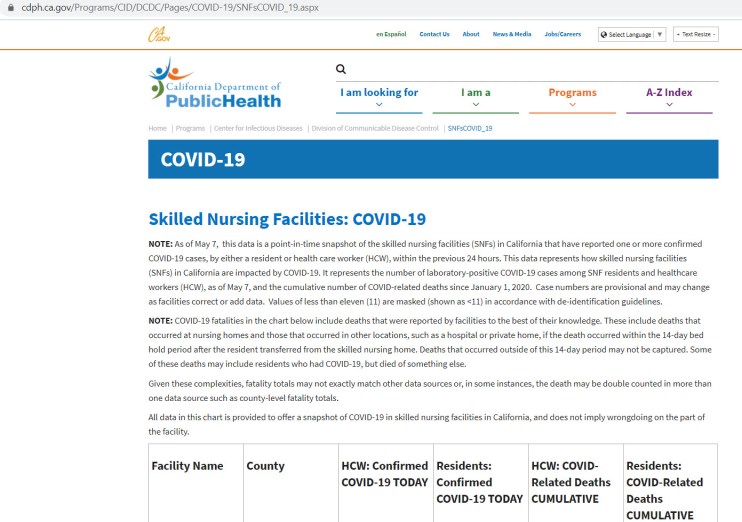
I have provided below two snapshots from the California Department of Public Health’s website discussing and disclosing some information pertaining to nursing home resident COVID-19 cases and deaths, as reported to the Department by the nursing homes themselves. I took both snapshots today, May 9, 2020. I have also provided below a link to the Department’s website page pertaining to nursing home residence COVID-19.

The first snapshot contains the Department’s top-of-the-page introductory paragraphs, indicating that the information provided by the nursing homes is as of May 7, 2020, and describes how that information is reported. The second snapshot is a random snapshot of some of the information that is provided by the Department in the chart of information further down the Department’s page. Note that the actual chart does contain an additional column to the left which provides the name for each nursing home that is listed – I left that information off because it is not related to the purpose of this post, and because you can also find that information yourself if you would like.

Nursing home resident care, processes and procedures, risk management, and reporting are always of absolutely key importance, and are of even more deadly importance in this COVID-19 time. You will also find other prior elder care and nursing home related posts on this blog.

As indicated in the first snapshot, the information that the Department has and provides only is information that is reported by the nursing home facilities themselves to the best of each nursing home’s knowledge. The Department does not discuss the actual criteria or evaluation processes were used by each nursing home, the extent to which the information that has been provided is reliable, whether reliability is evaluated, or how reliability is evaluated if in fact it is. Thus, I would have to assume that the information is not comparable as between different nursing homes. And I would also have to assume that some of the information that has been provided is not accurate or does not satisfy whatever reporting requirements the Department communicated.

Regarding evaluation of compliance programs the U.S. Department of Justice Criminal Division, just as an example, lists three primary criteria, plus subparts:

I.  Is the Corporation’s Compliance Program Well Designed?

II.  Is the Corporation’s Compliance Program Being Implemented Effectively?

III.  Does the Corporation’s Compliance Program Work in Practice?

It would be legitimate to ask the above three questions of each nursing home and of the Department of Public Health with respect to resident care, processes and procedures, risk management, and reporting in this COVID-19 time. The following is a link to an earlier post discussing the Department of Justice’s guidelines for its evaluation of compliance programs: https://wp.me/p75iWX-nb

The first snapshot is provided immediately below. Snapshot two and comments about snapshot two are provided following the first snapshot.

Below is the second snapshot. As I have stated above, the actual chart on the Department’s page contains an additional column to the left which provides the nursing home’s name. Let’s look at the chart. First I noticed that while most nursing homes have provided information, throughout the chart and in the snapshot below, there are facilities for which the information is N/A, or, in other words, there is no information provided. I do not know why there is no information provided, but if I was the Department I would want to investigate the reason for each such facility, and most likely report the reason. And for each such facility I would also need to decide how to proceed on the issue of reporting and there being no information. Of the sixteen facilities in the snapshot below, two are N/A, which is 8% based on a random sampling.

Many nursing homes report no COVID-19 cases or deaths, which is good, but only if the information is reliable. The first column in the snapshot below lists the county in which the nursing home is located, the second column lists confirmed health care worker COVID-19 cases reported that day (May 7, 2020), the third column reports confirmed resident COVID-19 cases reported that day, the fourth column reports confirmed health care worker COVID-19-related deaths cumulative, and the fifth column lists confirmed resident COVID-19-related deaths cumulative. For unknown reason if there are occurrences but those occurrences are less than 11, the actual number of occurrences is not listed. You can view the information provided yourself and reach your own opinions. If you have a loved one in a nursing home you should also ask the facility the questions for which you want information.

You might also be interested, the following is a link to a recent short blog post about family councils: https://wp.me/p1wbl8-w0.  And you can find the Department’s COVID-19 page at https://www.cdph.ca.gov/Programs/CID/DCDC/Pages/COVID-19/SNFsCOVID_19.aspx.

Best to you, Dave Tate, Esq. (San Francisco and California)

———————————————————————-

Remember, every case and situation is different. It is important to obtain and evaluate all of the evidence that is available, and to apply that evidence to the applicable standards and laws. You do need to consult with an attorney and other professionals about your particular situation. This post is not a solicitation for legal or other services inside of or outside of California, and, of course, this post only is a summary of information that changes from time to time, and does not apply to any particular situation or to your specific situation. So . . . you cannot rely on this post for your situation or as legal or other professional advice or representation.

Thank you for reading this post. I ask that you also pass it along to other people who would be interested as it is through collaboration that great things and success occur more quickly. And please also subscribe to this blog and my other blog (see below), and connect with me on LinkedIn and Twitter.

Best to you, David Tate, Esq. (and inactive California CPA) – practicing in California only.

I am also the Chair of the Business Law Section of the Bar Association of San Francisco.

Blogs

Trust, estate/probate, power of attorney, conservatorship, elder and dependent adult abuse, nursing home and care, disability, discrimination, personal injury, responsibilities and rights, and other related litigation, and contentious administrations http://californiaestatetrust.com

Business, D&O, board, director, audit committee, shareholder, founder, owner, and investor litigation, governance and governance committee, responsibilities and rights, compliance, investigations, and risk management  http://auditcommitteeupdate.com

My law practice primarily involves the following areas and issues:

Trust, Estate, Probate Court, Elder and Dependent Adult, and Disability Disputes and Litigation

      • Trust and estate disputes and litigation, and contentious administrations representing fiduciaries, beneficiaries and families; elder abuse; power of attorney disputes; elder care and nursing home abuse; conservatorships; claims to real and personal property; and other related disputes and litigation.

Business, Business-Related, and Workplace Disputes and Litigation: Private, Closely Held, and Family Businesses; Public Companies; Nonprofit Entities; and Governmental Entities

      • Business v. business disputes including breach of contract; unlawful, unfair and fraudulent business practices; fraud, deceit and misrepresentation; unfair competition; licensing agreements, breach of the covenant of good faith and fair dealing; etc.
      • Misappropriation of trade secrets.
      • M&A disputes.
      • Founder, officer, director and board, investor, shareholder, creditor, VC, control, governance, decision making, fiduciary duty, conflict of interest, independence, voting, etc., disputes.
      • Buy-sell disputes.
      • Funding and share dilution disputes.
      • Accounting, lost profits, and royalty disputes and damages.
      • Insurance coverage and bad faith.
      • Access to corporate and business records disputes.
      • Employee, employer and workplace disputes and processes, discrimination, whistleblower and retaliation, harassment, defamation, etc.

Investigations, Governance, and Responsibilities and Rights

      • Corporate, business, nonprofit and governmental internal investigations.
      • Board, audit committee, governance committee, and special committee governance and processes, disputes, conflicts of interest, independence, culture, ethics, etc.; and advising audit committees, governance committees, officers, directors, and boards.

Mediations and Services as a Mediator

* * * * *